A privately held hospitality investor says it has offered $2 billion in cash for every hotel owned by Service Properties Trust, a bid the bidder says exceeds the entire public market value of the Newton, Mass.-based real estate investment trust.
TKO Hotels said on Oct. 9 that it had submitted a formal written offer to acquire SVC’s entire hospitality portfolio for $2.0 billion in cash. The company, which gave an Aberdeen, S.D., dateline, describes itself as a hospitality-focused investment firm that acquires, repositions and operates U.S. hotel assets.
The offer is unsolicited. TKO said the transaction requires negotiation with and approval by SVC’s board, the execution of definitive agreements and the satisfaction or waiver of customary closing conditions, and it cautioned that there is no assurance a deal will be reached. SVC had filed nothing with the Securities and Exchange Commission in response as of Oct. 9, and TKO’s announcement does not indicate that the board has acted on the offer.
A price set against a halved share price
TKO built its pitch around the gap between SVC’s asset base and its stock. The release notes that SVC shares closed at $6.49 on Oct. 6, down more than 50% over the trailing twelve months, and argues that “the proposed $2.0 billion purchase price for the hotel portfolio alone exceeds SVC’s entire current public market capitalization.”
Jim Koehler, TKO’s chief executive, said the firm has “tremendous conviction in the long-term value of SVC’s hotel portfolio,” and said the structure removes a common obstacle: “Our all-cash offer eliminates financing risk and provides SVC with the certainty it needs.”
TKO’s case is that SVC should stop being two companies at once. Hotels are capital-intensive, operationally complex and cyclical, the firm argues, and holding them alongside a retail net lease business raises the cost of capital for both. Selling the lodging assets outright would leave a pure-play net lease retail REIT and generate proceeds sufficient to “retire more than forty percent (40%) of its outstanding indebtedness,” TKO says.
Those are the acquirer’s characterizations, not independently established conclusions, and TKO stands to benefit from them. The firm said it has engaged legal and financial advisers but named none.
What SVC’s hotel portfolio actually holds
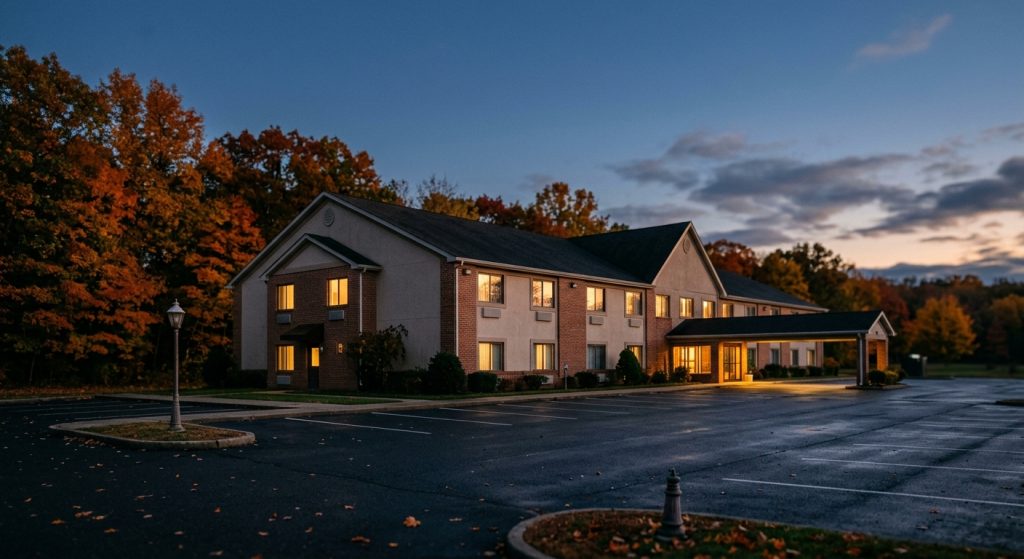
SVC’s own disclosures give the portfolio its scale. In its second-quarter results announcement, the trust reported $9.7 billion invested across two asset categories. As of June 30, it owned 93 hotels with more than 21,000 guest rooms in the United States, including Puerto Rico, and Canada, plus 745 service-focused retail net lease properties totaling more than 13.5 million square feet. The REIT is managed externally by The RMR Group.
The company is already shrinking the hotel side on its own terms. SVC’s quarterly release filed with the Securities and Exchange Commission shows a second-quarter net loss of $223.8 million, or $1.75 a share, a figure that included a $189.1 million impairment tied to hotels being marketed for sale. Total revenues fell to $421.0 million from $503.4 million a year earlier. Normalized funds from operations, the measure REITs lean on, were $55.0 million, or 43 cents a share.
Operationally the two halves diverge. Revenue per available room at the 78 hotels SVC intends to keep rose 6.6% year over year to $134.53, while the net lease portfolio was 96.6% occupied with net operating income up 1.4% to $94.9 million. Net debt stood at 56.1% of total gross assets.
Since July 1, SVC has sold one 133-key hotel for $18.4 million and agreed terms to sell 13 more with 2,589 keys for a combined $98.4 million, with closings expected in the third and fourth quarters. A further 300-key hotel is being marketed.
The arithmetic behind the bid
Those pending sales are the useful yardstick, and on our reading they explain why TKO chose this moment. The 13-hotel package works out to roughly $38,000 a key. TKO’s $2 billion for a portfolio of more than 21,000 rooms implies something closer to $95,000 a key. The comparison is not apples to apples — the hotels SVC is selling are the ones it chose to exit, and the retained 78 are the better-performing assets — but the spread shows how much faster an outright sale would move than the asset-by-asset program now under way.
Christopher Bilotto, SVC’s president and chief executive, framed that program in August as deliberate, saying the quarter showed “continued momentum in repositioning SVC and strengthening the company’s cash flows.” TKO’s release acknowledges that management “has articulated a strategy of selective portfolio streamlining” and argues a single cash sale is worth more on a risk-adjusted basis.
Approaches to listed landlords trading below the value of their real estate have become a recurring feature of this cycle. An activist investor took a 5.8% position in Empire State Realty Trust and pressed for a strategic review earlier this year, and hotel assets have kept clearing at firm prices, as when Ryman Hospitality agreed to buy Orlando’s Grande Lakes resort for $1.38 billion. Whole-company separations have also found buyers, including the $6.7 billion breakup of H&R REIT.
What distinguishes this one is the asymmetry. TKO is privately held, and it has put a $2 billion number on the table without naming a lender, an equity partner or an adviser. Whether SVC’s board treats the offer as credible or as a marker is the next thing to watch, and the answer is more likely to arrive in a filing than in a press release.