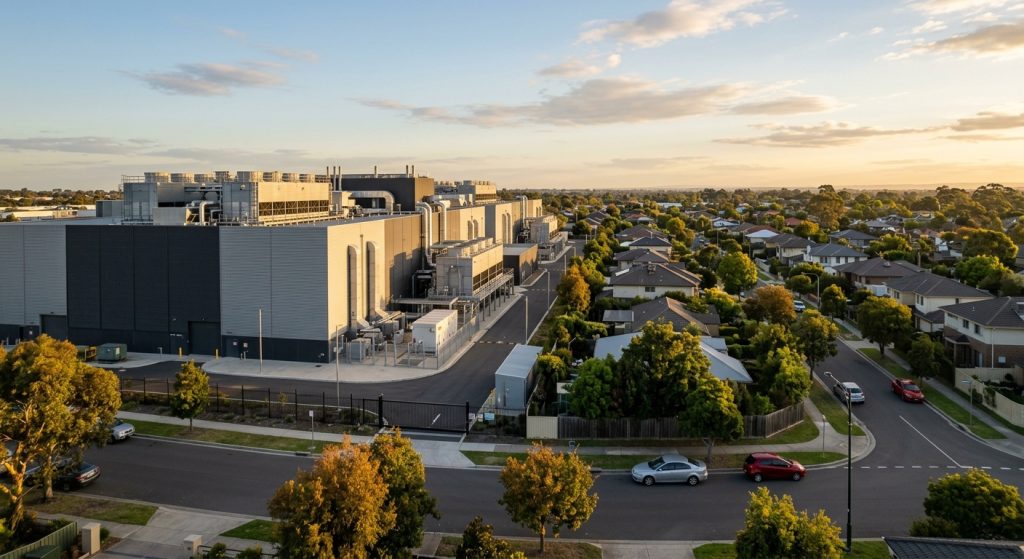
A wave of local and state pushback against data center construction is reshaping how the industry sites new AI infrastructure, with polling showing a large majority of Americans oppose new data centers in their own communities and county and state governments increasingly translating that sentiment into moratoriums, permitting fights and ballot-box battles.
Seven in 10 Americans — 71% — oppose construction of an AI data center in their local area, including 48% who are strongly opposed, according to a Gallup poll based on telephone interviews with 1,000 adults conducted March 2-18, 2026. Opposition to nearby data centers now runs higher than opposition to a nearby nuclear power plant, which drew 53% opposition in the same survey. Respondents most often cited water use (18%), energy demand (18%) and pollution, including noise, air and water impacts (16%), as their top concerns.
That opposition is no longer confined to polling. In DeKalb County, Ga., commissioners voted 6-1 on July 7 to extend a moratorium on new data center development through March 30, 2027, after the board unexpectedly rejected a separate set of industry-backed zoning and land-use regulations in June. The extension directs the county’s watershed management, public safety, transportation and public health departments to study the industry’s impact on water use, sewer capacity and other services before new rules are drafted, according to local reporting on the commission’s action.
New York has gone further than any single county. Gov. Kathy Hochul signed Executive Order No. 62 on July 14, establishing the nation’s first statewide moratorium on new hyperscale data centers while the state develops stronger standards for development and community benefits. The order applies to projects of at least 50 megawatts that require state permits or other approvals and will remain in place for up to a year. Hochul has said the moratorium will lift once the state can put in place a policy requiring AI companies to help cover rising energy costs, and she is separately backing repeal of a state sales-tax exemption for large data centers, which would require action from the legislature.
Not every jurisdiction is moving to restrict development, however. In Arkansas, Pulaski County’s Quorum Court voted down a proposed 12-month data center moratorium on July 28 by a 10-3 margin, after first rejecting an amendment that would have exempted the AVAIO Digital project already under construction near Wrightsville. The vote came weeks after a smaller Arkansas city, Clarksville, approved up to $55 billion in industrial revenue bonds to support Serverfarm’s $6.6 billion data center project, illustrating how sharply local responses to the same industry can diverge even within a single state.
The issue has become a defining flashpoint in this year’s statehouse races. In Michigan’s Senate primary, candidate Abdul El-Sayed has proposed a formal “Terms of Engagement” policy requiring data center developers to protect the electric grid and environment while delivering community benefits, positioning himself against rival Haley Stevens, who has cast artificial intelligence as “a revolutionary technology” worth embracing. In Kansas, where the gubernatorial primary is set for Aug. 4, Democratic candidate Cindy Holscher is the only major contender calling for a statewide data center moratorium after saying she regrets an earlier vote to grant the industry tax incentives, while rival Democrat David Skoog favors leaving siting decisions to local governments. Kansas Republican candidates have clashed over a 2025 law offering data center developers 20-year tax breaks on projects of at least $250 million.
In Pennsylvania, Allegheny County and Pittsburgh officials are moving cautiously on new regulatory frameworks specifically for data centers, and Wisconsin’s Democratic gubernatorial candidates have staked out competing positions on the issue heading into their own primary. Meanwhile, developers in Georgia continue to file plans for gigawatt-scale campuses, including a 1.25-gigawatt project in Lovejoy, even as neighboring DeKalb County tightens review — underscoring that the build-out itself has not slowed even as the political fights around it intensify.
What it means
The Gallup poll and New York’s executive order are verified primary sources establishing that opposition to data centers is both broad in public opinion and, in at least one state, now codified in policy. The county-level examples in Georgia and Arkansas are drawn from local government votes and are directly attributable to those jurisdictions’ own actions, not RealtyWire’s characterization of the industry’s trajectory nationally.
What the pattern means for real estate and construction markets is more properly RealtyWire analysis than established fact: the divergence between DeKalb County’s continued moratorium and Pulaski County’s rejection of one suggests that data center siting is becoming a case-by-case political contest shaped by local tax-revenue promises, water and grid capacity, and organized resident opposition, rather than settling into a uniform national regulatory posture. For developers and landowners, that likely means longer, more contested entitlement timelines in some markets and continued fast-tracking in others — a bifurcation that real estate investors weighing land near proposed campuses will need to watch on a jurisdiction-by-jurisdiction basis rather than assume the industry’s rapid build-out will proceed uniformly. New York’s moratorium, as the first of its kind at the state level, is also likely to be watched closely as a template other states could adopt if similar political pressure builds during 2026 campaign season.