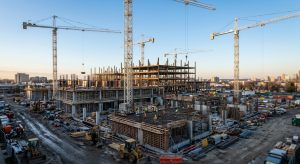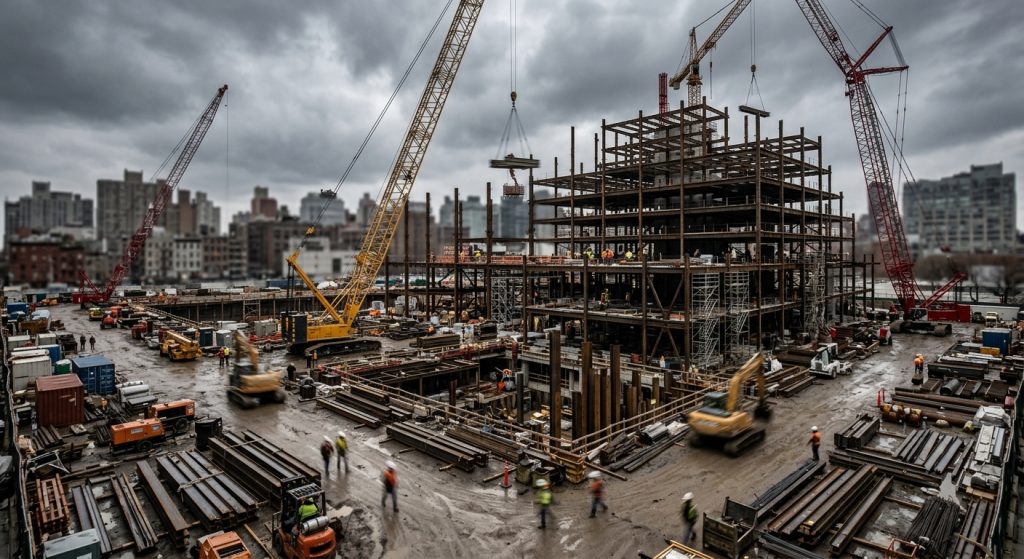
U.S. construction spending fell 0.1% in June from May and dropped 3.2% from a year earlier, the Census Bureau reported Monday, as a pullback in residential building outweighed a small gain in nonresidential construction.
Total construction put in place ran at a seasonally adjusted annual rate of $2,166.5 billion in June, according to the Census Bureau’s construction spending report. The monthly decline carries a wide margin of error (±0.8 percentage points), meaning the Census Bureau cannot say with statistical confidence that spending actually fell month over month; the year-over-year drop of 3.2% (±1.5 points) is a firmer signal of a slowing market. Over the first six months of 2026, construction spending totaled $1,046.9 billion, down 3.5% from $1,084.5 billion in the same period of 2025.
Residential building leads the pullback
Private construction spending ran at $1,622.5 billion SAAR, down 0.1% from May. Within that, residential construction fell 0.3% to $877.1 billion SAAR, the steepest monthly decline among the report’s major categories, while private nonresidential construction edged up 0.1% to $745.3 billion SAAR. The residential figure lines up with other data RealtyWire has tracked this summer showing homebuilders pulling back amid softer demand: mortgage rates near one-year highs and cooling new-home sales have weighed on builder activity even as some nonresidential segments, particularly data centers, keep growing.
That divergence shows up elsewhere in the numbers. RealtyWire has reported that nonresidential construction starts hit a one-month record of $100.3 billion in June, led by data centers, even as overall spending on residential building softened — a split between AI-driven data-center construction and a cooling housing sector that has defined much of the 2026 construction landscape.
Public construction holds flat
Public construction spending was essentially unchanged from May at $544.1 billion SAAR. Within that category, educational construction was virtually flat at $113.1 billion SAAR, and highway construction slipped 0.1% to $150.9 billion SAAR. The flat public spending figure suggests government-funded infrastructure and school projects are providing a steadying counterweight to the private-sector slowdown, though not enough to offset the residential decline in the headline number.
A widening gap between housing and everything else
The report’s monthly comparison is small enough, and its error margin wide enough, that a single month should not be read as a turning point on its own. But the year-over-year comparison — down 3.2% with a tighter confidence interval — and the six-month cumulative decline of 3.5% both point the same direction: residential construction spending is running meaningfully below where it stood a year ago, even as overall economic activity has continued to grow. That combination is consistent with a housing sector where elevated mortgage rates and cautious builder sentiment are outweighing underlying demand for new homes, while capital continues to flow into nonresidential categories tied to the broader AI infrastructure buildout.
What it means
The report is the Census Bureau’s own data and represents the most direct, government-sourced read on where construction dollars are actually being spent, as opposed to survey-based sentiment measures. It reinforces two trends RealtyWire has covered separately: contractors’ construction backlog slipped to 8.8 months in June, per Associated Builders and Contractors, and housing’s share of U.S. GDP moved lower in the second quarter, both consistent with a residential sector that is losing momentum relative to nonresidential and public building.
The Census Bureau’s monthly construction spending estimates are subject to revision, and the agency itself flags that the month-over-month change is not statistically significant given the margin of error. RealtyWire’s characterization of a residential slowdown draws on the year-over-year figure, which the Census Bureau presents with greater confidence, plus the fact that the ABC backlog and other RealtyWire coverage this summer point in the same direction. What to watch: whether July’s data (due roughly a month from now) shows residential spending stabilizing or continuing to slide, and whether nonresidential strength — concentrated in data centers — broadens to other commercial categories or remains narrowly concentrated.