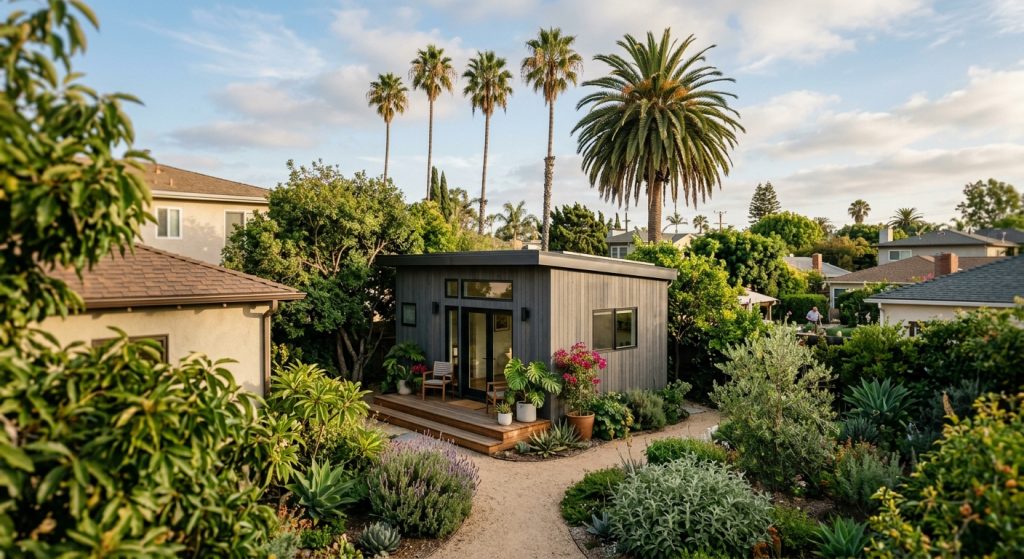
Los Angeles County, Calif., built a record 10,230 accessory dwelling units in 2025, more than six times the 1,624 completed in 2018, as state and local policy changes stripped away zoning barriers that once made backyard construction a yearslong ordeal.
The figures come from the University of Southern California’s Lusk Center for Real Estate, whose second annual State of Los Angeles County Housing and Neighborhoods report, released Aug. 11, found ADUs accounted for 37.5% of all newly certified housing units in 2025 — the highest share in the nearly 10 years USC has tracked the data. That growth came even as total countywide housing production dipped slightly to 27,293 units in 2025, down from 28,498 in 2024, meaning ADUs are now doing more of the work of adding housing supply even as overall construction softens.
The surge follows four state laws that took effect earlier this year barring local jurisdictions from adopting ADU rules stricter than state policy, part of a broader California push to remove permitting hurdles for secondary units on single-family lots. Costs still vary widely: according to R&D Builders of Woodland Hills, Calif., a basic garage conversion without plumbing can start around $25,000, a full conversion with a bathroom can run up to $200,000, and a detached backyard unit can cost as much as $350,000.
Demand is also being reshaped by the region’s recent wildfires. Patrick Cunningham, founder of Los Angeles design-build firm C&C Partners, said the firm is adding ADUs to nearly all of its Palisades fire rebuilds and about half of its other current projects, with homeowners requesting compact, detached units under 500 square feet with hideaway beds, kitchenettes and pool-adjacent baths. Devang Shah, principal at Genesis Builders, which works extensively with Eaton Fire rebuilds in Altadena, said roughly 65% of his clients are now adding an ADU to their rebuild — not only to replace lost space but to generate rental income, house aging family members, or eventually downsize into the smaller unit themselves.
What it means: Verified facts: ADU construction in Los Angeles County hit a record in 2025 even as overall housing production slipped, and new state laws removed local zoning discretion that previously restricted such projects. Attributed interpretation: USC Lusk research director Jared Schachner, an assistant professor at the USC Price School of Public Policy, credits the policy changes directly, saying “when voters and local leaders make it easier to build and invest in expanding affordable housing, it works” — but he also cautions that ADU growth remains “a drop in the bucket” against the county’s goal of adding 812,000 housing units by 2029, and flags that it’s unclear how many completed ADUs are even reaching the rental market rather than sitting vacant or housing family members informally. RealtyWire’s analysis: the divergence between record ADU output and a decline in overall housing production suggests California’s zoning reforms are succeeding at their narrowest goal — unlocking small-scale backyard construction — without yet solving the larger permitting and cost barriers still constraining larger multifamily and single-family development.
The findings arrive alongside other measures of California’s housing pressures, including a recent Cotality analysis finding wildfire risk now threatens $1.4 trillion in Western U.S. properties, and follow the rollout of a new federal law tying housing grants to local home construction that could further influence how California jurisdictions approach permitting in the years ahead.