More than 2.5 million properties across the 10 most wildfire-exposed Western states face moderate or greater wildfire risk, with a combined reconstruction cost value of $1.4 trillion, according to a 2026 Wildfire Risk Report released Wednesday by Cotality. The findings underscore how wildfire exposure has spread well beyond California’s borders and into fast-growing metros across the interior West.
California remains the epicenter of the risk, with 1.28 million at-risk properties carrying a reconstruction cost value of $850 billion, by far the largest share of any state in the analysis. But Cotality’s data shows nearly half of the top-10-state exposure — 49.9% — now sits outside California, a shift that has implications for insurers, lenders and homeowners in markets not traditionally associated with fire danger.
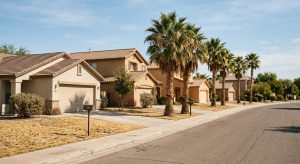
Colorado and Texas together account for roughly 560,000 at-risk properties and $252 billion in reconstruction cost value, according to the report. The remaining seven states in the top 10 — Oregon, Arizona, Idaho, New Mexico, Montana, Washington and Utah — combine for about $277 billion in exposure.
Los Angeles and Austin lead metro exposure
At the metro level, Los Angeles tops the list with 250,000 at-risk properties and $209 billion in reconstruction cost value, Cotality found. Austin, Texas, is the largest non-California metro on the list, with more than 100,000 at-risk properties worth a combined $49.2 billion. San Antonio, Denver and Spokane, Washington, also rank among the most exposed metro areas nationally.
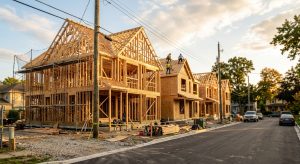
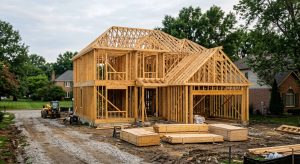
The report attributes part of the shift to population growth in fire-prone areas of Texas and Colorado, where new subdivisions have pushed further into wildland terrain even as overall U.S. home construction has cooled.
Conflagration risk reshapes the map
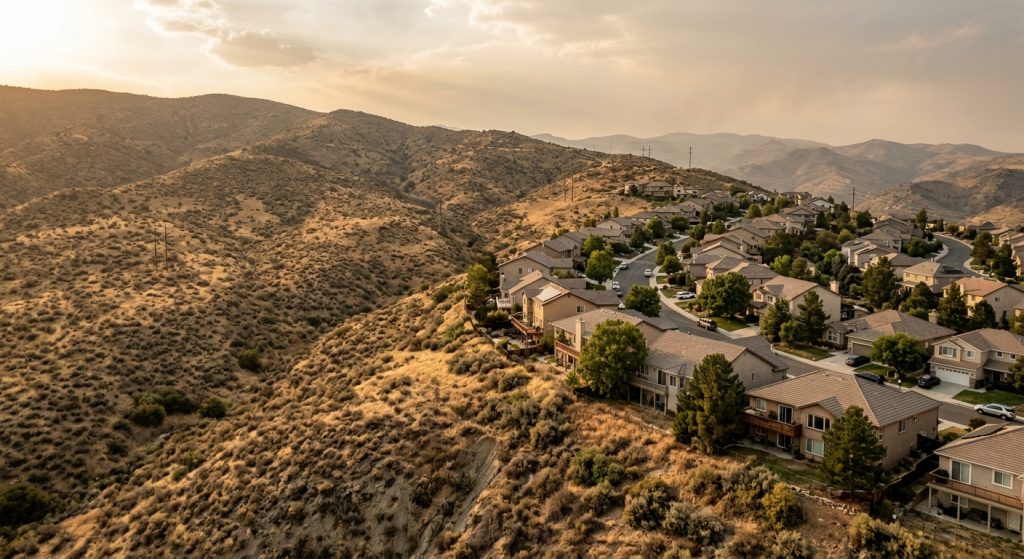
A key driver of the report’s findings is conflagration risk — the tendency of fire to spread structure-to-structure once it reaches a neighborhood, independent of the surrounding vegetation. Cotality’s modeling shows that accounting for conflagration can add up to 40 points to a property’s traditional wildfire risk score, a shift large enough to reclassify entire neighborhoods previously considered low-risk as hazardous.
That distinction matters increasingly for insurers setting rates and underwriting policies in wildfire-prone states, where traditional vegetation-based risk models have sometimes understated losses in dense residential areas.
The report also quantifies the value of home hardening and defensible-space work. Properties in the top 10% for wildfire mitigation had expected losses roughly 78% below the statewide average, Cotality found, while the bottom 10% of homes for mitigation carry expected losses of about $47 for every $1 of loss on the best-prepared homes — a gap Cotality says should inform how insurers price and structure coverage.
“New property-level data empowers insurers to identify mitigation steps and leverage resilience in decision-making,” said Jamie Knippen, Cotality’s director of hazard insights, in the release.
What it means
The verified facts: Cotality’s own data shows wildfire exposure has both grown and geographically broadened, with material shares of the $1.4 trillion in reconstruction cost value now sitting in Texas, Colorado and other interior states rather than California alone. That is consistent with Texas homeowners insurance premiums surging 30% over the past five years, a trend insurers have partly attributed to rising catastrophe risk.
As RealtyWire analysis: the widening geography of wildfire exposure suggests homeowners insurance pressure in non-coastal, non-California markets is likely to intensify rather than plateau, particularly in fast-growing Sun Belt metros where new construction continues to push into wildland-urban interface zones. That mirrors patterns RealtyWire has tracked in insurer claims handling and state-level reform fights such as Florida’s insurance litigation decline, where climate-linked risk has reshaped underwriting nationally, not just in the states historically seen as highest-risk.
What to watch: insurers’ 2027 rate filings in Texas, Colorado and Arizona, where regulators will likely face pressure to weigh conflagration-adjusted risk data against affordability concerns already straining homeowners in these markets.