A $2 billion Amazon Web Services data center campus in Gilroy, California, cleared its final local approval through a single staff signature rather than a City Council vote or Planning Commission hearing, according to the city’s own permit record. The approval, issued under an industrial zoning designation that predates the AI data center boom by more than four decades, is now pushing Gilroy’s council to consider rewriting its rules for future projects.
The Architectural and Site Review Permit, filed as AS 20-23 with the City of Gilroy’s Community Development Department, was signed on July 3, 2025, by Community Development Director Sharon Goei. The permit approves a data center campus for Amazon Data Services Inc. on a 56.33-acre vacant parcel at 8050 Camino Arroyo, at the southeast end of Arroyo Circle. No hearing before the Planning Commission or a vote by the City Council was required.
Why an administrative sign-off was enough
The site has carried an M2 General Industrial zoning designation since 1981, according to the approval letter. Under Table 30.23.10 of the Gilroy City Code, “data processing establishments” — the code’s term for data centers — are a principally permitted use within that zoning district, meaning they can proceed with a staff-level Architectural and Site Review permit rather than the discretionary review, public hearing, and City Council vote that a rezoning or conditional use permit would trigger. Because the property’s zoning and General Plan designation had not changed in more than 25 years, the project bypassed both the Planning Commission and the council by design, not by omission.
Amazon’s application traces back to November 13, 2020, with revisions filed in February 2021 and April 2022 and a final design submitted in February 2023, the approval letter states. From there, the project went through California Environmental Quality Act review: the city published a Draft Environmental Impact Report for a 45-day public comment period from August 12 to September 26, 2024, then certified a Final EIR that flagged two “significant and unavoidable” impacts — the conversion of prime farmland to industrial use and the project’s exceedance of vehicle-miles-traveled thresholds. Because those impacts couldn’t be mitigated to a less-than-significant level, the city adopted a formal “statement of overriding considerations,” concluding the project’s economic and technology benefits outweighed the harm. The only public-facing notice tied to the July 2025 decision itself was two signs posted on-site on May 21, 2025, ten days before the determination, as required by the city’s sign-posting rule — not a hearing.
The project’s scale
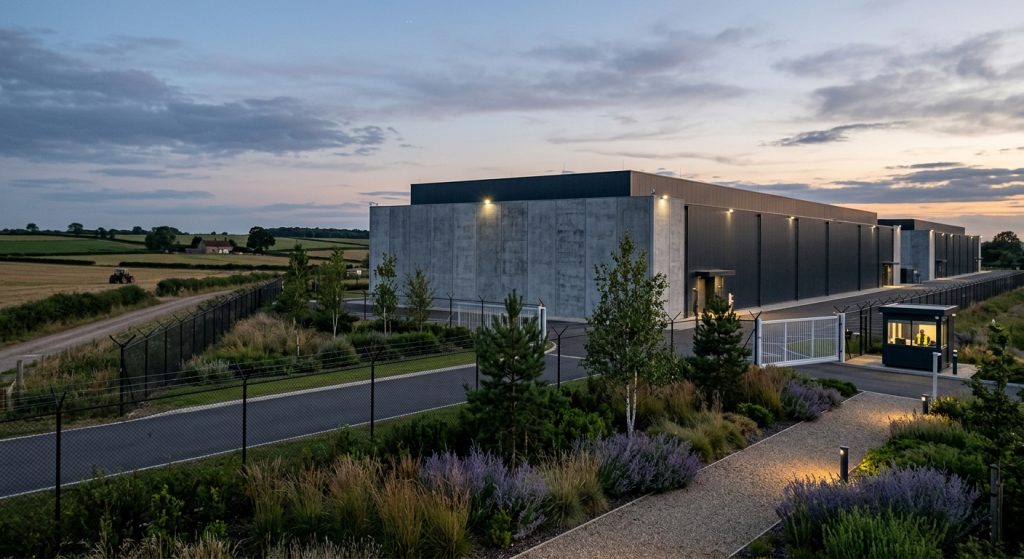
The approved campus totals roughly 438,500 square feet across two data center buildings and a security building, built in two phases. Phase 1’s 218,090-square-foot building requires a 49-megawatt connection to Pacific Gas & Electric and would be backed up by twenty-five 2.5-megawatt diesel generators plus a smaller 600-kilowatt unit for building systems. The project also includes a new 98-megawatt PG&E substation. Water use for cooling, irrigation, and domestic needs is projected at about 23 acre-feet a year — roughly 7.5 million gallons — concentrated in summer months. Under the city’s conditions of approval, Amazon committed a $1 million voluntary contribution to the Gilroy Fire Department for vehicles and equipment, and the project is expected to bring up to 125 employees and contractors on-site at full buildout, according to the approval record.
A single appeal of the director’s decision was filed on July 21, 2025, within the code’s 20-day window, then withdrawn on August 18, 2025, according to the city’s project information page. That is the extent of the formal public challenge on record.
What residents didn’t see coming
The scale of the approval only became widely known locally well after the fact. According to the Palo Alto Daily Post, which reported on the project on August 11, residents largely discovered it on their own, after construction cranes were already visible on the site — not through any city hearing, since none was legally required. The Daily Post reports that the Gilroy City Council is now drafting code changes that would require mandatory community review for future data center proposals, an acknowledgment that the existing industrial zoning code was not written with 400,000-square-foot server campuses in mind.
The widely cited $2 billion project cost comes from that and other press coverage of the filing; the AS 20-23 approval letter and its accompanying CEQA findings do not state a total project cost, though the city’s statement of overriding considerations notes the applicant “plans to invest hundreds of millions of dollars in the construction of the Project” as one justification for approval, separate from the full campus valuation reported elsewhere.
What it means
The verified facts: Gilroy’s approval process followed the city’s own zoning code as written, and the project underwent a full CEQA environmental review with a public comment period — just not a public vote. The Daily Post’s framing — that residents were effectively shut out of a decision they didn’t know was happening — is an interpretation grounded in the fact that no hearing was legally required, not evidence the city broke its own rules.
What’s less certain is how isolated this case is. Gilroy is one of several California cities where data center developers have been able to move faster than local zoning codes anticipated, and the council’s move to add community-review requirements mirrors a broader pattern of local governments retrofitting land-use rules after data center and other infrastructure projects arrive under decades-old industrial or administrative permitting tracks — the reverse of what happened in Seattle, where the city stripped environmental appeals from zoning votes to speed up a different category of development. RealtyWire has not independently verified the $2 billion figure against Amazon’s own capital disclosures for this specific campus.
What to watch
Gilroy’s council is expected to take up zoning-code changes for future data center applications before Amazon’s Phase 2 permits are filed; a supplemental CEQA review is already required for Phase 2 if a proposed battery back-up technology isn’t available at construction time. More broadly, the case adds to a growing list of California and national jurisdictions revisiting industrial-zoning language that predates today’s tight data center market, where record-low vacancy is pushing developers toward any site zoned to allow them — hearings or not.