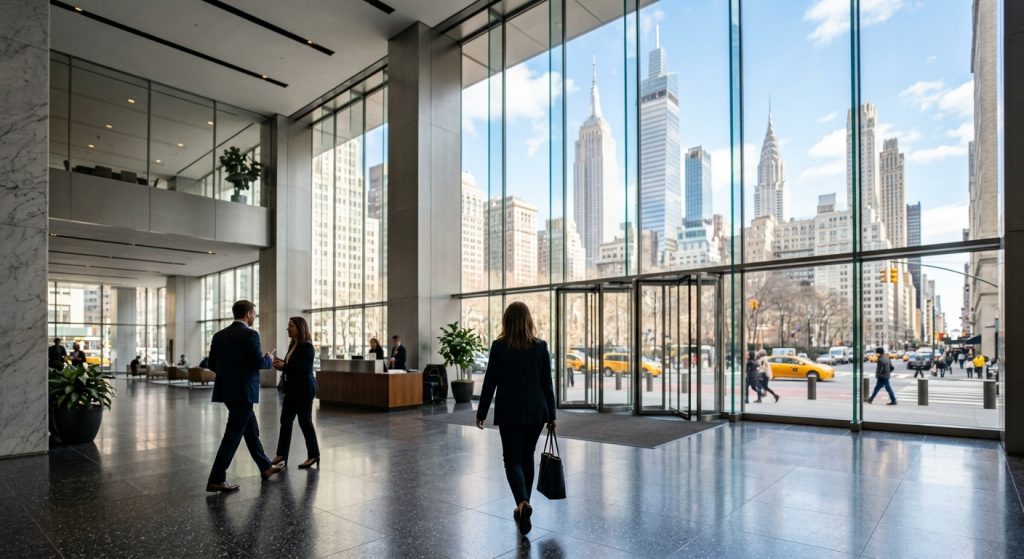
Manhattan office tenants signed 3.87 million square feet of leases in July, up 22 percent from June and 28 percent from a year earlier, as Midtown South accounted for nearly half of all activity, according to a monthly snapshot from Colliers. The surge pushed year-to-date leasing volume to 26.66 million square feet, putting the borough on pace for its strongest annual total since 2000.
The July numbers extend a run of demand that has defined Manhattan’s office market through the first seven months of 2026. Colliers said year-to-date volume is running 12.8 percent ahead of the same period last year, driven by a mix of return-to-office mandates and expansion from tech, legal, media and financial-services tenants.
Midtown South leads a broad-based month
Midtown South was the standout submarket in July, with roughly 1.9 million square feet of leasing activity — close to half of the borough-wide total, per Colliers. Availability in the submarket tightened to 12.2 percent.
The biggest deal of the month landed there: artificial-intelligence company Anthropic leased 466,000 square feet at 330 Hudson Street, a building owned by AEW Capital Management, taking the entire property. Snap also added to Midtown South’s momentum with a 199,000-square-foot sublease at Vornado Realty Trust’s Penn 2.
Elsewhere in the borough, NBCUniversal signed a 244,000-square-foot renewal at Rockefeller Group’s 1221 Sixth Avenue in Midtown, and insurer Aon renewed 202,000 square feet at Brookfield’s 1 Liberty Plaza downtown. Those two deals ranked as the second- and third-largest transactions of the month, Colliers said.
Availability at a six-year low, sublet space keeps shrinking
Sustained leasing has steadily eaten into the supply overhang that built up after the pandemic. Manhattan’s overall availability rate fell to 12.7 percent in July, down 0.3 percentage points from June, with total available space at 66.24 million square feet — the lowest level since September 2020 and down 32.4 percent from the post-pandemic peak of roughly 98 million square feet, according to Colliers.
Sublet space, long a drag on the market, contracted further. Colliers reported a 0.70-million-square-foot decline in sublet inventory during July alone, bringing the year-over-year drop to 26.4 percent and pushing sublet availability to its lowest point since August 2019. The firm said reductions in sublet inventory showed up across Midtown, Midtown South and Downtown.
The tightening supply also showed up in absorption and pricing. Manhattan posted 1.87 million square feet of positive net absorption in July, and Colliers said the average asking rent climbed to its highest level since July 2020.
What it means
The verified facts: July leasing volume, the year-over-year and month-over-month gains, the submarket breakdown and the availability and sublet figures all come from Colliers’ own July snapshot of the Manhattan office market. The named lease transactions — Anthropic at 330 Hudson Street, Snap’s Penn 2 sublease, NBCUniversal’s renewal at 1221 Sixth Avenue and Aon’s renewal at 1 Liberty Plaza — are also drawn from that report.
Colliers’ framing that 2026 is on pace for its strongest year since 2000 is the firm’s own interpretation of year-to-date trends and assumes leasing activity holds up through the rest of the year; it is not a guarantee. The consistent decline in both overall and sublet availability, paired with rising asking rents, points to a market where large blocks of quality space — particularly in Midtown South — are becoming harder to find, a dynamic that has been building since the post-pandemic peak in early 2024.
What to watch: whether tech and AI tenants keep absorbing large blocks at the pace Anthropic’s 330 Hudson Street lease suggests, whether Midtown and Downtown availability rates start converging with Midtown South’s tighter numbers, and whether rising asking rents begin to slow leasing velocity in the second half of the year. Colliers’ next monthly snapshot, covering August, is expected in early September.
Manhattan’s office market has been one of the more closely watched barometers for the broader U.S. office sector’s recovery. For related coverage, RealtyWire has reported on New York City’s halt of a second office-to-residential conversion and on BXP’s $1.2 billion construction loan for its 343 Madison Avenue tower near Grand Central, both signs of how developers and regulators are responding to shifting office demand. Office vacancy trends outside New York have also been improving, as seen in Phoenix’s third straight quarterly vacancy decline.