
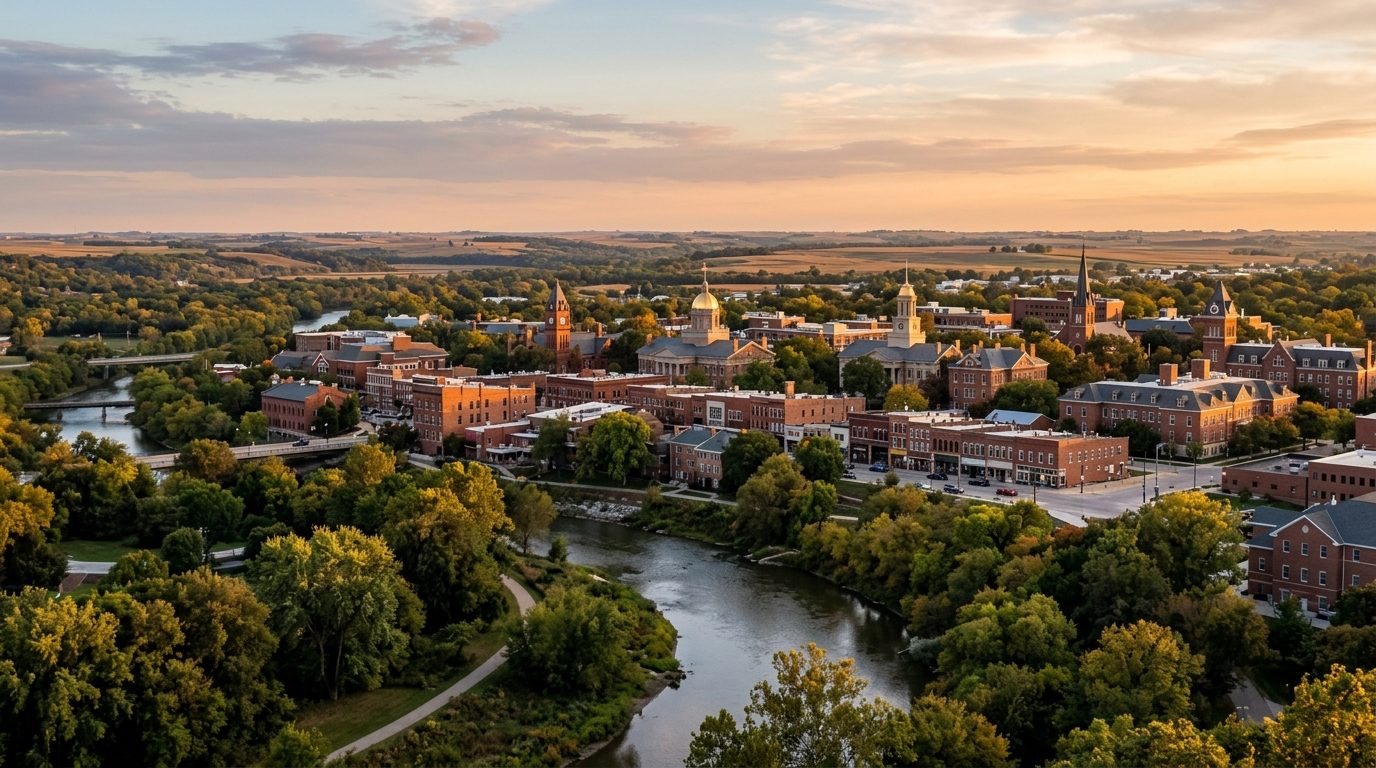
Current real estate market data, news and analysis for the Ann Arbor, MI metropolitan area — 370,214 residents across Washtenaw county.
Data as of May 2026. Sources: Redfin Data Center, U.S. Census Bureau.
Latest Ann Arbor Real Estate News
Coverage of this market is coming soon. Browse all housing market news.
Ann Arbor Real Estate Market Overview
Washtenaw County lies in southeastern Michigan along the Huron River, about a half hour west of Detroit and within easy reach of Lansing. The land is rolling glacial terrain laced with the river, kettle lakes, and remaining farmland, giving the outer townships an open, rural feel even as the core cities have filled in. Ann Arbor sits on hills above a bend in the Huron River, with the University of Michigan campus spanning both banks and splitting the city into a dense, walkable core and looser residential rings beyond. Ypsilanti sits downstream to the east around its old rail depot and mill district. Housing stock spans eras: nineteenth-century farmhouses, early-twentieth-century foursquares and bungalows near the city cores, mid-century ranch subdivisions, and newer infill development and student-oriented apartments near both campuses.
Prices vary mainly with proximity to the University of Michigan campus, the Huron River, and Ann Arbor’s downtown. Established neighborhoods near central campus, the city’s older tree-lined residential wards, and the wooded hillside enclaves northwest of downtown tend to command more, reflecting mature lots, architectural character, and short commutes to the university and hospital complex. Newer subdivisions in townships with strong school reputations also draw a premium. Prices run lower in Ypsilanti’s older core and surrounding township, along industrial and commercial corridors, and in smaller outlying towns such as Milan and Manchester. Chelsea, Dexter, and Saline sit in between, each offering a walkable small-town downtown within commuting range of the county’s main employers.
The University of Michigan dominates the county’s economy as its largest employer and as the anchor of the region’s health care and research sectors; its Ann Arbor campus and Michigan Medicine hospital system employ a large share of the workforce and drive housing demand near campus and the medical center. Eastern Michigan University adds a second public university presence in Ypsilanti. Health care is also a major employer in its own right, led by Trinity Health’s St. Joseph Mercy Ann Arbor hospital and the VA Ann Arbor Healthcare System. Technology and research firms cluster around the university’s research base, including Duo Security, Barracuda Networks, semiconductor equipment maker KLA, and federal labs such as NOAA’s Great Lakes research laboratory and the EPA’s vehicle emissions laboratory. Automotive ties persist through Toyota’s North America research center and a Ford components plant. Domino’s Pizza is headquartered in Ann Arbor, and Zingerman’s is a long-established local food business.
The climate is a four-season continental pattern with cold, snowy winters and humid summers; the county is inland, so it avoids the heaviest lake-effect snow totals found closer to Lakes Michigan and Erie, though buyers should still budget for winter heating and maintenance. Michigan taxes property on assessed and taxable value, with taxable value reset to market value upon sale, so buyers should confirm what a tax bill will actually be after purchase rather than relying on the seller’s figure. Historic districts in Ann Arbor and Ypsilanti can carry exterior-renovation review requirements worth checking before planning changes. Both universities support large rental markets, so neighborhoods near either campus see more turnover and rental activity than purely owner-occupied areas. Local bus service links Ann Arbor and Ypsilanti, but a car is necessary through most of the county’s townships and smaller towns, where new development continues to extend into former farmland.
Cities and Towns in the Ann Arbor Metro Area
Notable Communities and Neighborhoods
Ann Arbor Real Estate Market FAQ
How is the Ann Arbor metro area organized geographically?
The metro is Washtenaw County, built around the Huron River. Ann Arbor, anchored by the University of Michigan, sits at the county’s center on hills above the river and forms a dense, walkable core surrounded by looser residential rings. Ypsilanti, home to Eastern Michigan University, sits just downstream to the east. Smaller cities and villages, including Saline, Chelsea, Dexter, Milan, Manchester, and Barton Hills, ring the two larger cities and are separated by farmland and township land that has not yet been developed.
Which areas of the Ann Arbor metro tend to be pricier, and why?
Neighborhoods closest to the University of Michigan’s central campus, Ann Arbor’s older tree-lined residential wards, and the wooded, river-adjacent enclaves northwest of downtown tend to sit at the top of the market, largely because of short commutes to the university and hospital complex, mature lots, and architectural character. Newer subdivisions in townships with well-regarded schools also draw a premium. Ypsilanti’s older core, industrial and commercial corridors, and the smaller outlying towns tend to be more affordable, while Chelsea, Dexter, and Saline occupy a middle tier, trading some proximity for small-town downtowns and larger lots.
What should buyers verify locally before purchasing in this market?
Buyers should confirm what their actual property tax bill will be after closing, since Michigan resets taxable value to market value upon sale rather than carrying over the previous owner’s capped assessment. In Ann Arbor’s and Ypsilanti’s historic districts, buyers should check whether a property falls under local historic district review before planning any exterior changes. In the county’s rural townships, it is also worth confirming whether a property relies on a private well and septic system rather than municipal water and sewer, and when those systems were last inspected.
What is a distinctive risk or consideration specific to this market?
The heavy presence of the University of Michigan and Eastern Michigan University means neighborhoods near either campus function partly as rental markets, with a large seasonal population of students and short-term renters. Buyers purchasing in or near these areas should expect more rental turnover, on-street parking pressure, and noise variability than in neighborhoods further from campus, and should weigh how that rental activity might affect long-term resale value and day-to-day livability.
Nearby Markets