
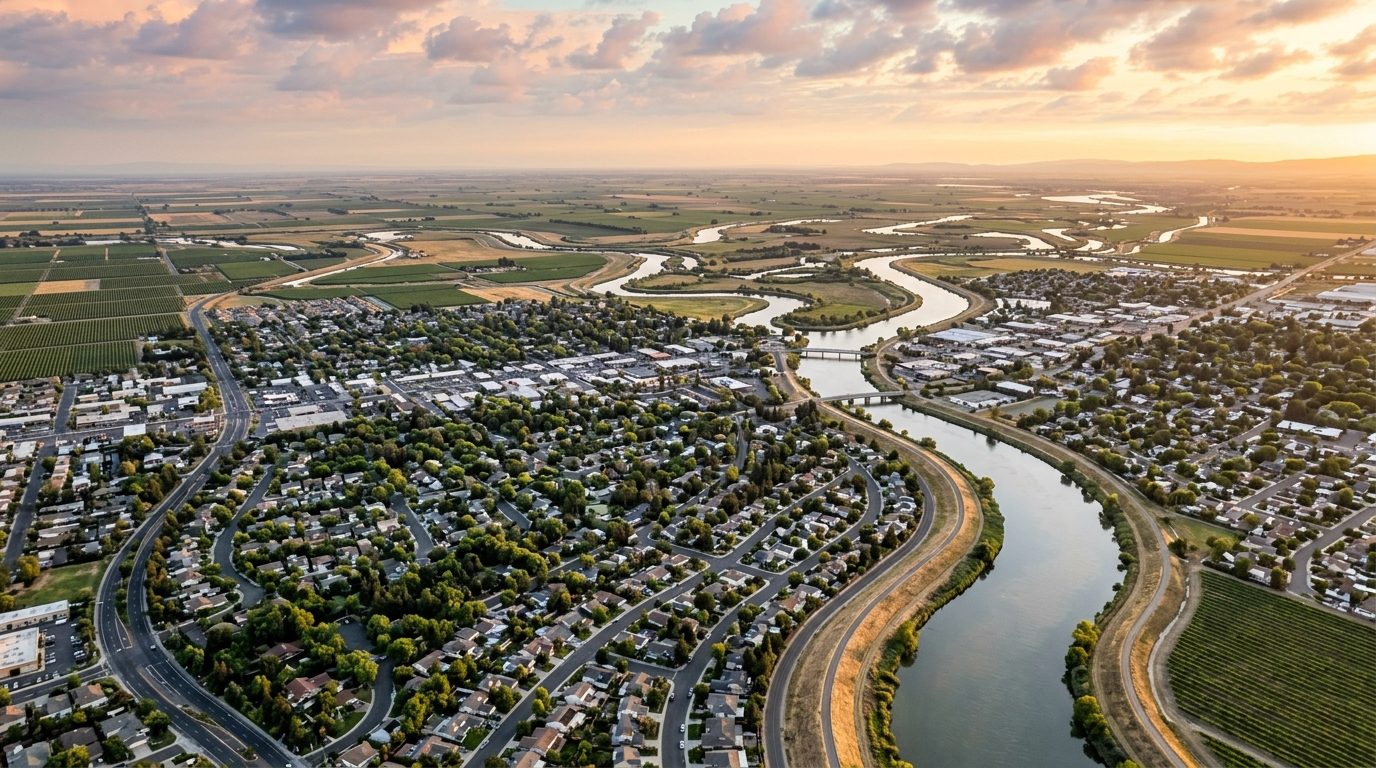
Current real estate market data, news and analysis for the Stockton-Lodi, CA metropolitan area — 823,815 residents across San Joaquin county.
Data as of May 2026. Sources: Redfin Data Center, U.S. Census Bureau.
Latest Stockton Real Estate News
Stockton Real Estate Market Overview
The Stockton-Lodi metro sits at the southern edge of the Sacramento-San Joaquin Delta in California’s Central Valley, laced by the San Joaquin River and reclaimed Delta islands. Stockton, the county seat, anchors the metro along Highway 99 and Interstate 5; Lodi lies north amid vineyard country; and Manteca, Ripon, Escalon, Tracy, Lathrop, and Mountain House ring the south and west, with Interstate 580 carrying commuters over the Altamont Pass toward the Bay Area. The valley floor is flat farmland turned residential at its edges. Downtown Stockton and Lodi retain early-twentieth-century bungalows and grid streets, while the newer cities and Stockton’s periphery are dominated by single-family tract subdivisions built since the 1990s, with the newest construction in master-planned communities around Tracy, Lathrop, Manteca, and Mountain House.
Cities closest to the Bay Area commute corridor tend toward the higher end of the price range. Mountain House, Tracy, and the River Islands community in Lathrop draw buyers priced out of the Tri-Valley and Silicon Valley; newer housing and shorter commutes support demand there. Ripon and parts of Manteca carry similar appeal on a smaller scale. Lodi sits in a middle tier, valued for its historic downtown and wine country despite being farther from Bay Area jobs. Stockton spans the widest range on its own: waterfront neighborhoods and newer north-side subdivisions carry a premium for water access and schools, while the older central and southern city, which absorbed the manufacturing decline and foreclosure crisis, remains most affordable, reflecting gaps in investment rather than land value.
Agriculture remains foundational, with San Joaquin County long ranked among the nation’s most productive farm counties and Lodi’s vineyards supporting a wine industry of dozens of wineries. Over the past two decades the metro’s economic center of gravity has shifted toward transportation, warehousing, and logistics, driven by the intersection of Interstate 5, Highway 99, Interstate 580, transcontinental rail lines, and the deep-water Port of Stockton, plus industrial land that stays affordable next to the Bay Area. Amazon operates multiple fulfillment centers and ranks among the county’s largest private employers, and logistics operators including FedEx have built distribution facilities around Tracy and Manteca. Healthcare and public institutions round out the largest employers, including St. Joseph’s Medical Center, Dameron Hospital, San Joaquin County government, area school districts, and the University of the Pacific. The Altamont Corridor Express rail line reinforces the commuter tie, linking Stockton, Lathrop, and Tracy to Silicon Valley jobs.
Flood risk tied to the Delta’s levee system is the most consequential local factor here. Much of Stockton and the Delta lowlands sit on land protected by an aging levee network maintained by local reclamation and flood-control districts, and a breach can inundate low areas quickly; buyers should check FEMA flood zone designations, confirm levee accreditation status, and ask about flood-control assessments before purchasing. Newer communities on former floodplain, such as River Islands in Lathrop, have been engineered with elevated levee perimeters, which buyers should verify independently. Newer subdivisions often add Mello-Roos assessments atop the base property tax rate, so buyers should request a full disclosure. Summers are hot and dry, winters bring tule fog, and wildfire risk is generally lower on the valley floor than in nearby foothills. Transit is limited to local buses, the ACE commuter line, and Amtrak, so travel outside rail-connected cities is largely car-dependent.
Cities and Towns in the Stockton Metro Area
Notable Communities and Neighborhoods
Stockton Real Estate Market FAQ
How is the Stockton-Lodi housing market organized geographically?
The metro is built around Stockton, the county seat and largest city, with Lodi to the north in vineyard country and a ring of smaller cities to the south and west, including Manteca, Ripon, Escalon, Tracy, Lathrop, and Mountain House. Highway 99 and Interstate 5 form the north-south spine through Stockton, while Interstate 580 links Tracy and Mountain House west toward the Bay Area over the Altamont Pass. Each city functions somewhat independently, with its own downtown core and surrounding subdivisions, rather than blending into one continuous urban area, and much of the land between cities remains active farmland.
Which parts of the metro tend to be pricier, and why?
Areas with the shortest effective commute to Bay Area job centers, particularly Mountain House, Tracy, and newer developments in Lathrop, tend to carry higher prices, reflecting demand from buyers who work in the Tri-Valley or Silicon Valley but want lower housing costs than they would find closer to the coast. Newer construction, planned community amenities, and stronger school ratings reinforce that premium. Lodi holds a middle position on the strength of its historic downtown and wine-country setting. Older central and southern Stockton, farther from the commute corridor and carrying a legacy of disinvestment, tends to be the most affordable part of the metro.
What should buyers verify locally before purchasing in this metro?
Buyers should confirm a property’s flood zone designation and the accreditation status of any levee protecting it, since much of the metro sits on Delta lowland behind levees maintained by local reclamation and flood-control districts. In newer subdivisions, it is worth requesting a full property tax disclosure, since many carry Mello-Roos special assessments on top of the base rate. Buyers should also check proximity to active agricultural land, since farming operations near newer subdivisions can bring odor, dust, or spraying, and should confirm which school district and municipal services apply, since city boundaries and unincorporated pockets are interwoven throughout the metro.
What is the region’s flood risk, and how does it affect real estate?
The Stockton-Lodi metro sits at the edge of the Sacramento-San Joaquin Delta, where an extensive network of aging levees protects low-lying land, including large sections of Stockton and reclaimed islands used for farming and, increasingly, housing. A levee breach can flood these areas quickly and with little warning, which is why levee maintenance and accreditation are an ongoing local concern. Newer developments built on former floodplain have been engineered with upgraded flood-protection levees, but buyers should independently verify current protection levels and flood insurance requirements rather than assume a levee’s design standard guarantees its current condition.
Nearby Markets