
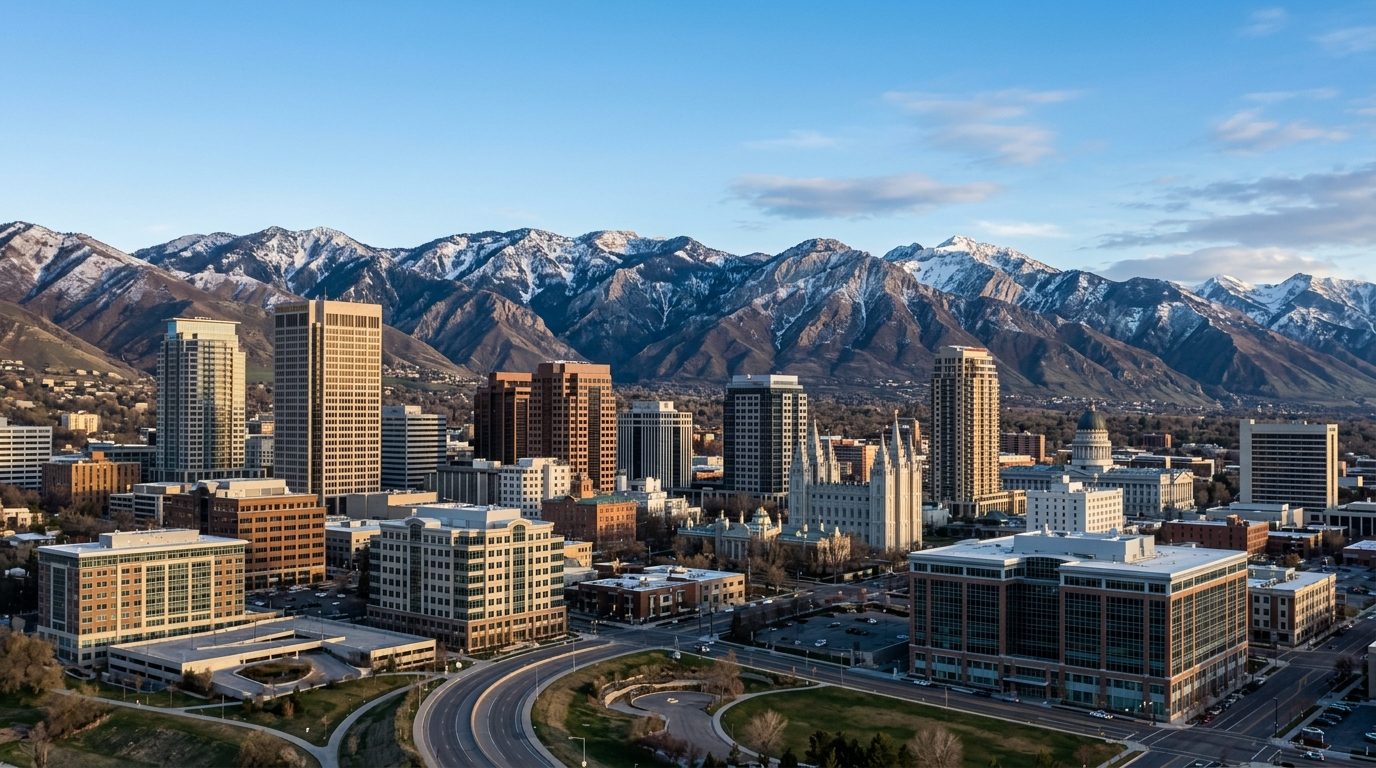
Current real estate market data, news and analysis for the Salt Lake City-Murray, UT metropolitan area — 1.3M residents across Salt Lake and Tooele counties.
Data as of May 2026. Sources: Redfin Data Center, U.S. Census Bureau.
Latest Salt Lake City Real Estate News
Coverage of this market is coming soon. Browse all housing market news.
Salt Lake City Real Estate Market Overview
Salt Lake City-Murray covers Salt Lake and Tooele counties, with most development concentrated in the Salt Lake Valley between the Wasatch and Oquirrh mountain ranges. Salt Lake City contains early brick houses, bungalows, apartments, condominiums, townhouses and newer urban infill. Holladay, Millcreek, Murray, Sandy and Cottonwood Heights include established suburban neighborhoods, while South Jordan, Herriman, Riverton, Bluffdale and Draper contain extensive newer construction and master-planned development. West Valley City, Kearns, Magna and West Jordan form large west-side housing markets, and Tooele County adds smaller cities, rural properties and commuter-oriented subdivisions beyond the Oquirrh Mountains.
Higher price tiers are generally associated with the Upper Avenues, Federal Heights, Harvard-Yale, East Bench, Olympus Cove, Holladay, Cottonwood Heights, Draper and selected foothill or canyon communities. These areas tend to combine views, larger lots, mature neighborhoods, mountain access or proximity to major employment centers. More attainable choices are commonly found in portions of the west and northwest valley, older suburban housing and communities in Tooele County. Lower acquisition costs farther west may be offset by longer commutes, limited transit options, air-quality differences, utility considerations and travel through constrained mountain or freeway corridors.
The economy is supported by state government, finance, technology, health care, education, transportation, outdoor recreation and professional services. The State of Utah and the University of Utah are major institutional employers, while Intermountain Health and University of Utah Health anchor medical activity. Financial-services and technology companies operate throughout Salt Lake City and suburban employment corridors. Salt Lake City International Airport supports aviation, freight and regional business travel. Downtown Salt Lake City, the University area, Murray, Sandy, Draper and the southwest valley contain separate office, medical and technology centers.
Earthquake, air-quality, wildfire, drought and water conditions are central property considerations. The Wasatch Fault and related hazards make foundation type, soil conditions and seismic retrofitting important, particularly for older masonry homes and properties near liquefaction zones. Foothill and canyon-edge communities may face wildfire, slope, snow and access concerns. Winter inversions can affect air quality across the valley, while drought and long-term water planning influence landscaping and development. TRAX, FrontRunner and bus services support selected corridors, but many outer communities remain automobile-dependent. Buyers should verify water providers, association obligations, special districts, solar agreements, basement moisture, snow access and whether adjacent open land is protected or approved for development.
Cities and Towns in the Salt Lake City Metro Area
Notable Communities and Neighborhoods
Salt Lake City Real Estate Market FAQ
How is the Salt Lake City metro housing market geographically organized?
The market is concentrated in the Salt Lake Valley between the Wasatch Mountains and the Oquirrh Mountains, with additional communities extending west into Tooele County. Mountain access, employment centers, transit corridors, water systems and available land divide the region into distinct submarkets.
Which Salt Lake City-area locations generally sit in higher price tiers?
The Upper Avenues, Federal Heights, Harvard-Yale, East Bench, Olympus Cove, Holladay, Cottonwood Heights, Draper and selected canyon or foothill communities generally occupy higher tiers. Views, larger lots, mountain access, established neighborhoods and proximity to employment centers contribute.
What should buyers investigate about earthquake risk along the Wasatch Front?
Buyers should review foundation type, retrofit history, soil conditions and proximity to mapped faults, liquefaction zones or steep slopes. Older unreinforced masonry homes and hillside properties may require specialized structural or geotechnical evaluation.
What should buyers verify in a new Salt Lake Valley community?
Buyers should review homeowners association rules, special-district obligations, builder warranties, water and utility arrangements, school plans and nearby approved land uses. Planned transit, roads and commercial centers should be treated as future projects until construction is complete.
Nearby Markets