
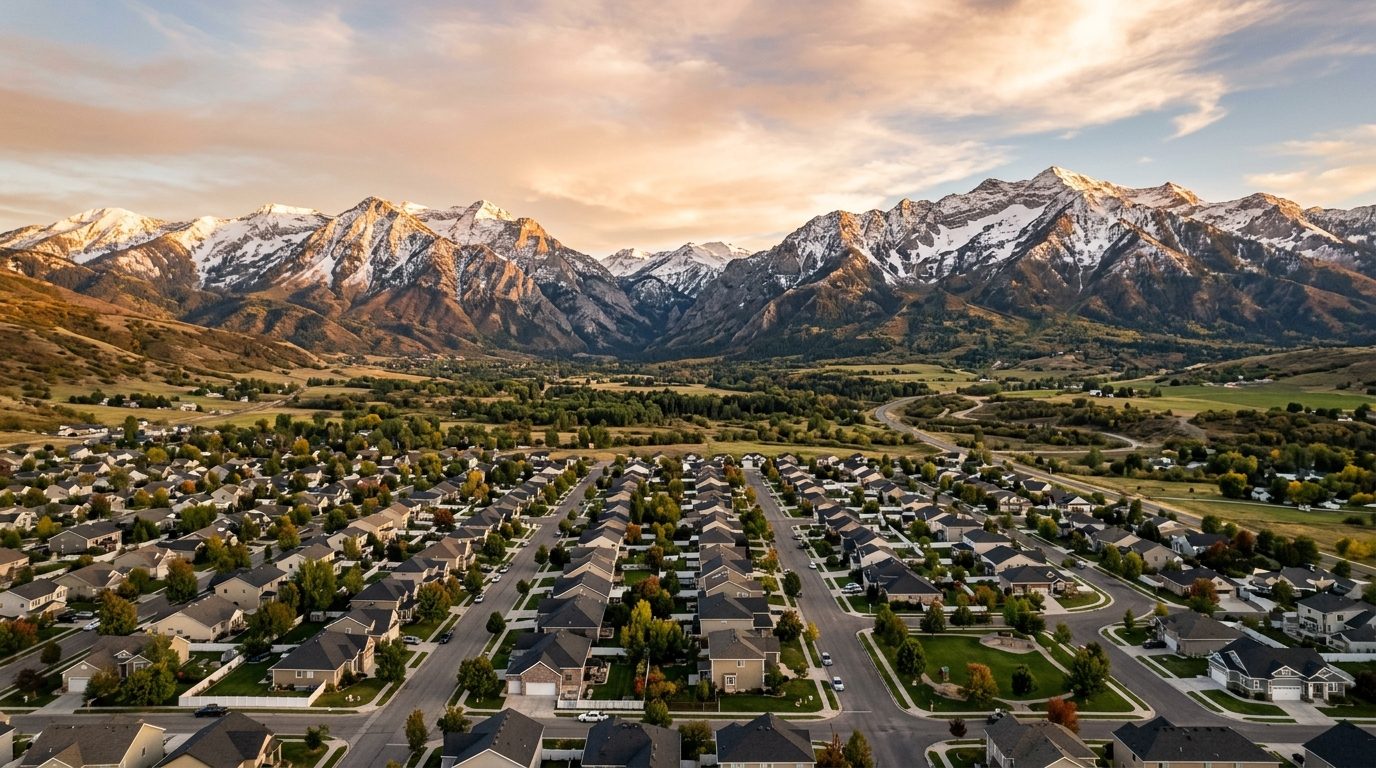
Current real estate market data, news and analysis for the Ogden, UT metropolitan area — 672,784 residents across Davis, Morgan and Weber counties.
Data as of May 2026. Sources: Redfin Data Center, U.S. Census Bureau.
Latest Ogden Real Estate News
Coverage of this market is coming soon. Browse all housing market news.
Ogden Real Estate Market Overview
The Ogden metro area occupies the northern Wasatch Front, where Davis, Morgan, and Weber counties stretch along a narrow shelf between the Great Salt Lake and the Wasatch Range. Ogden sits where the Ogden and Weber rivers exit their canyons onto the valley floor, and a similar pattern repeats throughout the corridor: older, closely built neighborhoods on the flat valley floor give way to bench and foothill neighborhoods climbing toward the mountains, then to newer subdivisions spreading west toward the lake. Housing stock mirrors this layering. Ogden’s core and older suburbs hold early-twentieth-century bungalows, brick cottages, and post-war ranch homes on established streets, while Davis County and western Weber County have newer two-story houses built since the 1990s. A separate cluster of mountain communities in Ogden Valley, near Eden and Huntsville, offers cabins, condos, and custom homes tied to nearby ski areas.
Neighborhoods along the east bench, closer to canyon mouths in cities such as North Ogden, South Ogden, Kaysville, Centerville, and Bountiful, tend to sit in higher price tiers, reflecting larger lots, valley views, and proximity to hiking and skiing. The Ogden Valley communities around Eden and Huntsville, anchored by Powder Mountain, Snowbasin, and Wolf Creek, form a separate upper tier driven by recreational and second-home demand. Flatter areas nearer the Great Salt Lake’s shoreline, along with older core neighborhoods in Ogden, tend to sit lower, partly because wetlands, wildlife refuge land, and industrial or rail corridors limit development there. Growing suburbs such as Syracuse, Layton, and Clearfield fall in between, offering newer construction without the premium tied to mountain-adjacent locations.
The regional economy centers on Hill Air Force Base, which spans Davis and Weber counties and is the area’s largest employment center, supporting depot maintenance, logistics, and nearby aerospace and defense contractors. Weber State University in Ogden is another major employer, alongside the Davis and Weber county school districts. Health care is a third pillar, led by Intermountain Health’s McKay-Dee Hospital in Ogden, a regional referral and trauma center, with additional clinics spread across both counties. Beyond these anchors, the metro has a manufacturing and outdoor-products base, warehousing and distribution tied to Interstate 15 and rail lines, and a seasonal tourism economy built around Ogden Valley’s ski resorts and Pineview Reservoir.
A few local factors are worth understanding before buying. The Wasatch Fault runs along the base of the mountains through Weber and Davis counties, and older masonry buildings in particular carry seismic retrofit considerations worth asking about. Winter temperature inversions trap air pollution in the valley for days at a stretch, a recurring seasonal condition that affects the valley floor more than higher bench and canyon locations. Property tax rates, irrigation or secondary water assessments, and special improvement district charges are set locally and can vary by city, so they should be confirmed with the county assessor. UTA’s FrontRunner commuter rail runs the length of the corridor, with stations in Ogden, Roy, Clearfield, Layton, and Farmington, giving some neighborhoods direct rail access to Salt Lake City that others lack. Growth patterns differ too: some cities favor transit-oriented development near rail stations, others more conventional subdivision growth on remaining farmland, so local zoning plans are worth reviewing directly.
Cities and Towns in the Ogden Metro Area
Notable Communities and Neighborhoods
Ogden Real Estate Market FAQ
How is the Ogden metro area organized geographically?
The metro follows a narrow north-south corridor along the northern Wasatch Front, bounded by the Wasatch Range to the east and the Great Salt Lake to the west, and spans Davis, Morgan, and Weber counties. Cities sit in a layered pattern: older centers like Ogden and Bountiful on the valley floor near canyon mouths, bench and foothill suburbs climbing toward the mountains, newer subdivisions spreading west and north across former farmland, and a separate cluster of mountain resort communities in Ogden Valley (Eden and Huntsville) east of the main ridge, reached through Ogden Canyon.
Which areas tend to be pricier, and why?
East-bench and foothill neighborhoods in cities such as North Ogden, South Ogden, Kaysville, Centerville, and Bountiful tend to cost more, reflecting larger lots, mountain and valley views, and proximity to trailheads and canyons. The Ogden Valley communities around Eden and Huntsville, near Powder Mountain, Snowbasin, and Wolf Creek, form a separate higher tier driven by recreational and second-home demand. Flatter, lake-adjacent areas and some older core neighborhoods in Ogden tend to sit lower, partly due to wetlands and industrial or rail corridors nearby.
What should buyers verify locally before purchasing here?
Confirm the property’s proximity to Hill Air Force Base flight paths and any related noise disclosures, check whether the home carries a secondary or irrigation water assessment common in this region, ask about seismic retrofit status for older masonry construction, and review each city’s zoning and long-range growth plans directly, since land-use rules and special improvement district charges vary from one municipality to the next along this corridor.
Is earthquake risk a real consideration in this area?
Yes. The Wasatch Fault runs along the base of the mountains through Weber and Davis counties, and geologic studies identify it as one of the more active fault zones in the region. Buyers, especially of older homes with unreinforced masonry, should ask about construction type, foundation condition, and any seismic retrofitting when evaluating a property in this corridor.
Nearby Markets