
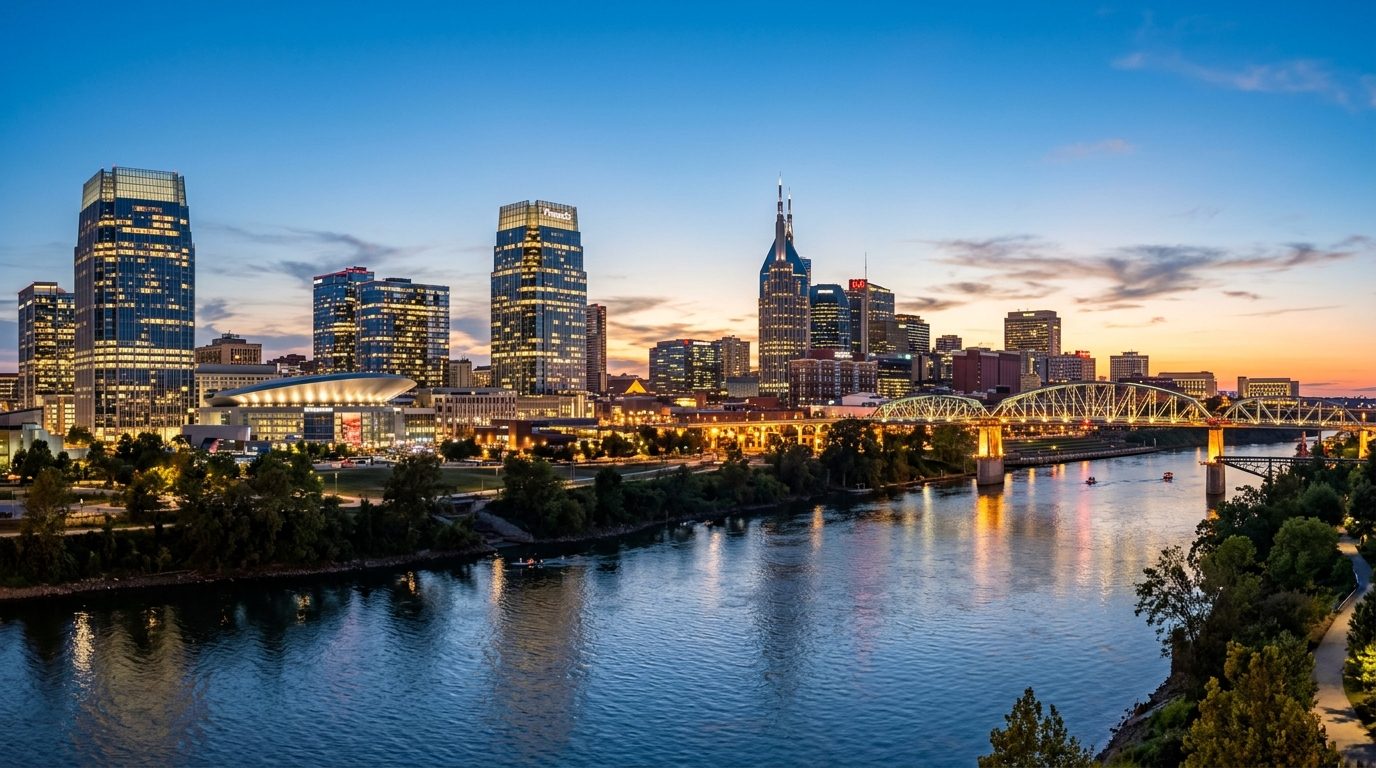
Current real estate market data, news and analysis for the Nashville-Davidson–Murfreesboro–Franklin, TN metropolitan area — 2.2M residents across 14 counties in Tennessee.
Data as of May 2026. Sources: Redfin Data Center, U.S. Census Bureau.
Latest Nashville Real Estate News
Nashville Real Estate Market Overview
Nashville-Davidson–Murfreesboro–Franklin covers a broad section of Middle Tennessee centered on the Cumberland River and the consolidated Nashville-Davidson government. Nashville contains early streetcar neighborhoods, cottages, brick houses, duplexes, apartments, condominiums and extensive infill construction. Williamson County combines historic Franklin, established Brentwood neighborhoods and newer planned communities. Rutherford, Wilson and Sumner counties contain large suburban growth corridors around Murfreesboro, Smyrna, Mount Juliet, Lebanon, Gallatin and Hendersonville. Maury, Robertson, Dickson and the outer counties add small towns, farms, wooded land and lower-density housing connected to Nashville by interstate and state highways.
Higher price tiers are generally associated with Belle Meade, Forest Hills, Green Hills, West End, selected neighborhoods near central Nashville, Brentwood, Franklin and parts of Williamson County. These areas tend to combine larger lots, established housing, mature landscaping, school access, walkability or shorter travel to major job and cultural districts. More attainable choices are often found in portions of north and southeast Davidson County, La Vergne, Smyrna, Lebanon, Springfield, Columbia, Dickson and smaller outer-county communities. A lower acquisition cost farther from Nashville may be offset by commuting, limited transit, private utilities or the need to wait for road, school and commercial infrastructure to catch up with development.
The regional economy is supported by health care, state government, higher education, music and entertainment, tourism, finance, technology, logistics and manufacturing. HCA Healthcare is headquartered in Nashville, and Vanderbilt University and Vanderbilt University Medical Center are major institutional employers. State government supports downtown employment, while music labels, publishers, studios and venues are concentrated in Nashville’s entertainment districts. Nissan’s North American operations and manufacturing activity in the broader region contribute to the automotive sector. Distribution and industrial development follow the interstate corridors through Rutherford, Wilson and surrounding counties.
Rapid outward development has made transportation, utilities and stormwater management important housing considerations. Nashville’s public transportation system serves selected routes, but most suburban and outer-county households depend on automobiles. Limestone geology can create sinkhole and drainage concerns, while hills and wooded lots may require review of slopes, retaining walls and tree condition. Severe thunderstorms, tornadoes, heavy rain and occasional winter weather affect roofs, drainage and insurance. Buyers should verify school assignments, sewer or septic service, association obligations, construction permits and nearby development approvals. Historic-district requirements can affect renovations in central Nashville and Franklin, while rural-edge properties may involve private roads, wells, agricultural uses or utility expansion plans.
Cities and Towns in the Nashville Metro Area
Notable Communities and Neighborhoods
Nashville Real Estate Market FAQ
How is the Nashville metro housing market geographically organized?
Nashville and Davidson County form the central employment market, with suburban corridors extending south through Williamson and Maury counties, southeast through Rutherford County and northeast through Wilson, Sumner and Robertson counties. The outer counties add small towns, farms, wooded parcels and separate local job centers.
Which Nashville-area locations generally sit in higher price tiers?
Belle Meade, Forest Hills, Green Hills, selected central Nashville neighborhoods, Brentwood, Franklin and parts of Williamson County generally occupy higher tiers. Larger lots, established housing, school access, walkability and proximity to major employment and cultural districts contribute.
What should buyers verify in a new Nashville-area development?
Buyers should review homeowners association rules, builder warranties, stormwater facilities, school plans, road capacity and nearby approved land uses. They should also determine whether community amenities, retail areas and transportation improvements are already complete or remain planned.
What property conditions should Middle Tennessee buyers investigate?
Buyers should examine drainage, foundations, crawl spaces, roofs, retaining walls and sewer or septic systems. Limestone geology, steep terrain, heavy rain, severe storms and tornadoes can create property-specific concerns that require inspection rather than neighborhood-level assumptions.
Nearby Markets