Spending on data centers ran at a seasonally adjusted annual rate of $85.0 billion in August, 73% above the same month of 2025, according to detail tables behind the monthly construction report the U.S. Census Bureau released Oct. 1. No other category in the report’s main table is growing at even half that rate, and without data centers the nonresidential side of the industry would be shrinking.
Total construction spending was $2.2031 trillion at an annual rate in August, 0.9% above July’s revised $2.1845 trillion. Census cautioned that the monthly move is not statistically significant — the 90% confidence interval around it, plus or minus 1.0 percentage point, includes zero. The annual comparison is firmer: August spending was 1.7% below the $2.2420 trillion of August 2025. Through the first eight months of 2026, construction put in place totaled $1.4504 trillion, 3.1% below the $1.4966 trillion of the same period last year.
Data centers are now two-thirds of private office construction
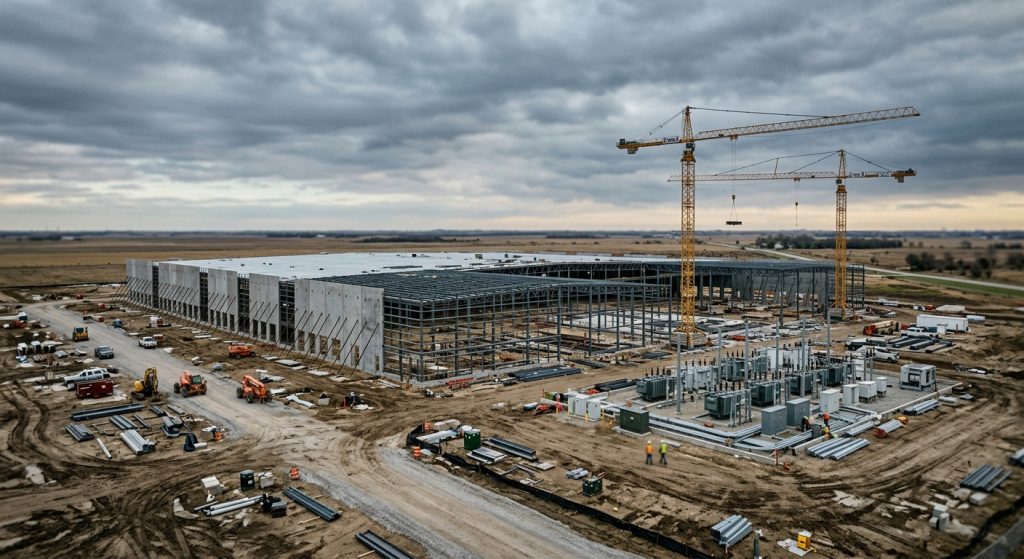
Census does not headline data centers. It files them as a subcategory of “office,” defined in the agency’s own survey definitions as buildings “that contain the hardware needed for storing, processing, and transmitting digital information.” The detailed private series published with the release puts that line at $84.95 billion in August, up from $79.01 billion in July and $49.05 billion in August 2025. In August 2022 it was $13.14 billion.
Data centers now account for 63% of all private office construction, against 48% a year earlier. The rest of the office category is going the other way: the “general” office line — administration buildings, computer centers and professional buildings — was $45.8 billion in August, down 9.7% from a year earlier. Total office construction including public projects reached $150.7 billion, up 24.6% year over year, a figure that exists almost entirely because of the server halls.
The arithmetic matters for how the industry reads the headline number. Private nonresidential construction rose $8.0 billion month over month in August; data centers supplied about three-quarters of that increase. Measured against August 2025, private nonresidential spending is down $7.4 billion — but strip the data-center line out of both months and the decline is 5.9%, by RealtyWire’s calculation from the Census tables. Do the same to total construction spending and the year-over-year drop widens from 1.7% to 3.4%.
Factory building keeps unwinding
The category data centers replaced at the top of the nonresidential growth tables is manufacturing. Private factory construction was $168.2 billion in August, essentially unchanged from July and 19.8% below a year earlier. The computer, electronic and electrical segment within it — the chip and component plants that drove the 2023 and 2024 numbers — fell to $52.3 billion from $95.4 billion in August 2025, a 45% decline.
Electrical infrastructure is tracking the computing buildout rather than the factory one. Private power construction, which Census reports separately, reached $141.2 billion for electric projects in August, up 10.8% year over year; total power spending including public utilities was $186.0 billion, up 8.5%.
Elsewhere in commercial real estate the direction is down. Lodging construction was $24.9 billion, 10.0% below August 2025. The commercial category, which Census uses for retail, wholesale and selected service buildings, was $122.8 billion, down 5.4%. Private warehouse construction fell 8.1% year over year to $53.1 billion, a third straight August decline from the $80.9 billion rate of August 2023.
Housing stays weak
Residential construction, public and private, was $894.6 billion at an annual rate, 1.1% above July but 4.8% below August 2025. New single-family building was $403.3 billion, up 0.2% on the month and down 3.5% on the year. New multifamily was $115.8 billion, up 0.2% on the month and down 0.6% on the year — a line that has barely moved all year, holding between $115 billion and $117 billion every month since January.
That is consistent with the direction of the pipeline data. Construction starts fell 24.8% in August as July’s megaproject surge unwound, and July’s spending report had single-family building down 3.2%. Associated Builders and Contractors’ August survey found one in six member firms under contract on a data center, which the group called the highest proportion on record, alongside a sharp rise in unprompted mentions of labor shortages.
Public construction was $547.8 billion in August, up 0.2% on the month — again inside the confidence interval — and up 2.5% from a year earlier. Highway and street spending was $150.6 billion and public educational construction $113.1 billion, both roughly unchanged from July.
Census labels current-month figures preliminary and revises them as more survey data arrives; the average absolute revision for total construction is 0.65%. The September report is scheduled for Nov. 2. More commercial real estate coverage is on RealtyWire.