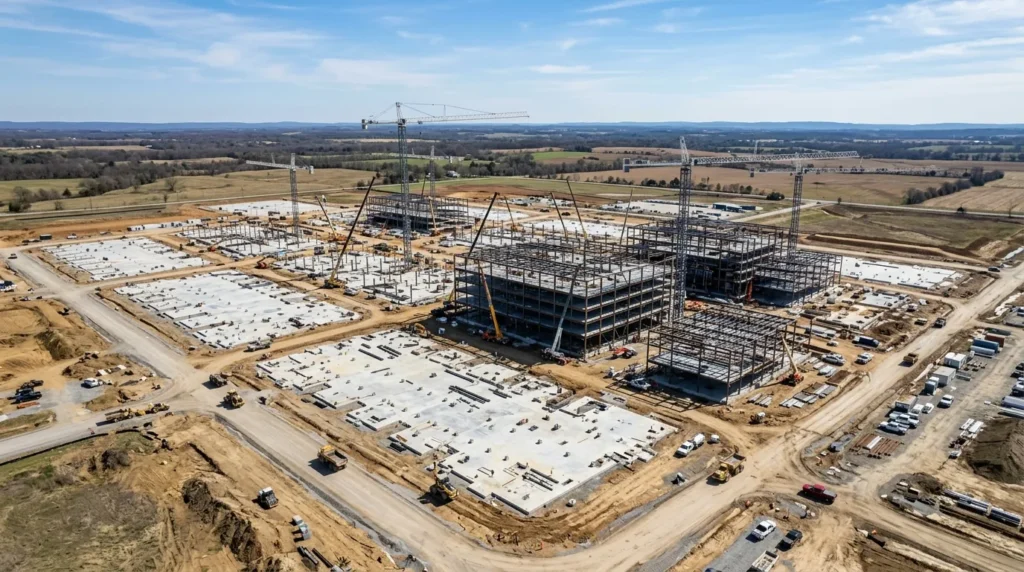
Data center construction starts reached $58.1 billion year to date through May across 91 projects — more than four times the prior-year record pace — according to ConstructConnect. May starts alone totaled $7.9 billion.
These are tracked construction starts using ConstructConnect’s proprietary methodology, not a measure of total industry spending.
Key facts
- Year-to-date starts through May: $58.1 billion.
- Projects counted: 91 year to date.
- May starts: $7.9 billion.
- Pace: more than four times the prior-year record.
- Figures represent tracked starts under ConstructConnect’s methodology.
The average project is enormous
Divide the total by the project count and the average data center start is roughly $638 million.
That single figure explains why this sector reshapes markets so abruptly. A $638 million average project is larger than most stadiums and comparable to major hospital campuses. Ninety-one of them in five months represents a concentration of construction capital with few precedents in commercial real estate.
It also clarifies why these projects are geographically concentrated. A half-billion-dollar facility requires large parcels, major power interconnection and a workforce capable of executing specialized electrical work. Only a limited number of markets can host one, so the spending clusters rather than distributing.
Four times the record is the number that should prompt questions
Exceeding a prior record is notable. Exceeding it by more than fourfold warrants scrutiny.
Growth at that rate is difficult to sustain, and it raises the question of whether starts reflect durable demand or a rush to secure position — power, land and contractors — ahead of competitors. Both can be true simultaneously, and the distinction only becomes visible later.
The relevant precedent is that infrastructure buildouts driven by a new technology have historically overshot. Capacity gets committed on demand projections that assume continued exponential growth, and construction timelines mean facilities deliver years after the decision. If AI compute demand grows more slowly than assumed, the correction arrives as delivered capacity without tenants.
That is not a prediction, and the current tenant base — large, well-capitalized technology companies signing long leases — is genuinely stronger than in prior speculative cycles. But four times a record is a pace worth watching rather than extrapolating.
Capacity constraints are already binding
At this volume, the industry is straining the inputs required to build.
Electrical contracting capacity has become scarce enough to drive consolidation, visible in MasTec’s $1.65 billion agreement for Superior Group and its roughly 3,000 workers. Power availability remains the primary constraint, as covered in our analysis of how power demand is reshaping industrial markets.
Local consent has emerged as a third limit. QTS terminated a roughly 2,139-acre Virginia proposal amid opposition and litigation, demonstrating that capital alone does not guarantee delivery.
What it means
For contractors and suppliers serving this sector, the pipeline is exceptional and the pricing power is real. The risk is customer concentration — a small number of clients driving a large share of backlog.
For industrial landowners in power-rich markets, site values reflect this demand. The strategic question is whether to sell into the current pace or hold, and that depends on a judgment about durability that reasonable parties disagree on.
For investors, the appropriate posture is to underwrite these as development projects with real absorption risk rather than as guaranteed-lease infrastructure. The tenant credit is strong today; the question is what four times a record pace means for occupancy three years from now.
—