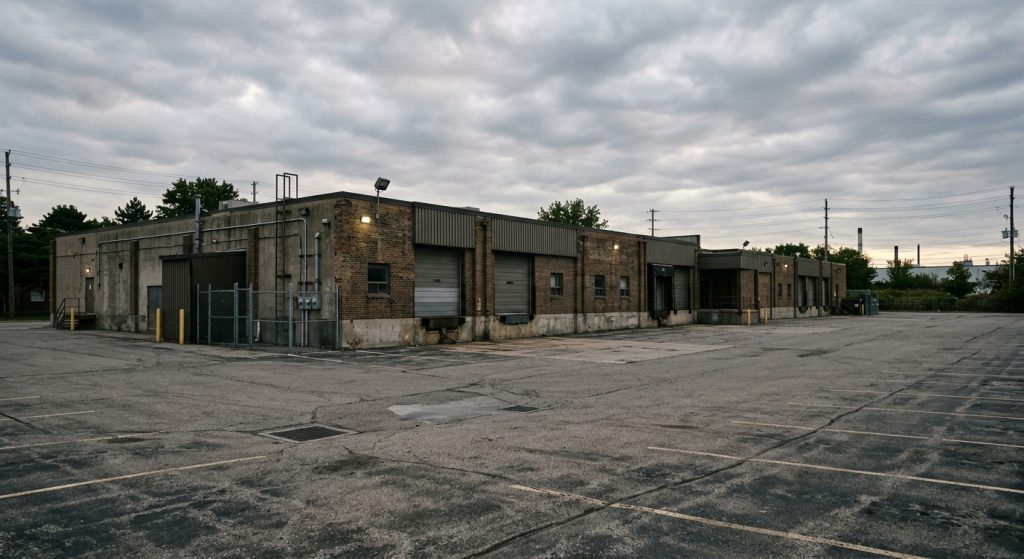
DWS is winding down its U.S. non-traded real estate trust. The board of RREEF Property Trust unanimously approved a plan of complete liquidation and dissolution on Sept. 15, and the company disclosed the decision on Sept. 18, saying it will sell all seven of its remaining properties and dissolve.
The trust reported a net asset value of $203.1 million as of June 30, with real estate carried at $448.4 million in fair value against $172.6 million of mortgage debt and $75.3 million drawn on a line of credit. It is small by the standards of the non-traded REIT business, but the reason the board gave for shutting it is the one that has defined that business for three years.
Todd Henderson, the trust’s chairman, president and chief executive, said the company was proud of its legacy and the performance of its individual investments, “however, a period of heightened redemption activity experienced by the Company and the industry in general and the challenges of attracting new capital led us to a diligent exploration of various strategic alternatives.” His statement, in the announcement filed with the Securities and Exchange Commission, continued: “As a result, our board of directors determined that the voluntary and orderly liquidation of the Company’s assets is the most attractive path to maximizing stockholder value.”
What stops immediately, and what does not
Three things stopped the day the board acted. RREEF Property Trust suspended sales of new shares in both its public and private offerings, suspended its share redemption plan, and suspended its distribution reinvestment plan. Shareholders who wanted out through the redemption plan no longer have that route.
Monthly distributions continue, at the board’s discretion, while the company seeks a shareholder vote. The plan does not take effect until holders of a majority of the outstanding shares approve it at a special meeting the company expects to hold in early 2027. After approval, management has up to 24 months to sell the assets, and the board may move anything left into a liquidating trust and distribute interests in it to stockholders rather than wait for the last closing.
Jones Lang LaSalle Securities is financial adviser on the strategic review. Alston & Bird is company counsel and Venable is Maryland counsel.
A small, diversified portfolio in five states
RREEF Property Trust was formed in February 2012 and never grew large. As of June 30 it owned eight properties; it sold Terra Nova Plaza in Chula Vista, Calif., to a third party on Aug. 7, leaving the seven that will now be marketed:
- Industrial: Commerce Corner in Logan Township, N.J. (400,901 square feet) and Seattle East Industrial in Redmond, Wash. (210,321 square feet), both fully leased at midyear.
- Residential: The Glenn in Centennial, Colo. (306 units, 91.5% leased) and The Flats at Carrs Hill in Athens, Ga. (138 units, 95.9% leased).
- Retail: Providence Square in Marietta, Ga. (222,805 square feet, fully leased) and Wallingford Plaza in Seattle (30,761 square feet, 90.9% leased).
- Office: Loudoun Gateway in Sterling, Va. (102,015 square feet), a single-tenant building that was fully leased at midyear.
The two largest income contributors in the second quarter were Commerce Corner, at 20.2% of property-related income, and The Glenn, at 19.9%. Weighted average remaining lease term, excluding the apartments, was 6.5 years.
Performance was not the problem
Henderson’s statement leads with returns rather than defending them. Class I shares, the largest and longest-running class, had a since-inception annualized total return of 6.35% through Aug. 31, and annualized monthly distributions across all classes ran between 5.1% and 6.9% over the past two years.
The strain shows up instead in flows. In August the trust redeemed roughly $2.67 million of shares, about 1.3% of its combined net asset value measured at the end of the prior quarter, against a plan cap of 2% a month. The company had filed a registration statement for a fifth public offering as recently as July 27 — an offering that will not now proceed.
Daily-NAV vehicles like this one were built on a promise of continuous fundraising paired with limited but regular liquidity. When new money stops arriving and redemptions keep coming, the manager has to sell assets to honor withdrawals, which shrinks the fee base and accelerates the cycle. That is the pressure Henderson’s statement names. On our reading, a trust of this size had little room to grow out of it; selling into a market where private capital is still writing billion-dollar checks for portfolios is a more credible route to value than waiting for retail inflows to return.
DWS Group, whose affiliate RREEF America advises the trust, reported 1.19 trillion euros of assets under management as of June 30 and about 5,000 employees. The RREEF real estate platform continues; only this vehicle is being liquidated.
The wind-down lands in a year when investor sentiment has already tested record lows. Seven assets across industrial, residential, retail and office will now be tested against live bids, and the results will say more about pricing in those sectors than another appraisal would. Further commercial real estate coverage is on the site.