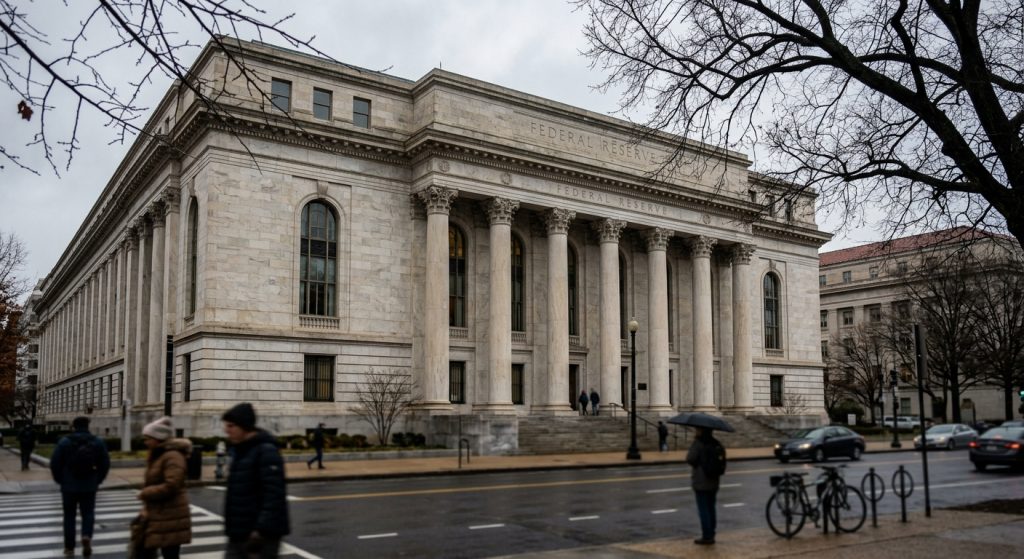
The Federal Reserve raised its benchmark interest rate on Sept. 16, 2026, lifting the target range for the federal funds rate by a quarter point to 3.75% to 4.00% — the first increase since July 2023 and a decisive turn against the easing cycle that carried rates down through 2024 and 2025.
The Federal Open Market Committee approved the statement by a 12-0 vote. That unanimity is itself the news. At the Committee’s previous meeting on July 29, it held rates on a 9-3 split, with Cleveland Fed President Beth M. Hammack, Minneapolis Fed President Neel Kashkari and the New York Fed’s Lorie K. Logan all dissenting because they wanted a quarter-point hike then. Seven weeks later, the rest of the Committee joined them.
The statement is blunt about why. “Inflation remains elevated,” it says. “Today’s policy action will support a timelier return to the Committee’s 2 percent goal. The Committee will deliver price stability.”
What the Fed says the economy is doing
The Committee described economic activity as “expanding at a solid pace,” with productivity growth “strong” and capital investment “robust.” Job gains, it said, “have kept pace with the workforce, and the unemployment rate has changed little.”
The language shifted in a way worth noting. In July the Fed attributed elevated uncertainty in part to “the conflict in the Middle East” and blamed above-target inflation partly on “supply shocks” in sectors including energy. The September statement drops the supply-shock framing entirely, cites “geopolitical developments” more generally, and adds that “domestic spending has been resilient.” Read against each other, the two statements describe a central bank that has stopped treating high inflation as somebody else’s fault.
The projections point to more tightening
The Summary of Economic Projections released alongside the decision moved sharply. The median participant now sees the federal funds rate at 4.1% at the end of 2026, up from 3.8% in the June projections. With the midpoint of the new target range at 3.875%, that median implies roughly one more quarter-point increase before the year ends. The central tendency for end-2026 runs 4.1% to 4.4%, and the full range of participant projections is 3.9% to 4.4%, the low end of which is essentially today’s midpoint.
The path stays higher for longer, too. The median projection for the end of 2027 rose to 4.1% from 3.6% in June, and for 2028 to 3.9% from 3.4%. Participants nudged their longer-run estimate of the federal funds rate up to 3.2% from 3.1%.
The inflation forecasts barely improved: median PCE inflation for 2026 is 3.7%, up a tenth from June, with core PCE at 3.4%. What changed most was the labor market. The median projection for the 2026 unemployment rate fell to 4.1% from 4.3% in June, and the 2027 median dropped to 4.1% from 4.3%. Median real GDP growth for 2026 ticked up to 2.3%. In short, participants marked down the recession risk that had justified patience and left their inflation problem intact.
What moves first for real estate
The mechanical effects arrive immediately. In the implementation note, the Board of Governors voted unanimously to raise the interest rate paid on reserve balances to 3.90% and to approve a quarter-point increase in the primary credit rate to 4.0%, both effective Sept. 17. The Open Market Desk was directed to conduct standing overnight repurchase agreements at 4.0% and reverse repos at 3.75%.
Banks followed within the hour. KeyCorp said it would raise its prime lending rate to 7.00% from 6.75%, effective Sept. 17; BNY announced the same 7.00% prime rate. Prime is the reference rate for home equity lines of credit, most construction loans, and a large share of bridge and floating-rate commercial mortgages — so borrowers on those products see the increase on their next reset, not eventually.
Long-term mortgage rates are a different mechanism. The 30-year fixed rate tracks the 10-year Treasury yield and mortgage-backed securities spreads rather than the overnight rate the Fed sets, which is why a hike does not translate one-for-one into a higher mortgage payment. Freddie Mac’s Primary Mortgage Market Survey put the 30-year fixed at 6.76% and the 15-year at 6.09% in its Sept. 10 reading, already near the highest level in more than a year.
On our reading, the more consequential signal for housing is not the quarter point itself but the projection table behind it. A committee that has revised its 2027 rate path up half a percentage point and lifted its longer-run estimate is telling borrowers that the cheap financing of 2021 is not a benchmark the market should be waiting to return to. For builders carrying floating-rate construction debt, for multifamily sponsors facing 2027 maturities, and for commercial owners who underwrote refinancings at lower exit rates, that repricing of expectations matters more than the 25 basis points.
The Committee next meets Oct. 27-28, and the projections suggest the debate will be about the size and timing of another increase rather than whether one is coming. Fed Chairman Kevin Warsh has argued since his Jackson Hole address in August that housing strain does not override the inflation mandate. The September statement, and the unanimous vote behind it, is that argument carried.