The U.S. housing market entered summer 2026 with a split message: existing-home sales improved in May, but new-home sales weakened and affordability remains a major constraint.
The latest national housing data does not point to a simple boom, bust or crash. Instead, it shows a market that is slowly becoming more negotiable for buyers while still expensive by historical standards. More inventory is giving buyers additional choices in many areas, but higher mortgage rates and elevated home prices continue to limit how much buyers can afford.
For sellers, the message is equally important: pricing and preparation matter more than they did during the tightest years of the housing shortage.
Key takeaways
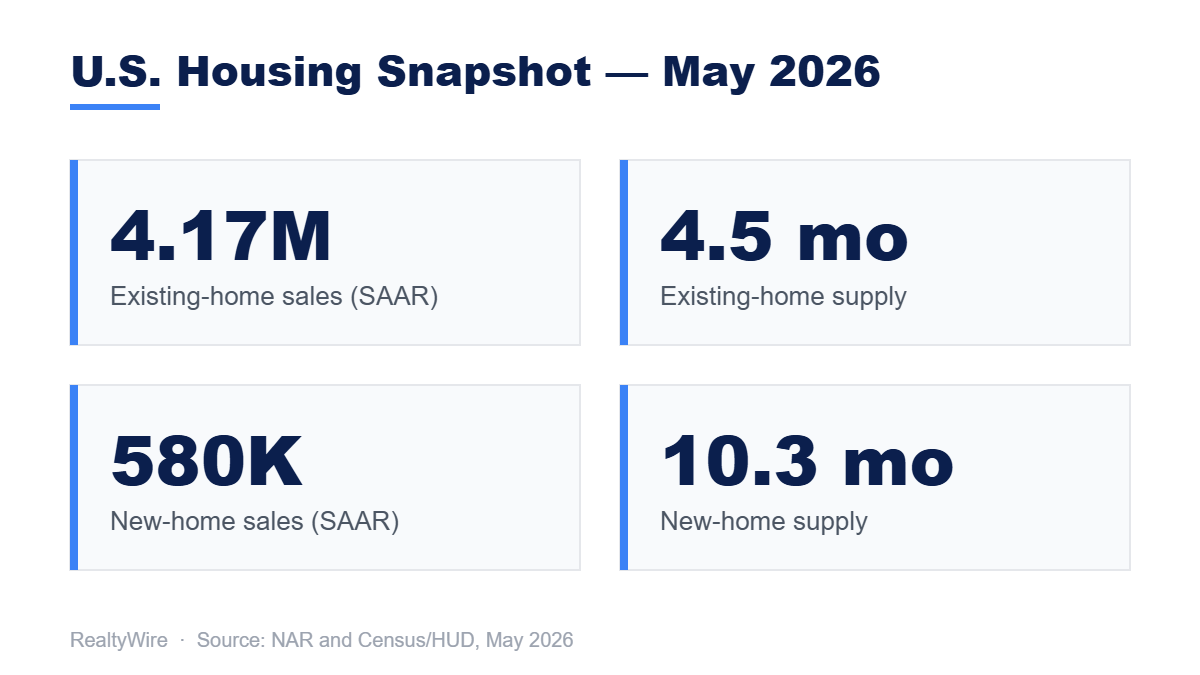
- Existing-home sales rose 3.2% month over month and year over year in May 2026.
- NAR reported a seasonally adjusted annual existing-home sales rate of 4.17 million.
- The national existing-home median sales price was $429,300.
- Existing-home inventory stood at 4.5 months of supply.
- New-home sales fell to a 580,000 seasonally adjusted annual rate.
- New homes for sale represented 10.3 months of supply.
- Zillow and Realtor.com both showed more national inventory than a year earlier.
What changed in May
The clearest change in the May housing data is that the resale market improved while the new-home market softened.
The National Association of Realtors reported that existing-home sales rose 3.2% in May 2026, reaching a seasonally adjusted annual rate of 4.17 million. NAR also reported a national median existing-home sales price of $429,300 and 4.5 months of inventory.
The new-home market told a different story. Census/HUD reported that new single-family home sales fell to a 580,000 seasonally adjusted annual rate in May. New homes for sale totaled 496,000, equal to a 10.3-month supply at the current sales pace.
That contrast is the most important part of the June housing market update. Existing homes and new homes are related, but they are not the same market. Existing-home sales depend heavily on homeowner behavior, mortgage-rate lock-in, local inventory and resale pricing. New-home sales depend more directly on builder inventory, construction costs, financing incentives, land costs and buyer traffic.
Existing homes vs. new homes
A side-by-side view shows why the market feels different depending on what a buyer is shopping for.
| Segment | Latest May 2026 signal | What it suggests |
|---|---|---|
| Existing-home sales | 4.17 million SAAR | Resale activity improved |
| Existing-home inventory | 4.5 months | More supply than the tightest years, but not a national glut |
| Existing-home median price | $429,300 | Prices remain high nationally |
| New-home sales | 580,000 SAAR | Builder sales weakened |
| New-home supply | 10.3 months | New construction has more inventory pressure |
A buyer comparing resale and new construction should not assume one is automatically the better deal. A resale home may offer a stronger location or lower ongoing costs. A builder may offer closing-cost help, rate buydowns, upgrades or discounts on finished inventory.
The right comparison is not just list price. Buyers should compare monthly payment, insurance, taxes, HOA dues, builder incentives, repair risk, warranty coverage and resale value.
Inventory is improving, but affordability still dominates
Inventory is moving in a more buyer-friendly direction, but affordability remains the larger issue.
Realtor.com reported 1,058,693 active listings in May, up 2.2% from a year earlier, with a national median list price of $429,500. Zillow reported 1.36 million homes for sale nationwide in May, with active inventory up 1% year over year.
More inventory gives buyers more time and more choices. It can reduce pressure to rush into a decision, waive protections or compete aggressively on every listing.
But more listings do not automatically mean homes are affordable. A home near the national median price still produces a much higher monthly payment than many buyers faced when mortgage rates were lower. Taxes, homeowners insurance, HOA dues, maintenance and closing costs can make the real cost of ownership much higher than the mortgage payment alone.
That is why the market is better described as “more negotiable” than “cheap.”
What this means for buyers
Buyers may have more leverage in 2026 than they did during the tightest years of the housing market, but they still need to be disciplined.
Buyers should watch:
- how long homes are sitting before going under contract,
- whether nearby listings are cutting prices,
- whether builders are offering incentives,
- whether insurance or HOA costs change the monthly payment,
- and whether the seller is open to credits, repairs or closing-cost assistance.
In markets with heavy new-home inventory, buyers should compare builder incentives against resale-home concessions. A builder rate buydown may look attractive, but the total deal still depends on the home price, loan terms, HOA costs, lot premium, taxes and long-term suitability.
What this means for sellers
Sellers are still benefiting from high national prices, but they face a more selective buyer pool.
A listing that is overpriced, poorly prepared or difficult to insure may struggle, especially in markets where inventory has risen or buyers have nearby new-construction alternatives.
Before listing, sellers should review:
- recent comparable sales,
- active competing listings,
- nearby builder inventory,
- likely buyer objections,
- repair or inspection issues,
- insurance-related concerns,
- and whether a targeted concession may be more effective than a later price cut.
The first impression matters. In a slower market, a seller who starts too high may lose the most motivated buyers early.
Florida, Sun Belt and luxury-market angle
National data should not be applied blindly to Florida, Naples or other Sun Belt markets.
In coastal and second-home markets, insurance costs, condo fees, flood risk, HOA rules and special assessments can matter as much as the purchase price. A buyer comparing homes in Naples, Miami, Tampa or other Florida markets may need a deeper due-diligence process than a buyer in a lower-cost inland market.
Luxury markets can also behave differently. Some affluent buyers are less affected by mortgage rates, especially if they are paying cash. But even cash buyers may be sensitive to insurance, taxes, association costs, property condition and future resale liquidity.
For seasonal owners thinking about selling, the national message is clear: buyers have more options than they did a few years ago. Pricing, presentation and property-specific due diligence are becoming more important.
What to watch next
The next few months will show whether May’s improvement in existing-home sales becomes a trend or a temporary bounce.
The most important signals to watch are:
- mortgage rates,
- active listings,
- price cuts,
- new-home supply,
- builder incentives,
- pending sales,
- and contract cancellations.
One month of data does not establish a trend. Census/HUD new-home sales data can be revised and includes sampling variability. But the June 2026 housing market snapshot shows a market that is changing: buyers have more choices, sellers face more competition, and affordability remains the central obstacle.
Frequently asked questions
Is the U.S. housing market improving in 2026?
It is improving in some ways. Existing-home sales rose in May 2026 and inventory is higher than a year earlier in several national datasets. But new-home sales weakened, mortgage rates remain elevated, and affordability is still challenging.
Are home prices still rising nationally?
The national existing-home median sales price was $429,300 in May 2026. That shows prices remain high nationally, even though some local markets are seeing more price cuts or softer listing prices.
Is inventory finally coming back?
Inventory is improving, but it varies widely by market. NAR reported 4.5 months of existing-home supply, while Zillow and Realtor.com both reported more active inventory than a year earlier.
Why are new-home sales weaker than existing-home sales?
New homes are affected by builder inventory, construction costs, financing incentives, buyer traffic and regional supply. In May 2026, the new-home market had 10.3 months of supply, suggesting more pressure than the existing-home market.
Is 2026 a buyer’s market or a seller’s market?
Nationally, 2026 looks more buyer-friendly than the tightest recent years, but it is not a simple buyer’s market everywhere. Local inventory, price range, property type and mortgage-rate sensitivity all matter.
Sources
NAR Existing-Home Sales (May 2026); Census/HUD Monthly New Residential Sales, May 2026; Zillow May 2026 Market Report; Realtor.com May 2026 Monthly Housing Report.