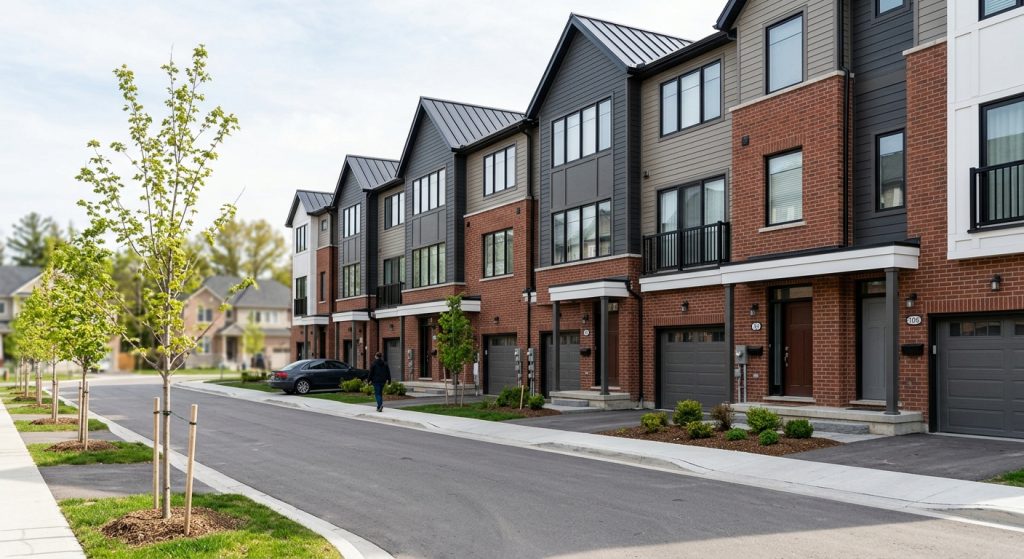
Townhouse construction fell in the second quarter, pulling the segment’s market share off the record high it set last year, though it remains well above its historical norm, according to an analysis by the National Association of Home Builders.
Single-family attached starts totaled 42,000 units in the second quarter of 2026, a 9% decline from a year earlier, NAHB chief economist Robert Dietz wrote, citing the Census Bureau’s Starts and Completions by Purpose and Design data.
The four-quarter moving average — the more reliable read on direction for a series this size — stood at 159,000 townhouse starts, down 12% from 180,000 in the prior four-quarter period.
Off the peak, but structurally elevated
Townhouses accounted for 17% of all single-family housing starts in the second quarter. On a one-year moving average basis, market share was 17.4%, down from the all-time high of 18.7% reached in the third quarter of 2025.
The step down still leaves the segment far above where it sat in earlier cycles. The previous two-decade peak came in the first quarter of 2008, when townhouse market share reached 14.6% on the same one-year moving average basis. In other words, a segment in retreat is still capturing a larger slice of single-family construction than it ever did before this cycle.
Dietz attributed the near-term weakness to housing affordability challenges weighing on buyer demand, particularly in larger metropolitan markets — the same markets where attached product is most likely to be built.
He remains constructive on the longer term, pointing to growing homebuyer interest in medium-density residential neighborhoods that offer walkability and amenities, where construction is feasible if zoning permits. That is NAHB’s outlook, not an established trend in the current data.
What it means
The zoning caveat in Dietz’s forecast is the operative constraint. Townhouses are the primary form of attached, fee-simple ownership housing that builders can deliver at lower price points than detached homes, which makes the segment the most direct construction-side response to affordability pressure. But the metros with the strongest demand for that product are frequently the ones whose zoning codes make it hardest to build.
That tension explains why the segment can be both structurally elevated and cyclically weak at the same time. Builders shifted toward townhouses precisely because buyers were priced out of detached homes; when affordability deteriorates further, even the cheaper attached product stops clearing.
For builders, the practical read is that townhouse projects are no longer an automatic hedge against a softening detached market. RealtyWire’s assessment is that the 12% decline in the smoothed average tracks the broader for-sale slowdown rather than reflecting any loss of appetite for density — a reading consistent with Dietz’s affordability explanation, though the data alone does not separate the two.
The decline fits a wider pullback in residential construction. Single-family housing starts plunged in July even as permits rose, and single-family permitting has declined through June while multifamily activity held up comparatively better. NAHB separately reported that single-family built-for-rent starts fell 16% over the same four-quarter window, indicating the weakness extends across ownership and rental product alike.