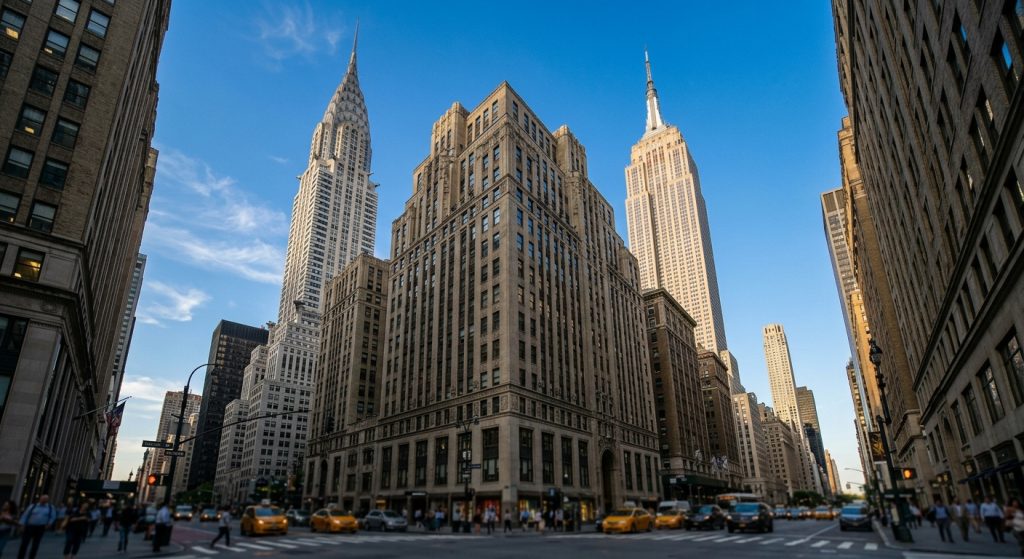
Tishman Speyer has signed a 150-year ground lease on the Chrysler Building and committed $235 million to rebuilding the landmark’s systems, restoring its facade and turning it into what it calls Manhattan’s most distinctive boutique office tower.
The developer and The Cooper Union for the Advancement of Science and Art, which has owned the land under 405 Lexington Avenue since 1902, announced the finalized agreement on Oct. 7. Tishman Speyer will also make ground rent payments to the college. The Public Sector Pension Investment Board, the Canadian pension manager known as PSP Investments, is the lead investor alongside what the companies described as multiple global institutional partners.
The group is funding it entirely with equity. Tishman Speyer said it and its partners will deploy 100 percent equity to finance both the ground lease and the redevelopment — no acquisition debt on a 1.3 million-square-foot office repositioning, at a moment when borrowing costs have climbed sharply. PSP Investments reported C$320.6 billion of net assets under management as of March 31, 2026.
What the money buys
The program is heavy on infrastructure rather than cosmetics. Tishman Speyer said it will modernize the mechanical, elevator, electrical and air handling systems and optimize the cooling towers for energy efficiency — the unglamorous work that decides whether a 1930 tower can compete for modern tenants. The facade will be restored and the building’s crown polished and renewed.
Two amenity levels anchor the leasing pitch. The 61st floor, known for the eagle gargoyles modeled on the hood ornament of the 1929 Plymouth, is being reserved for an indoor-outdoor program with an upscale lounge, food and beverage service and gathering space. Fitness, wellness and meeting rooms go into the building’s underground arcade.
The leasing strategy is the most commercially revealing part of the plan. Tishman Speyer will prebuild 75 percent of the building’s current and upcoming vacancy as ready-to-occupy suites, an approach it says it used at its neighboring 6 Grand Central tower. Prebuilding at that scale is expensive, and it is a bet on a particular kind of demand: smaller tenants who want to sign and move in rather than design and build.
“We are pursuing an ambitious plan for the Chrysler Building at a historically strong moment for the Manhattan office market,” said Tishman Speyer Chief Executive Rob Speyer. “Just as we have done through new developments like The Spiral and our continuous reinvention of Rockefeller Center, we will create an environment that will make our customers proud and excited to work here every day.”
Tishman Speyer says the submarket supports the thesis: the Grand Central area has one of the lowest office availability rates in Manhattan, and construction of new supply there has been virtually nonexistent for decades. That is the company’s own characterization of the market it is entering, but it is consistent with nearby activity RealtyWire has covered — BXP’s $1.2 billion construction loan for 343 Madison Avenue and SL Green filling 245 Park Avenue during a strong year for Manhattan leasing.
Why Cooper Union did the deal
For the college, this is a financing transaction. Cooper Union was founded in 1859 by the inventor and industrialist Peter Cooper; his children granted the school the land beneath the Chrysler Building in 1902 as a permanent source of support. Cooper Union is in the middle of a plan to restore full-tuition scholarships for all undergraduates.
“The significance of this agreement is ultimately about what it makes possible for generations of Cooper Union students,” said Steven W. McLaughlin, president of The Cooper Union. “For more than a century, the Chrysler Building has helped sustain Peter Cooper’s vision of opening access to education by removing financial barriers.” McLaughlin said the agreement is part of an integrated financial plan that gives the school a framework to pursue that goal.
John Ruth, Cooper Union’s vice president of finance and administration, said the college ran a competitive process. “There was great interest in the property as evidenced by the competitive proposals we reviewed and considered. Tishman Speyer emerged as the clear leader,” he said. The college was advised by Steve Klein, a partner at Gibson Dunn, and David Heller, vice chairman of the capital markets group at Savills North America.
PSP’s framing was narrower. “This transaction reflects our deliberate investment strategy in prime office: acquiring high-quality assets in the strongest locations and executing a clear business plan alongside a proven global partner,” said Simon Marc, senior vice president and global head of private equity and real estate investments at PSP Investments.
A 150-year horizon
The William Van Alen-designed tower opened in 1930 at 1,046 feet, the tallest building in the world at the time, and housed the Chrysler Corporation for more than two decades. Its 77 stories sit on Lexington Avenue between 42nd and 43rd Streets with direct access to Grand Central Terminal. Decorative elements throughout were inspired by automobile parts, and the lobby once held a car showroom.
The term of the new lease is the detail worth sitting with. A 150-year ground lease hands one operator the building for longer than it has stood, and on our reading that length is what makes the all-equity structure coherent: Tishman Speyer is not underwriting a hold period and an exit, it is underwriting a century of rent. Cooper Union, for its part, has traded flexibility for predictability — a long contracted income stream from a single counterparty, and a decision it will not revisit. More commercial real estate coverage is on RealtyWire.
Tishman Speyer says it has acquired, developed and operated 594 properties totaling 240 million square feet since 1978. It entered the Charlotte, N.C., market in August with a multifamily acquisition.