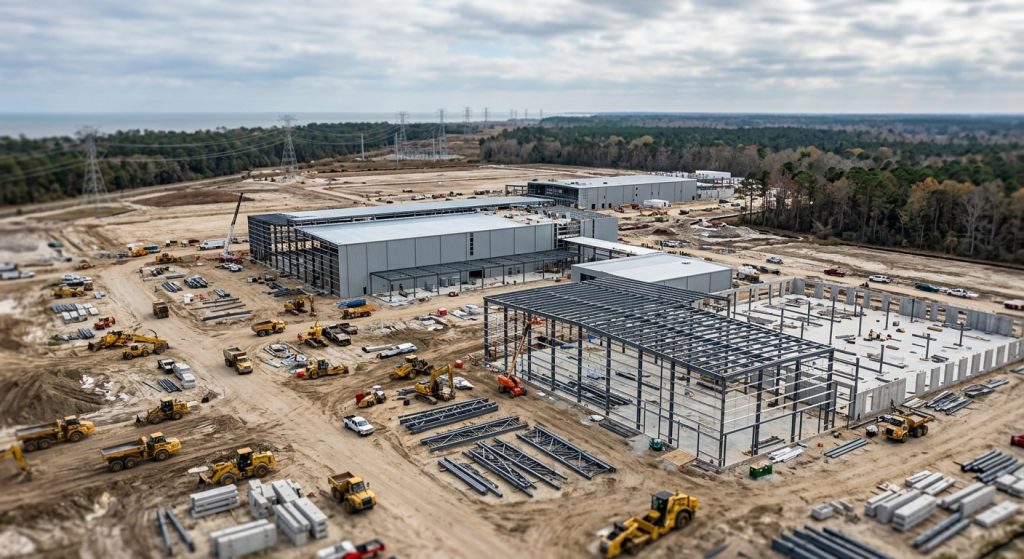
OpenAI said it will invest $20 billion to build a 3.2-gigawatt data center campus in Effingham County, Georgia, in what the company described as its first ground-up data center project that it is designing and building itself. The commitment, announced this week, ranks among the largest single real estate and infrastructure projects tied to the artificial intelligence buildout and underscores how AI compute demand is reshaping industrial land markets far from traditional tech hubs.
The project, called Project Camellia, adds to a wave of hyperscale data center announcements that has turned rural and exurban industrial sites into some of the most sought-after real estate in the country. OpenAI’s own Stargate venture with Oracle and SoftBank has already committed roughly $500 billion toward AI infrastructure across sites in Texas, New Mexico and the Midwest, according to OpenAI. The Georgia project marks a shift toward OpenAI acting as its own developer rather than leasing capacity from data center operators, a structure that real estate investors have increasingly watched as AI companies move deeper into land acquisition and vertical development.
According to OpenAI’s announcement, the campus will sit on roughly 1,400 acres within the 2,600-acre Savannah Gateway Industrial Hub near Rincon, about 45 minutes from Savannah. OpenAI said the buildout calls for four data center structures of approximately 720,000 square feet each, with a maximum building height of 35 feet.
OpenAI said it has signed a 25-year power agreement with Georgia Power for 3.2 gigawatts of capacity, to be delivered in phases between 2028 and 2032 — enough electricity, the company said, to serve more than 2 million homes. OpenAI said it will also provide up to 1 gigawatt of flexible demand-response capacity to help the utility manage grid load, and that it will pay the full cost of the infrastructure and electric-service upgrades required to serve the site, so existing Georgia Power customers would not subsidize the project. The company said the facility will use a closed-loop water recirculation system designed to keep ongoing water consumption comparable to that of a typical office building.
OpenAI said the campus is expected to open in 2028 with about 400 permanent operations, maintenance and security jobs, scaling toward 1,000 by 2032, alongside thousands of temporary construction positions the company said will prioritize local contractors. As part of the deal, OpenAI said it committed $80 million to a community benefits fund covering local schools, public safety, health care and workforce training, plus up to $71 million in credits for its Codex coding software at Georgia colleges and technical schools. Local officials have also approved a 50% property tax abatement for the project over 15 years, according to CommercialSearch, which reported that Effingham County expects the campus to become its largest taxpayer.
What it means
For real estate and land markets, the Georgia deal is a concrete data point in the broader repricing of industrial land near utility infrastructure. A single campus absorbing 1,400 acres and 3.2 gigawatts of contracted power signals that site selection for AI-scale data centers now hinges as much on transmission capacity and utility willingness to build new generation as on land cost or proximity to population centers. That dynamic has already pushed developers and hyperscalers toward secondary industrial corridors — like the Savannah Gateway hub — that combine large contiguous parcels with existing rail, fiber and power infrastructure.
The tax abatement and community benefits structure OpenAI negotiated also offers a template other AI developers and local governments are likely to reference as more mega-campuses compete for sites. RealtyWire’s analysis of recent hyperscale filings suggests power-purchase agreements of this scale, tied to multiyear phased delivery, are becoming standard deal architecture for any site large enough to host gigawatt-class compute — a factor commercial land brokers and utility planners are increasingly building into industrial site valuations.
What to watch
Key milestones ahead include local permitting and site-plan approvals for the four buildings, environmental and water-use review tied to the closed-loop cooling system, and whether Georgia Power’s transmission upgrades stay on pace with the 2028-2032 phased power delivery schedule. Construction execution — and whether OpenAI’s $20 billion figure holds or grows, as some outside estimates suggest it could exceed $30 billion at full buildout — will also shape how the project is judged against other AI infrastructure commitments nationally.
Related coverage: Google Named End User of 8 Million-Square-Foot Data Center Project in Columbia, Georgia · Digital Realty Trust Posts Strong Q2 2026 Earnings as AI Data Center Demand Surges · 2-Gigawatt Data Center Project Advances in Texas