Digital Realty Trust (NYSE: DLR) reported second-quarter 2026 results that topped Wall Street expectations, posting record core funds from operations per share as demand for data center capacity tied to artificial intelligence workloads continued to accelerate. The real estate investment trust also raised its full-year 2026 guidance, citing strong leasing activity and an expanding development pipeline.
The results were disclosed July 23, 2026 in a press release and a Form 8-K filed with the Securities and Exchange Commission. They illustrate how AI-driven compute demand is reshaping one of commercial real estate’s fastest-growing sectors. Data center landlords like Digital Realty lease space, power and cooling infrastructure to cloud providers, enterprises and increasingly to companies training and running AI models — a shift that has pushed rents, occupancy and construction activity higher across the industry.
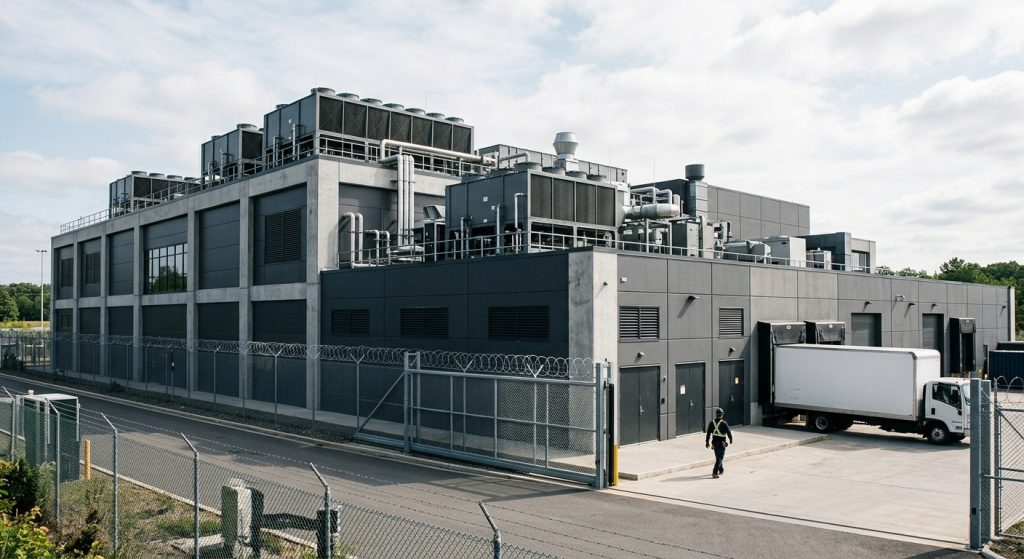
Digital Realty owns and operates one of the largest data center platforms globally, with 310 facilities — including 89 held through unconsolidated joint ventures — and roughly 3,102 megawatts of IT load capacity across more than two dozen countries. The company leases space to hyperscale cloud operators, enterprises and, increasingly, AI infrastructure customers that require large, power-dense facilities to train and run machine learning models. For real estate readers, that demand is a key driver of industrial land values and power infrastructure investment in markets from Northern Virginia to Malaysia.
For the quarter ended June 30, 2026, Digital Realty reported total revenue of $1.924 billion, up 18% from the first quarter and 29% higher than the same period a year earlier, according to the earnings release. Net income available to common stockholders was $443.1 million.
Funds from operations (FFO), a standard REIT profitability measure that adds back real estate depreciation, came in at $2.73 per share. Core FFO per share, excluding net promote income, was $2.13 — a figure the company described as a quarterly record.
Portfolio occupancy stood at 90.2%, while same-capital occupancy, a measure that strips out recently acquired or developed assets, was 92.5%. Renewal leases signed during the quarter carried cash-basis rent increases of 25.4%, the company said.
Digital Realty signed $307 million of new bookings, measured as annualized GAAP base rent on a 100%-ownership basis, during the quarter, with $208 million attributable to the company’s own share of joint ventures. Total leasing backlog — signed deals not yet commenced — reached $1.9 billion at 100% share and $1.4 billion at the company’s share, which the company called a record.
Among the quarter’s larger transactions, Digital Realty disclosed a $475 million acquisition of powered land in the Kansas City metro area, a $134 million expansion of its Malaysia data center footprint, and a deal valuing a 64% stake in a Northern Virginia hyperscale campus at $3.5 billion.
Citing the results, Digital Realty raised its full-year 2026 guidance. The company now expects core FFO per share, excluding net promote income, of $8.15 to $8.20, up from its prior outlook. Total revenue guidance for 2026 was raised to a range of $6.85 billion to $6.95 billion, and adjusted EBITDA guidance was increased to $3.75 billion to $3.85 billion. Digital Realty also guided to 75 to 125 basis points of portfolio occupancy improvement by year-end.
“Digital Realty delivered record Core FFO per share in the quarter, reflecting robust customer demand and strong execution across our core pillars of growth,” Andrew P. Power, the company’s president and chief executive officer, said in the earnings release. That statement reflects management’s own characterization of the results, not independently verified analysis.
What it means
The verified facts are straightforward: Digital Realty’s revenue, FFO and occupancy metrics all rose from the prior quarter and prior year, and the company raised its own full-year guidance in a public SEC filing. Those figures come directly from the company’s earnings release and 8-K exhibit and are not in dispute.
Management’s framing — that results reflect “robust customer demand” — is an attributed statement from a Digital Realty executive, not an independently audited causal claim. It is consistent with broader industry trends toward power-dense data center leasing, but readers should treat it as company commentary rather than verified fact.
RealtyWire’s analysis: the scale of the Northern Virginia and Kansas City transactions, both tied to hyperscale and powered-land acquisitions, suggests Digital Realty is positioning its balance sheet for continued large-block leasing rather than smaller retail colocation deals — a trend likely to keep bidding pressure on power-ready industrial and data center sites in major U.S. markets. For readers tracking broader commercial real estate trends, data center demand remains one of the few segments posting double-digit rent growth in 2026.
What to watch
Digital Realty’s next quarterly results, expected in late October 2026, will show whether the raised guidance holds and whether bookings momentum continues at the pace seen in the second quarter. Investors and real estate observers will also watch whether the $1.9 billion leasing backlog converts to revenue on schedule, and whether power availability constraints in key markets slow the pace of new development starts. Continued real estate earnings coverage will track how other data center REITs perform against Digital Realty’s benchmark this earnings season.
Related coverage: OpenAI Unveils $20 Billion Data Center Development Plan · 2-Gigawatt Data Center Project Advances in Texas · Google Named End User of 8 Million-Square-Foot Data Center Project in Columbia, Georgia