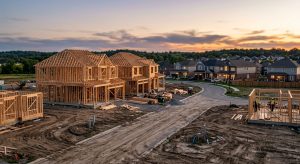
Americans put homes up for sale in late August at the fastest pace in four years, but buyers were in no hurry to snap them up — a mismatch that is steadily tilting the housing market in buyers’ favor. New listings rose 8% from a year earlier to their highest level since August 2022, while pending sales fell 2.5%, according to Redfin data for the four weeks ending Aug. 30.
The result is a market with more choice and less urgency. Active listings totaled just over 1.5 million, up 2.4% year over year, and the supply of homes for sale climbed to four months, up from 3.7 a month earlier. A reading above roughly six months traditionally signals a buyer’s market; the national figure is still below that, but the trend line has been moving steadily in buyers’ direction all summer.
Rates back near 7%
The soft demand tracks closely with borrowing costs. Redfin’s weekly average 30-year fixed mortgage rate was 6.66%, and its daily measure hit 6.91% on Sept. 2, up from 6.56% a year earlier. At that level, the median monthly mortgage payment reached $2,592, about 0.7% higher than a year ago even as price growth has cooled.
Purchase demand is treading water. Mortgage-purchase applications rose 2% week over week but were essentially flat, down 0.2%, from a year earlier. Google searches for “homes for sale” were down 13% from a month earlier and 6% year over year, though in-person home tours were up 7% from the start of the year — a sign that the shoppers who remain are still active.
Prices flatten as sellers give ground
Price gains have downshifted. The median U.S. sale price was $398,632, up 2.2% from a year earlier, but the median asking price slipped 0.1% year over year — a rare decline that shows sellers recalibrating to a cooler market. Nearly 21% of listings carried a price cut, up from 20.2% a month earlier, and the typical home took 45 days to sell.
The competitive signals were mixed. About 25.9% of homes sold above their list price, up slightly, and the average sale-to-list ratio ticked up to 98.7%, indicating that well-priced, move-in-ready homes in desirable areas still draw offers even as the broader market softens.
A widening gap between metros
National averages continue to mask sharp regional splits. The strongest annual price growth came in San Francisco (+9%), West Palm Beach, Fla. (+8.1%), Cincinnati (+7.8%), Milwaukee (+7.4%) and Pittsburgh (+7.4%). The steepest declines were concentrated in pandemic-era boomtowns and the Pacific Northwest: Austin, Texas (-7.1%), Seattle (-6.2%), Fort Worth, Texas (-1.9%), San Jose, Calif. (-1.7%) and Orlando, Fla. (-1.4%).
The supply surge was similarly uneven. New listings jumped most in San Jose (+29.4%), Boston (+26.1%), Nashville, Tenn. (+21.5%), Seattle (+16.9%) and Philadelphia (+14%). On the demand side, pending sales fell hardest in Seattle (-15.1%), San Diego (-14.2%), Denver (-13.5%) and Houston (-13%) — the same Sun Belt and Western markets where inventory has been building fastest.
That divergence echoes a pattern RealtyWire has tracked all year, including a stark split between San Francisco and Seattle as tech-sector wealth reshapes coastal demand.
What it means
The core story is a durable one: supply is rebuilding faster than demand, and rates near 7% are keeping a lid on both prices and sales. For buyers who can afford today’s payments, the combination of more listings, longer marketing times and more frequent price cuts adds up to real negotiating leverage — the strongest in years across much of the country.
For sellers, the message is that pricing discipline now matters more than it has in some time; the market is rewarding realistic list prices and punishing aspirational ones with price drops and stale listings. These are Redfin’s proprietary figures, drawn from multiple-listing-service data and the company’s rate tracker, and they capture late-August activity, historically one of the slower stretches of the year.
What to watch: whether the autumn typically brings a seasonal pickup in demand, and where mortgage rates head next. The trajectory has broadly matched other recent readings showing a pullback in pending sales and a record-low buyer count even as inventory grows. More coverage is on RealtyWire’s housing market page.