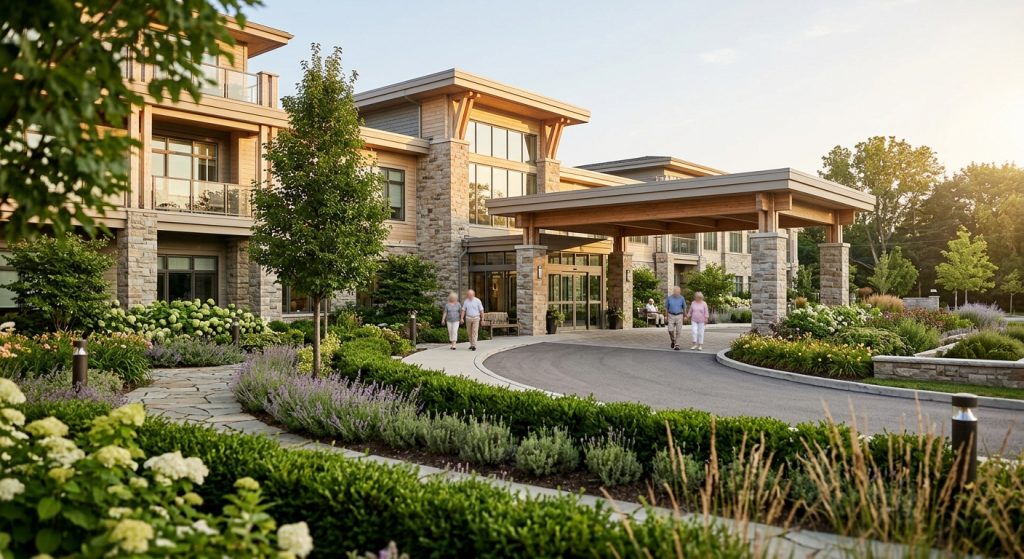
American Healthcare REIT has closed the first and largest piece of its Kensington Senior Living portfolio purchase, taking ownership of six luxury communities for roughly $572 million and formalizing what both companies describe as a long-term operating partnership rather than a one-time trade.
The Irvine, Calif.-based REIT (NYSE: AHR) announced the closing on Sept. 1 in a press release filed with the Securities and Exchange Commission. The six communities hold 464 units. They are part of an eight-community, 745-unit portfolio carrying an aggregate contract purchase price of about $873 million — a price the company said is well below replacement cost.
RealtyWire reported the underlying agreement last month, when AHR disclosed the $873 million deal for all eight Kensington communities across three separate purchase agreements. The two remaining communities are under definitive purchase agreements and are expected to close in the fourth quarter, subject to specified closing conditions.
With the Kensington closings, AHR said its year-to-date investments now exceed $2 billion. Its awarded investment pipeline stands at more than $675 million, which the company expects to fund with match-funded equity proceeds from unsettled forward agreements — a reference to the $712 million forward stock offering it priced in August for a then-unnamed senior housing acquisition.
Assisted living and memory care in constrained markets
The portfolio is concentrated in higher-acuity senior housing rather than independent living: roughly 93% of the units are dedicated to assisted living and memory care, and Kensington purpose-built seven of the eight communities.
The properties sit in the Los Angeles, San Francisco Bay Area, Washington, D.C., and New York metropolitan areas — infill submarkets that AHR characterized as affluent and supply-constrained, with scarce developable land, restrictive zoning and long entitlement and construction timelines.
“We are acquiring Class A, luxury senior housing that is extraordinarily difficult to replicate, in some of the most affluent and supply-constrained markets in the country, but the strategic value extends well beyond these eight communities,” said Jeff Hanson, chairman and chief executive officer.
Gabe Willhite, president and chief operating officer, put a number on that scarcity: “Kensington operates highly differentiated communities in markets where new competitive supply can require five to eight years from concept to delivery, assuming an appropriate site can be assembled and entitled at all.”
Kensington will continue operating the communities after each closing. The company was founded by senior housing executives with more than 30 years in the industry, including previous leadership at Sunrise Senior Living.
Not the highest bid
How the deal was sourced is an unusual detail. AHR said the opportunity came through a limited-channel marketing process rather than a broadly marketed auction, with Kensington — as both owner and operator — controlling the process and weighing capital partners on factors beyond price.
“When we decided to pursue a transaction, our objective was not simply to maximize price,” said Dave Faeder, founding managing partner of Kensington Senior Living. “We were primarily seeking the best long-term strategic partner for Kensington, and we chose AHR. They were not the highest bidder.”
Faeder said the conversations began with alignment on resident care quality and employee culture. Chief Investment Officer Stefan Oh framed it similarly: “Our strategy is not to accumulate buildings. It is to scale an integrated operating platform.”
A new finance chief from Public Storage
The day after the closing, AHR named a new chief financial officer. In a Sept. 2 filing, the company said Aric Chang will become CFO effective Oct. 1, succeeding Brian Peay, who is retiring after a decade in the role. Peay will serve through Sept. 30 and then continue as a non-employee consultant through April 15, 2027. The filing states his retirement is not the result of any disagreement with the company.
Chang, 47, joins from Public Storage, where he is chief financial officer, real estate, and has overseen approximately $16 billion of capital deployment. He previously held senior finance roles at Rexford Industrial and Rouse Properties and spent 2015 to 2022 at J.P. Morgan Asset Management as an executive director on a real estate platform with more than $80 billion in assets. His package includes a $500,000 base salary, a target bonus of 100% of salary pro-rated for 2026, a $1 million target annual equity award beginning in 2027, and a $310,000 cash inducement payment.
What it means
The verified facts are the closing, its size and the pipeline figures AHR disclosed. The characterizations — “well below replacement cost,” the supply-constrained framing, the durability of the partnership — are the companies’ own, and two communities have yet to close.
As analysis, the sequencing is the interesting part. AHR raised equity in August against an acquisition it would not then name, and has now deployed it, crossing $2 billion of investment for the year. That is a REIT converting a capital raise into owned assets inside a single quarter, in a sector where the constraint is usually finding sellers rather than finding money. Faeder’s comment that AHR was not the highest bidder is a self-interested statement from the seller, but if accurate it supports a long-running industry argument: in operator-dependent property types, the buyer’s platform can outweigh the last dollar of price.
What to watch is the fourth quarter, when the final two communities are scheduled to close, and AHR’s next earnings report, which will show whether the year’s acquisitions extend a streak of double-digit same-store net operating income growth that reached ten consecutive quarters at midyear. Additional coverage of REIT transactions is collected on our Commercial Real Estate page, including CareTrust REIT’s push past $1.5 billion of 2026 investments.