
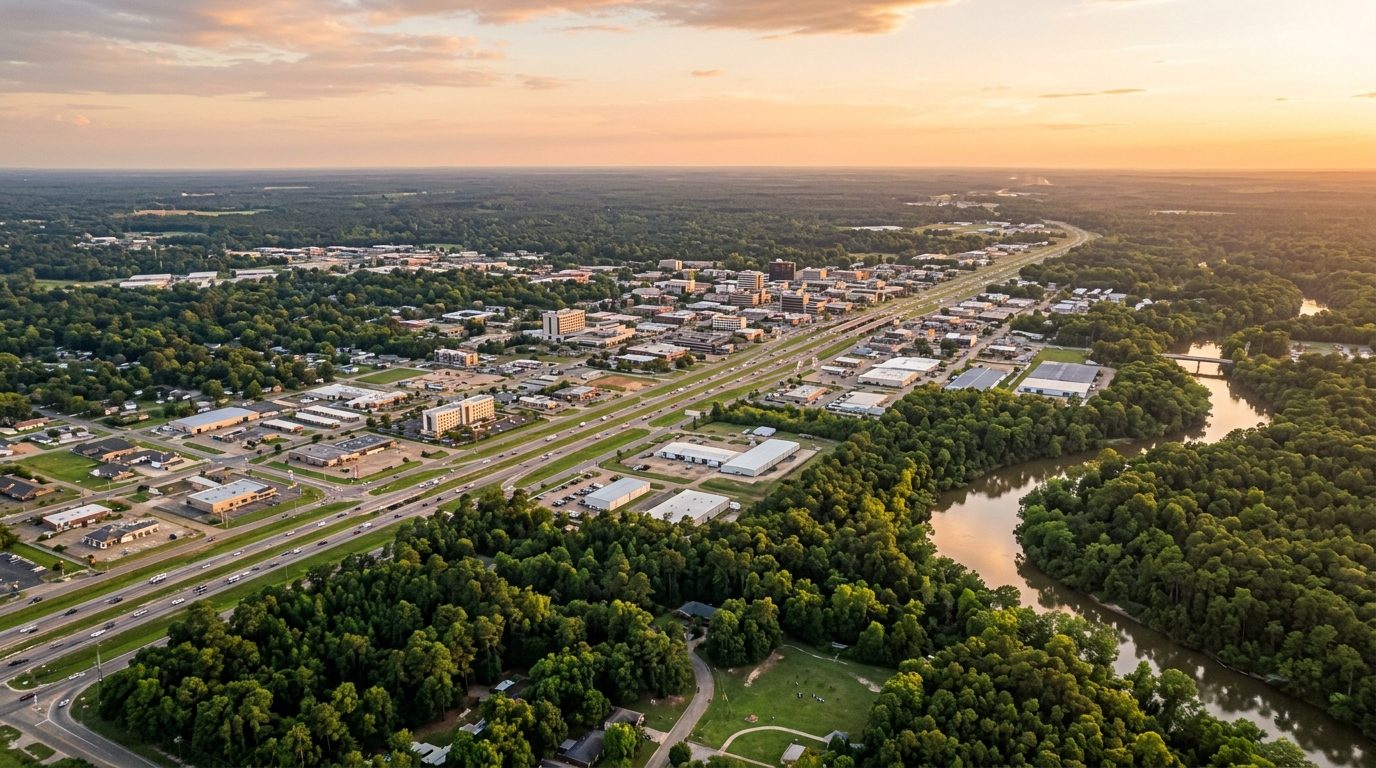
Current real estate market data, news and analysis for the Texarkana, TX-AR metropolitan area — 146,816 residents across Bowie, TX, Little River, AR and Miller, AR counties.
Data as of May 2026. Sources: Redfin Data Center, U.S. Census Bureau.
Latest Texarkana Real Estate News
Coverage of this market is coming soon. Browse all housing market news.
Texarkana Real Estate Market Overview
Texarkana is split by the state line itself, with Texarkana, Texas and Texarkana, Arkansas forming one built-up urban core sharing streets and shopping corridors while a landmark straddles the border. The metro reaches into rural Bowie County on the Texas side and Miller and Little River counties on the Arkansas side, taking in smaller towns such as Ashdown, De Kalb, Hooks, Nash, New Boston, and Wake Village, plus rural communities like Fouke and Garland. The land is flat to gently rolling Piney Woods terrain, threaded by the Red River and Sulphur River and covered in pine and hardwood forest, shaping the wooded-lot feel of local subdivisions. Housing stock runs from older brick and frame homes in established neighborhoods to newer subdivisions on the growing edges, with manufactured housing common in the smaller towns.
Within Texarkana, Texas, the western and southwestern side of the city, including the Pleasant Grove area, is generally regarded as the higher-tier residential area, favored for larger, newer homes and planned subdivisions. Close-in, older neighborhoods nearer downtown, such as the Rose Hill area, offer historic architecture and mixed-condition housing spanning restored to deferred-maintenance, keeping entry prices lower even where lot sizes and tree cover are attractive. The Arkansas side of the twin city tends to trade at a lower tier, reflecting housing age but also the fact that Arkansas levies a state income tax while Texas does not, tilting buyer demand toward the Texas side. Outlying towns like Ashdown and New Boston offer a rural alternative with larger lots, while De Kalb, Hooks, and Fouke sit at the affordable end, valued for acreage and school loyalty over job proximity.
The economy is anchored by defense and heavy manufacturing. Red River Army Depot, an Army maintenance and overhaul installation for tactical vehicles west of the city, is the region’s largest employer and has drawn defense partners, including Lockheed Martin, onto its footprint and the neighboring TexAmericas Center, an industrial park redeveloped from former ammunition-plant land. Health care is another pillar, led by CHRISTUS St. Michael Health System, which runs hospitals on both sides of the metro after absorbing the former Wadley Regional Medical Center. Manufacturers including Cooper Tire & Rubber, Domtar, and Graphic Packaging International round out the base, alongside logistics tied to the crossing of Interstate 30. Public education, government, and Texas A&M University-Texarkana add stable employment, giving the metro a more industrial character than comparably sized Southern metros built around retail and hospitality.
Because the metro sits on the Texas-Arkansas line, buyers should note which side of the border a property sits on before assuming anything about taxes or schools. Texas has no state income tax but leans on property taxes for schools and local government, while Arkansas collects a state income tax and generally carries lighter property tax bills, so ownership costs can differ between neighboring homes on opposite sides of the line. The region is prone to severe thunderstorms, tornadoes, and winter ice storms, making wind and hail coverage standard in insurance shopping; flood risk should be checked near the Red River, Sulphur River, and their tributaries. The metro is car-dependent with no meaningful transit outside the core, and development has spread along highway corridors. Buyers should confirm the city, county, state, school district, floodplain status, and utility service for any listing.
Cities and Towns in the Texarkana Metro Area
Notable Communities and Neighborhoods
Texarkana Real Estate Market FAQ
How is the Texarkana housing market organized across the state line?
The metro is built around twin core cities, Texarkana, Texas and Texarkana, Arkansas, that share a downtown and street grid but are separately incorporated, so the same neighborhood can carry different city services, tax rules, and school districts depending on which side of the line a parcel falls on. Beyond the twin cities, the market fans out into smaller Texas-side towns in Bowie County and Arkansas-side towns in Miller and Little River counties, each with its own more rural character.
Which parts of the metro tend to carry higher prices, and why?
The western and southwestern side of Texarkana, Texas, including the Pleasant Grove area, generally commands the highest prices, reflecting newer construction, larger lots, and planned subdivisions along with proximity to newer retail corridors. Older, close-in neighborhoods nearer downtown trade lower due to age and mixed condition, and the Arkansas side of the twin city tends to price below comparable Texas-side homes, a gap tied partly to Arkansas’s state income tax pulling relative demand toward the no-income-tax Texas side.
What should buyers verify locally before purchasing in this metro?
Confirm exactly which city, county, and state a listing sits in, since the metro straddles a state line and municipal boundaries do not always match popular neighborhood names. Also verify the assigned school district, floodplain status relative to the Red River, Sulphur River, and local creeks, whether the property uses municipal water and sewer or well and septic, and whether it lies inside city limits for zoning and building-code purposes.
What is a region-specific risk buyers should understand?
Because the metro sits on the Texas-Arkansas border, otherwise similar homes a short distance apart can carry different tax exposure: Texas relies more heavily on property taxes with no state income tax, while Arkansas collects income tax and typically has lighter property tax bills, so total ownership cost depends on which side of the line a home is on. Severe weather is the other standing risk, since the region is prone to tornadoes, damaging thunderstorms, and occasional ice storms, which makes wind and hail insurance terms worth reviewing closely rather than assuming standard coverage applies.
Nearby Markets