
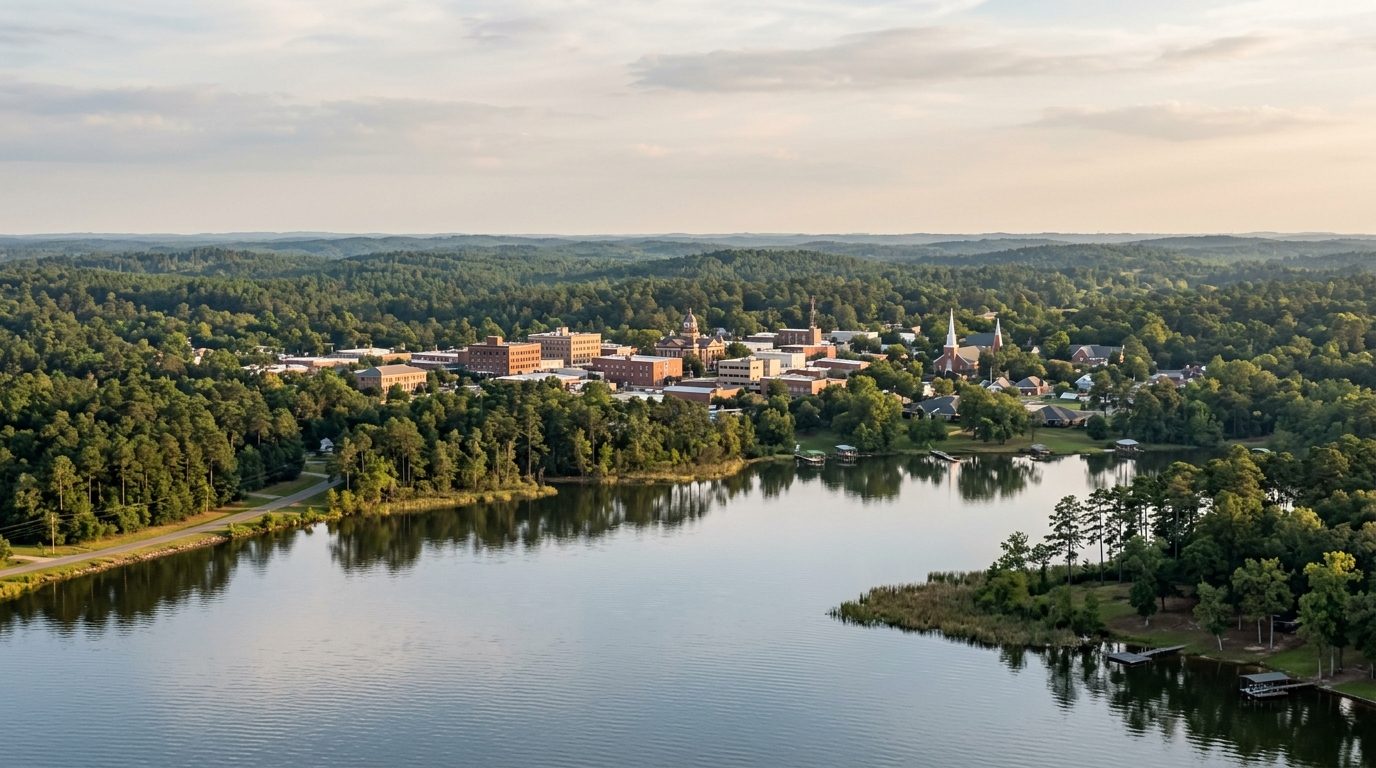
Current real estate market data, news and analysis for the Longview, TX metropolitan area — 297,315 residents across Gregg, Harrison, Rusk and Upshur counties.
Data as of May 2026. Sources: Redfin Data Center, U.S. Census Bureau.
Latest Longview Real Estate News
Coverage of this market is coming soon. Browse all housing market news.
Longview Real Estate Market Overview
The Longview metro sits in the Piney Woods of deep East Texas, a rolling, densely forested landscape of loblolly and shortleaf pine mixed with hardwoods, cut by bayous and creeks that feed the Sabine River system and reservoirs such as Lake o’ the Pines. Gregg County anchors the core around Longview and Kilgore, with Harrison County (Marshall) toward the Louisiana line, Rusk County (Henderson) to the south, and Upshur County (Gladewater and the Lake o’ the Pines shoreline towns) to the north. Housing stock reflects a metro built in successive waves: modest wood-frame and brick ranch houses from the mid-20th-century oil-boom era anchor close-in neighborhoods in Longview, Marshall, and Kilgore, while newer subdivisions have filled in along growth corridors north and west of Longview and around Hallsville. Rural and semi-rural parcels with acreage are common throughout the four counties, and lake-oriented cabins cluster around Lake o’ the Pines.
Within Longview, the western and northern parts of the city, including the Judson Road corridor toward Hallsville and the annexed Spring Hill area, generally sit in a higher price tier, reflecting newer construction, larger lots, and proximity to shopping along Loop 281 and US 259. The Longview Country Club area, built around the city’s semi-private golf course, is a long-established higher-end pocket. Older neighborhoods closer to downtown Longview and in central Kilgore and Marshall tend to be more affordable, with smaller homes dating to the oil-boom and postwar decades. Hallsville and White Oak, just outside Longview, draw buyers seeking newer homes and their own independent school districts, supporting firmer pricing than surrounding smaller towns. Gladewater, Henderson, and the smaller unincorporated communities generally offer more affordable entry points, though waterfront property around Lake o’ the Pines carries its own premium.
The region’s economic identity is inseparable from the East Texas Oil Field, discovered near Henderson and centered under Gregg County; oil and gas extraction remain part of the economy today. Manufacturing is a major employment base, led by Eastman Chemical Company’s large integrated plant in Longview, alongside employers such as Komatsu and Trinity Rail. Health care is a leading sector, anchored by CHRISTUS Good Shepherd Health System, which operates hospitals in Longview and Marshall. Higher education adds stability: LeTourneau University and Kilgore College are based in Longview and Kilgore respectively. Blue Cross and Blue Shield of Texas runs an administrative center in Marshall, and timber remains part of the rural economy.
Texas has no state income tax, so property taxes carry more of the load for local government and schools, and burdens vary by city, county, and school district, worth checking before purchase. Flood risk is localized: land near creeks, bayous, the Sabine River, and the Lake o’ the Pines shoreline can fall inside mapped floodplains, so a FEMA flood-zone check is worth obtaining. The region is also subject to severe thunderstorms, occasional tornadoes, and periodic ice storms, which can affect insurance cost. Public transit is minimal and the metro is car-dependent, though Amtrak’s Texas Eagle serves Longview and Marshall. County areas outside city limits often sit outside municipal zoning, so buyers looking at unincorporated parcels should verify septic, well, and road-maintenance status with the county. The metro sits roughly two hours from both Dallas-Fort Worth and Shreveport, keeping the market locally driven rather than shaped by commuter demand.
Cities and Towns in the Longview Metro Area
Notable Communities and Neighborhoods
Longview Real Estate Market FAQ
How is the Longview metro area organized geographically for housing purposes?
The metro spans four counties in the East Texas Piney Woods: Gregg County (Longview, Kilgore), Harrison County (Marshall), Rusk County (Henderson), and Upshur County (Gladewater and the Lake o’ the Pines area). Longview functions as the metro’s commercial and employment hub, with the other cities and numerous smaller towns and unincorporated communities forming a ring of more independent, small-town markets around it, each with its own school district and, in many cases, its own city government and zoning.
Which parts of the Longview area tend to be pricier, and why?
Newer subdivisions in western and northern Longview, the Judson Road corridor toward Hallsville, the Spring Hill area, and the established Longview Country Club neighborhood tend to sit at the higher end, reflecting newer construction, larger lots, and access to retail corridors. Hallsville and White Oak, both close to Longview but with their own school districts, also support firmer pricing than more distant small towns. Older, close-in neighborhoods in downtown Longview, central Kilgore, and central Marshall, along with rural and outlying communities, tend to be more affordable.
What should a buyer verify before purchasing in this area?
Confirm which city, county, and independent school district a property sits in, since property tax rates and services vary by jurisdiction. For land outside city limits, verify septic system, well water, private road maintenance, and any deed restrictions directly with the county, since unincorporated areas may lack municipal zoning or utilities. Also check the specific flood zone for any property near a creek, bayou, the Sabine River, or Lake o’ the Pines, and confirm whether flood insurance would be required or advisable.
What is the main region-specific risk buyers should be aware of?
Localized flood exposure along waterways and the Lake o’ the Pines shoreline is the most property-specific risk, since flood zones can vary block by block rather than applying metro-wide. More broadly, the region is prone to severe thunderstorms, occasional tornadoes, and periodic winter ice storms, all of which are worth factoring into insurance planning regardless of where in the metro a property sits.
Nearby Markets