
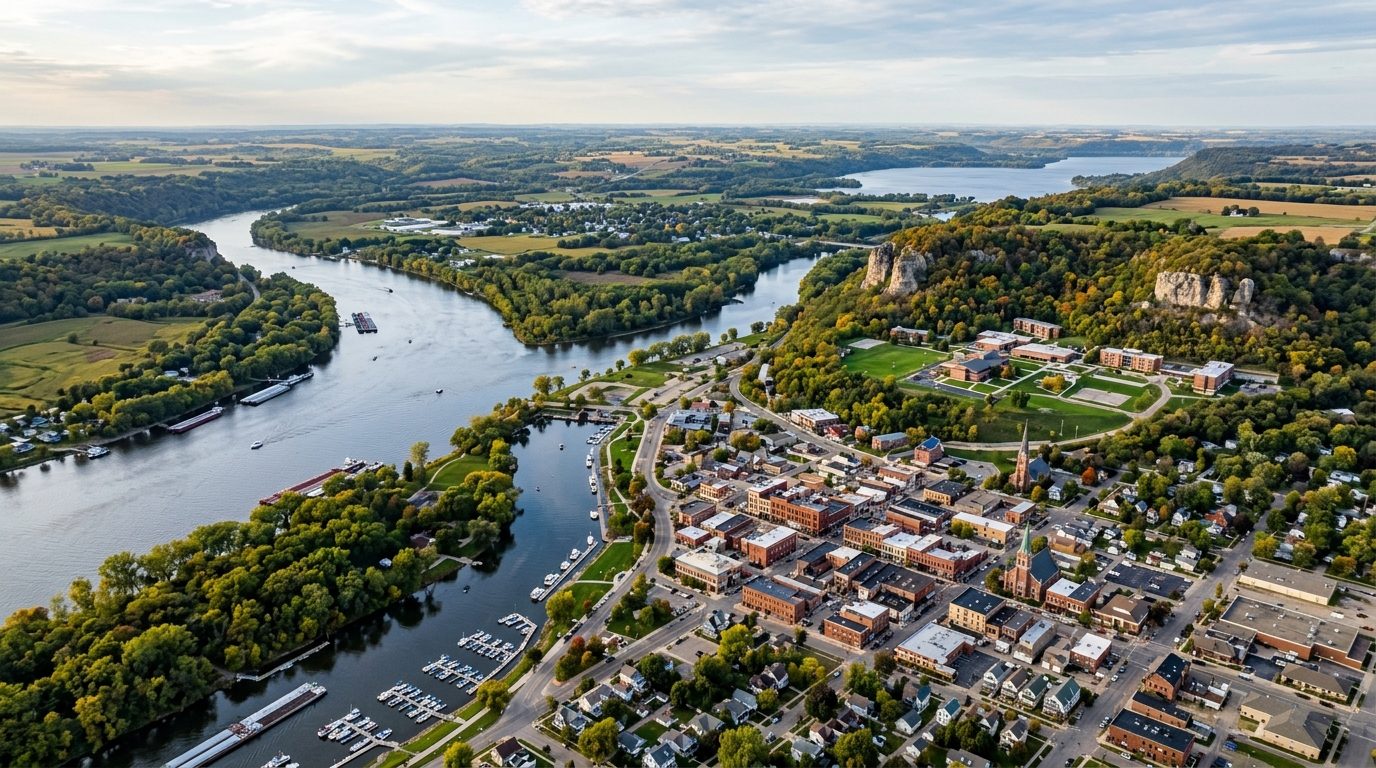
Current real estate market data, news and analysis for the Mankato, MN metropolitan area — 104,907 residents across Blue Earth and Nicollet counties.
Sources: U.S. Census Bureau.
Latest Mankato Real Estate News
Coverage of this market is coming soon. Browse all housing market news.
Mankato Real Estate Market Overview
The Mankato area sits at the confluence of the Minnesota and Blue Earth rivers, and that river valley setting shapes the physical character of the region. Mankato and North Mankato occupy a valley bottom framed by limestone bluffs, so older housing clusters near downtown on lower ground while newer construction climbs the bluff tops on both sides of the river. Surrounding the urban core is a ring of small lake towns and farm communities: some, like Eagle Lake and Madison Lake, are organized around recreational lakes, while others remain working agricultural centers. St. Peter, upriver in Nicollet County, carries its own small-college character. Housing stock ranges from early twentieth-century valley homes to newer bluff-top subdivisions and rural farmsteads on acreage rather than platted lots.
Price tiers generally track topography and proximity rather than any single factor. Homes on or near the region’s recreational lakes, especially Eagle Lake and Madison Lake, tend to command a premium because water access is a scarce, non-replicable amenity locally. Within Mankato and North Mankato, bluff-top neighborhoods and newer upper-terrace development typically sit above the older, flatter river-valley sections, reflecting both lower flood exposure and newer housing stock on larger lots. Proximity to Minnesota State University, Mankato and to downtown Mankato supports values in the surrounding older neighborhoods as well, even though those homes tend to be smaller and older. Outlying farm towns across Blue Earth and Nicollet counties are generally more affordable, reflecting distance from regional job centers and a housing stock weighted toward older farmhouses rather than new construction.
The regional economy centers on education and healthcare alongside manufacturing and agriculture. Minnesota State University, Mankato is the area’s largest single employer and shapes housing demand near campus, while Gustavus Adolphus College gives St. Peter a comparable small-college economy. Mayo Clinic Health System operates a major hospital and clinic network based in Mankato, and Taylor Corporation, a printing and marketing services company headquartered in North Mankato, is among the region’s largest private employers. Manufacturing is represented by firms such as Nidec Kato Engineering, and agribusiness, including large livestock operations such as Christensen Farms, remains central to the surrounding farm towns. South Central College adds workforce training, and a regional Walmart distribution center and area school districts are also major employers. This mix gives the metro a more diversified base than many similarly sized Minnesota communities.
Winters are long and cold with regular snow, and summers are warm and humid, worth planning for when budgeting heating and home maintenance costs. The Minnesota and Blue Earth rivers have flooded the valley repeatedly over the past century, and Mankato and North Mankato are now protected by a permanent levee and floodwall system built after past major flood events; buyers should still confirm a property’s flood zone status, especially outside the protected core or along smaller tributaries. The partial failure of the aging Rapidan Dam upstream on the Blue Earth River in recent years underscores that river infrastructure nearby is old and worth asking about for any property near the waterway. Property tax rates and zoning rules vary by county and by whether a parcel sits within city limits, a township, or unincorporated farmland, so buyers should check with the relevant county assessor, and rural buyers should verify well, septic, and agricultural zoning restrictions before closing.
Cities and Towns in the Mankato Metro Area
Notable Communities and Neighborhoods
Mankato Real Estate Market FAQ
How is the Mankato-area housing market organized geographically?
The market splits between the urbanized river valley core of Mankato and North Mankato, a handful of small lake towns built around area lakes, the college town of St. Peter upriver on the Minnesota River, and a ring of outlying farm communities spread across Blue Earth and Nicollet counties. Each area has its own housing character, from tight, walkable in-town blocks near downtown and campus to acreage and farmstead properties on the surrounding prairie.
Which areas tend to be pricier, and why?
Lakefront and lake-view property around Eagle Lake and Madison Lake tends to carry a premium because direct water access is limited and cannot be replicated elsewhere in the region. Within Mankato and North Mankato, bluff-top neighborhoods and newer upper-terrace subdivisions generally command more than older valley-floor housing, reflecting both lower flood exposure and newer construction, while walkable proximity to Minnesota State University and downtown Mankato also supports values in older, established neighborhoods.
What should buyers verify locally before purchasing?
Buyers should confirm a property’s flood zone status and any history of water intrusion, check with the relevant county assessor on property tax rates since they vary by county and by jurisdiction, and for rural or small-town properties verify well and septic system condition along with any agricultural zoning restrictions that could limit future use or subdivision.
What is the region’s main natural-hazard consideration?
The Minnesota and Blue Earth rivers have flooded the valley repeatedly over the area’s history, and while Mankato and North Mankato are now protected by a levee and floodwall system built after past flood events, older river infrastructure upstream, including the aging Rapidan Dam on the Blue Earth River, has shown signs of strain in recent years. Buyers should ask about a specific property’s flood history and its relationship to the levee-protected zone, particularly for homes outside the urban core or along smaller creeks and tributaries.
Nearby Markets