
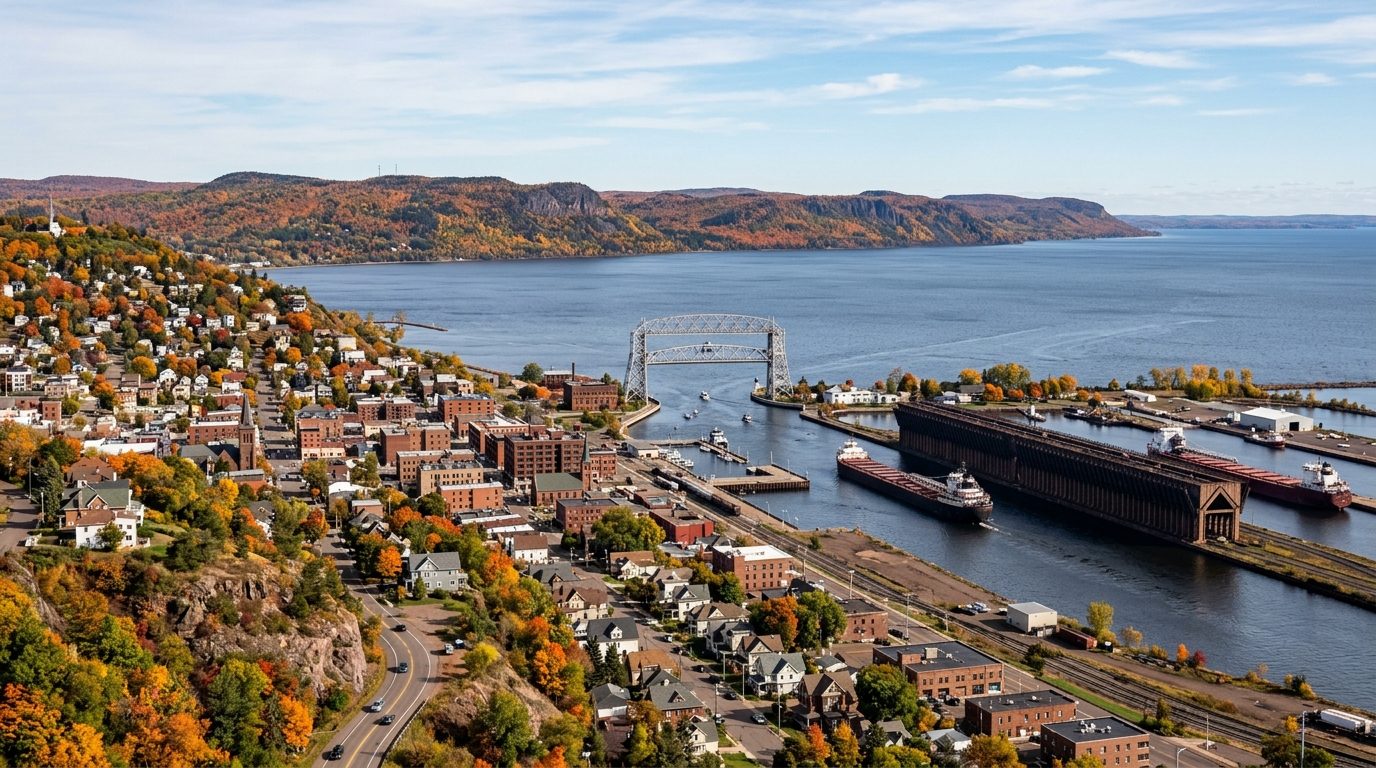
Current real estate market data, news and analysis for the Duluth, MN-WI metropolitan area — 281,219 residents across Carlton, MN, Douglas, WI and St. Louis, MN counties.
Sources: U.S. Census Bureau.
Latest Duluth Real Estate News
Coverage of this market is coming soon. Browse all housing market news.
Duluth Real Estate Market Overview
The Duluth, MN-WI metro sits at the western tip of Lake Superior, where hillside Duluth and its Wisconsin twin, Superior, face each other across the St. Louis River estuary. The metro extends along Carlton County toward Cloquet, north toward Two Harbors, and northwest toward the Mesabi Iron Range towns of Hibbing, Virginia, Chisholm, and Eveleth. Duluth is built on a steep, terraced hillside above the harbor, producing narrow lots and a housing stock dominated by early twentieth-century Craftsman bungalows, foursquares, and duplexes built for dockworkers and mill families, interspersed with larger Tudor and Colonial Revival homes on the east side built for shipping and mining executives. West Duluth carries similarly old, working-class housing tied to former rail yards and steel operations, and Superior mirrors this pattern. Iron Range towns were platted quickly during the mining boom and retain compact grids of small homes and postwar ramblers near former mine pits. Newer construction concentrates in suburban-fringe communities such as Hermantown and Proctor.
Within Duluth, the eastern neighborhoods along the shoreline and near the university and hospital campuses tend to command higher prices, reflecting lake views, mature tree canopy, walkable retail, and an association with the historic Congdon estate and its surrounding parks, which shaped early development for the city’s professional class. West Duluth, the Lincoln Park corridor, and the Central Hillside carry older, denser, more affordable housing tied to their industrial origins, though parts of the Hillside have seen renewed investment tied to arts and craft-business activity. Superior and the Iron Range communities are generally more affordable, reflecting smaller local economies, older housing, and distance from the lakefront and university anchors. Suburban-fringe communities trade lake proximity for newer construction and larger yards.
The regional economy centers on the Port of Duluth-Superior, the largest tonnage port on the Great Lakes, moving iron ore, coal, and grain and anchoring shipping and rail employment on both sides of the harbor. Healthcare is a major employer, led by Duluth-headquartered Essentia Health along with the St. Luke’s hospital system. Higher education contributes through the University of Minnesota Duluth, the College of St. Scholastica, and Lake Superior College. On the Iron Range, taconite mining remains central, with operations run by Cleveland-Cliffs and U.S. Steel supplying steelmakers. Petroleum refining also plays a role through the Superior refinery, and tourism tied to the shoreline and North Shore supplements the base.
The metro’s setting produces distinctive risks and costs. Lake-effect snow adds to winter totals in the hills above the harbor, and long, cold winters affect heating and maintenance costs. Duluth’s steep terrain and stormwater infrastructure have produced serious flash flooding in the past, so buyers should independently check flood mapping and drainage history for any property. On the Iron Range, mining’s legacy means buyers should ask about proximity to mine pits and subsidence history, and confirm well and septic condition, since many rural properties lack municipal water and sewer. Taxation also differs across the metro: taconite operations pay a state production tax in lieu of property tax, funding Iron Range cities and school districts. The metro straddles the Minnesota-Wisconsin line, so tax rates and zoning differ for similar properties in Duluth versus Superior. Growth has concentrated in suburban-fringe communities, and buyers should verify zoning, flood-zone status, insurance availability, and well and septic condition with local authorities before purchase.
Cities and Towns in the Duluth Metro Area
Notable Communities and Neighborhoods
Duluth Real Estate Market FAQ
How is the Duluth, MN-WI metro area organized geographically?
The metro spans two states around the western tip of Lake Superior. Duluth, Minnesota and Superior, Wisconsin form the urban core on either side of the St. Louis River harbor, often called the Twin Ports. The metro also extends south into Carlton County toward Cloquet, and northwest into St. Louis County toward the Mesabi Iron Range mining towns of Hibbing, Virginia, Chisholm, and Eveleth, which function as smaller, more self-contained communities distinct from Duluth proper.
Which parts of the metro tend to have higher home prices, and why?
Neighborhoods on Duluth’s east side along the Lake Superior shoreline and near the university and hospital campuses tend to be priced higher, reflecting lake views, mature landscaping, walkable amenities, and historic architecture. Newer suburban communities on the metro’s edge also carry a premium for new construction and larger lots. West Duluth, the city’s Hillside neighborhoods, Superior, and the Iron Range towns generally have older and more affordable housing stock tied to their industrial and mining origins.
What should buyers verify locally before purchasing in this metro?
Buyers should confirm whether a property relies on private well and septic systems, which are common in rural St. Louis County and Iron Range communities, and check municipal flood mapping and stormwater history for properties on Duluth’s steep hillside. On the Iron Range, it is worth asking about proximity to active or former mine pits and any documented subsidence history. Because the metro straddles the Minnesota-Wisconsin line, property tax structure, closing procedures, and zoning rules should be confirmed with the specific city or county involved.
What is a region-specific risk to understand about this market?
Winters are long and produce significant lake-effect snow off Lake Superior, particularly in the hills above Duluth’s harbor, which adds to heating and maintenance costs. The region’s economy also carries some dependency on cyclical industries, including taconite mining on the Iron Range and bulk shipping through the Port of Duluth-Superior, so local employment and housing demand in mining-dependent towns can be more sensitive to shifts in steel and shipping markets than in more diversified metros.
Nearby Markets