
Current real estate market data, news and analysis for the Sherman-Denison, TX metropolitan area — 153,613 residents across Grayson county.
Data as of May 2026. Sources: Redfin Data Center, U.S. Census Bureau.
Latest Sherman Real Estate News
Coverage of this market is coming soon. Browse all housing market news.
Sherman Real Estate Market Overview
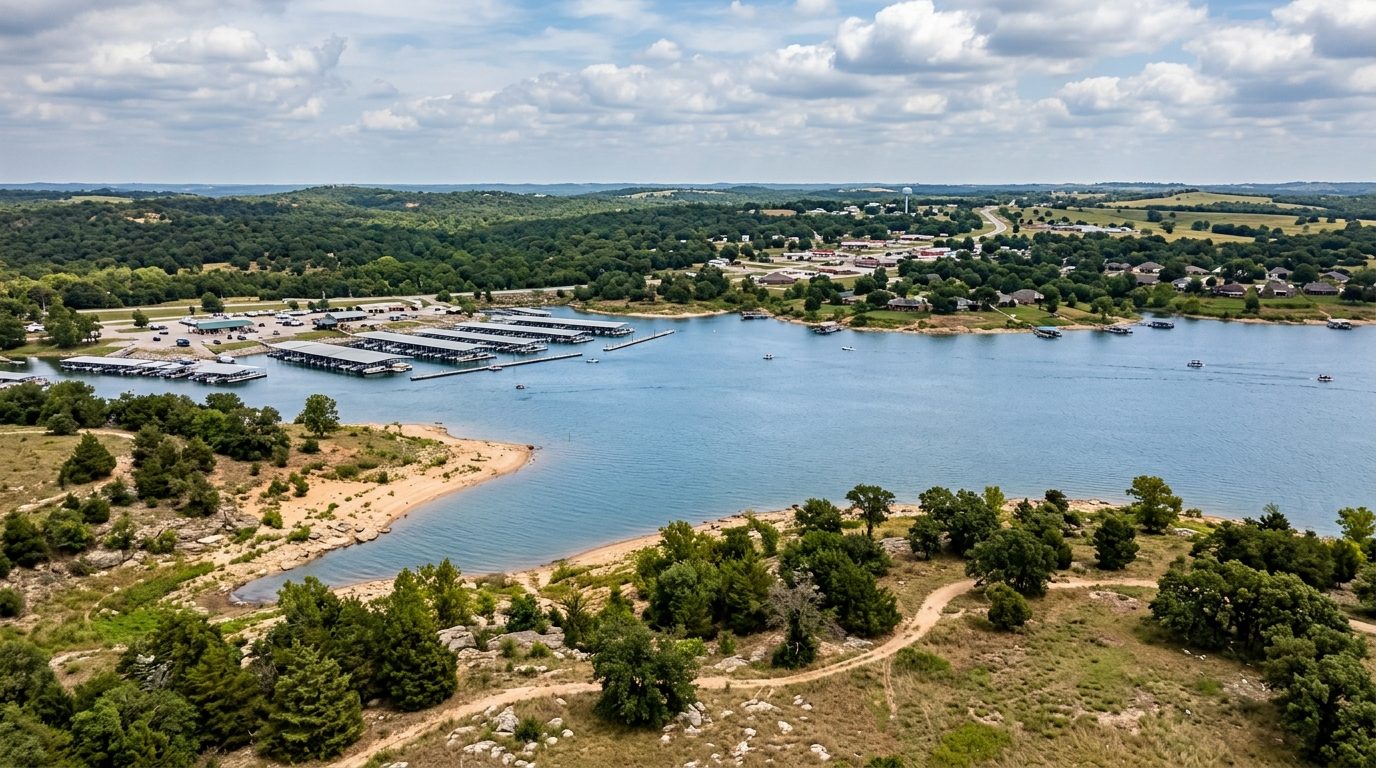
The Sherman-Denison area lies in the blackland prairie and Post Oak Belt of North Texas, generally level ground with gentle rolling hills, crossed by the Red River along the Oklahoma line. Lake Texoma, impounded behind Denison Dam, forms the metro’s northern edge and gives the region a mix of prairie farmland and lakeshore terrain. Sherman and Denison form the urbanized core, linked by US Highway 75, which also connects the metro south toward Dallas-Fort Worth. Smaller towns, including Van Alstyne, Howe, Gunter, Whitesboro, Pottsboro, Bells, Collinsville, Tioga, Tom Bean, Whitewright, Sadler, Southmayd, Dorchester, and Knollwood, ring the twin cities and remain more rural. Historic Sherman and Denison hold Victorian, Craftsman, and turn-of-the-century homes from the railroad era, postwar neighborhoods add ranch-style houses, newer subdivisions cluster along US Highway 75, and lake houses line the Texoma shoreline near Pottsboro.
Lakefront and lake-view property near Pottsboro tends to sit at the higher end, reflecting limited waterfront lot supply and recreational demand. Newer subdivisions along the US 75 corridor in towns such as Van Alstyne, Howe, and Gunter also skew higher, since these communities sit closest to the Dallas-Fort Worth commute shed and offer newer construction. Established neighborhoods near the historic downtowns occupy a middle tier; restored homes in preservation districts can carry a premium for character, while surrounding blocks of older, smaller houses trade more moderately. Towns farther from the corridor, such as Tom Bean, Whitewright, Sadler, and Dorchester, tend to sit lower, reflecting distance from jobs and older housing stock. Industrial investment near Sherman has added momentum to development on the city’s edges.
The local economy has been reshaped by Texas Instruments, which operates a semiconductor wafer fabrication campus on Sherman’s east side, among the largest industrial investments in the region’s history and a magnet for suppliers and workers. GlobiTech, a GlobalWafers subsidiary producing silicon epitaxy products, also operates a Sherman facility, reinforcing the area’s role in chip manufacturing. Longer-standing manufacturers include Tyson Foods, which runs a meat processing plant in Sherman, and Kaiser Aluminum, which operates an extrusion facility there. Austin College, a long-established private liberal arts college, anchors Sherman’s institutional life, while Grayson College, a public community college in Denison with a branch in Van Alstyne, serves as the region’s higher-education and workforce pipeline. Health care is another major employer, led by Texoma Medical Center in Denison and Wilson N. Jones Regional Medical Center in Sherman.
Buyers should know the metro sits at the leading edge of Dallas-Fort Worth’s exurban expansion, with growth pushing north along US 75 into towns that were, until recently, small and rural, bringing new infrastructure alongside construction traffic and changing character. Texas has no state income tax, but local services are funded through property taxes set by Grayson County and its cities and school districts, with rates varying by jurisdiction. Land near Lake Texoma and the Red River carries flood risk, and buyers there should check floodplain maps kept by the Grayson Central Appraisal District and federal emergency management authorities. Much of the county outside incorporated city limits is unregulated by municipal zoning, so land use and construction standards vary between properties, and rural parcels may rely on private wells and septic systems. Development ranges from dense older street grids in the historic cores to large-lot rural tracts on the fringe.
Cities and Towns in the Sherman Metro Area
Notable Communities and Neighborhoods
Sherman Real Estate Market FAQ
What role does Lake Texoma play in the Sherman-Denison area?
Lake Texoma sits along the Red River on the Texas-Oklahoma border and is impounded by Denison Dam. It is a defining geographic feature of the metro, drawing recreational boating and fishing traffic and shaping settlement patterns in towns such as Pottsboro that sit closest to its shoreline.
What industries anchor the Sherman-Denison economy?
Semiconductor manufacturing, led by Texas Instruments and GlobiTech, is a major driver, alongside longer-established manufacturers such as Tyson Foods and Kaiser Aluminum. Higher education through Austin College and Grayson College, along with health care systems based in Sherman and Denison, also provide substantial local employment.
How does the Sherman-Denison metro relate to Dallas-Fort Worth?
The area sits north of the Dallas-Fort Worth region along the US Highway 75 corridor, functioning as an outer exurban extension of the metroplex. Growth and commuting patterns tend to radiate along this highway, connecting towns like Van Alstyne, Howe, and Gunter more closely to Dallas-area employment than towns farther east or west of the corridor.
What should someone buying rural or lakeside property in Grayson County consider?
Much of the county outside incorporated city limits falls outside municipal zoning, so land use and construction standards can vary between neighboring properties, and many rural parcels rely on private wells and septic systems rather than municipal utilities. Property near Lake Texoma and the Red River can also carry flood risk, which is worth checking against floodplain maps before purchasing.
Nearby Markets