
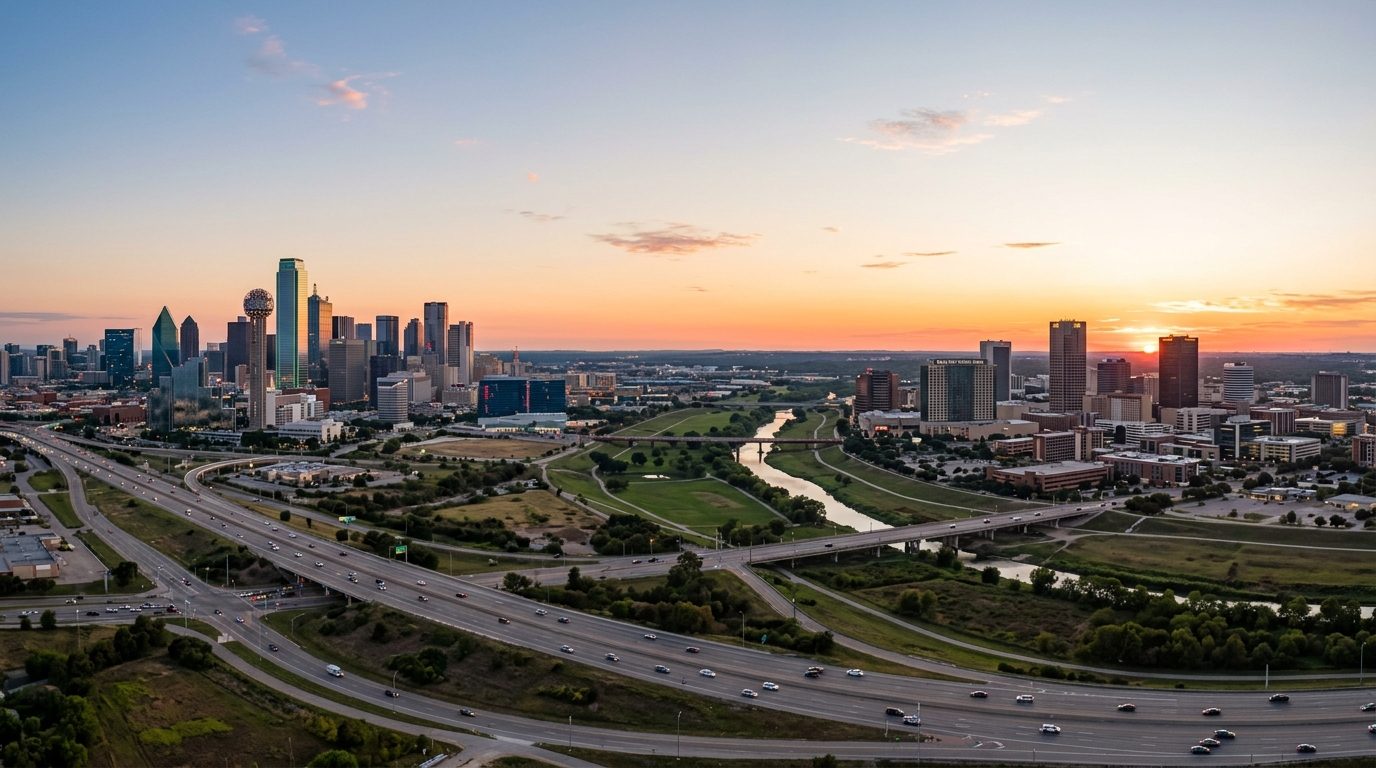
Current real estate market data, news and analysis for the Dallas-Fort Worth-Arlington, TX metropolitan area — 8.5M residents across 11 counties in Texas.
Data as of May 2026. Sources: Redfin Data Center, U.S. Census Bureau.
Latest Dallas Real Estate News
Dallas Real Estate Market Overview
Dallas-Fort Worth-Arlington covers a broad section of North Texas, from the dense employment centers of Dallas and Fort Worth to fast-growing suburban and exurban communities in Collin, Denton, Ellis, Hunt, Johnson, Kaufman, Parker, Rockwall, Tarrant and Wise counties. Housing near the two urban cores includes early-twentieth-century bungalows, brick Tudor houses, duplexes, townhouses, apartments and high-rise condominiums. Postwar ranch homes are common in established inner suburbs such as Richardson, Garland, Irving, Hurst and Bedford. Farther north, east, south and west, development shifts toward newer subdivisions, master-planned communities and larger-lot housing linked by freeways and toll roads. The region has no single dominant housing pattern because Dallas, Fort Worth, Arlington, Plano, Frisco, Denton, McKinney and other cities function as separate employment and residential centers.
Higher price tiers are generally found in Highland Park, University Park, Preston Hollow, Bluffview, Westlake, Southlake, parts of West Plano, Frisco, Prosper and selected golf or gated communities. These areas tend to combine proximity to major job centers, larger lots, newer construction, established school districts or limited land availability. More attainable ownership options are often found in southern Dallas County, portions of Garland and Mesquite, established Fort Worth neighborhoods, Arlington, Grand Prairie and communities farther from the main northern employment corridor. Outer counties may offer newer homes or more land, but buyers should account for tolls, commuting distance, municipal utility districts, homeowners association obligations and the timing of schools, roads and retail services.
The regional economy is distributed across corporate services, finance, health care, transportation, logistics, defense, technology, telecommunications, manufacturing and higher education. American Airlines is based near Dallas Fort Worth International Airport, while Southwest Airlines and AT&T are headquartered in Dallas. Texas Instruments, Lockheed Martin, JPMorgan Chase, Baylor Scott & White Health, UT Southwestern Medical Center and major public school and university systems support additional employment. AllianceTexas and the airport corridor anchor logistics and industrial development, while Legacy and Legacy West in Plano, Las Colinas in Irving, downtown Dallas, Uptown, downtown Fort Worth and the North Dallas Tollway corridor contain major office concentrations.
Local ownership costs are shaped by property taxes, insurance, commuting and neighborhood-specific assessments. Severe thunderstorms, hail, high winds, tornadoes, expansive clay soils and occasional winter freezes can affect roofs, foundations, drainage and insurance claims, so inspection and policy review are important. DART, Trinity Metro, TEXRail and the Denton County A-train serve selected corridors, but much of the region remains automobile-oriented. Municipal zoning and development standards vary substantially among cities, and annexation or extraterritorial jurisdiction can affect utilities and future land use near the fringe. Buyers comparing established neighborhoods with new master-planned communities should verify tax districts, builder warranties, planned infrastructure, deed restrictions and whether nearby undeveloped land has approved uses.
Cities and Towns in the Dallas Metro Area
Show all 149
Notable Communities and Neighborhoods
Dallas Real Estate Market FAQ
How is the Dallas-Fort Worth housing market geographically organized?
The metro operates as several connected housing and employment markets rather than one central-city market. Dallas, Fort Worth, Arlington, Plano, Frisco, McKinney, Denton and the airport corridor each anchor surrounding neighborhoods and commuter patterns.
Which parts of the Dallas metro generally sit in higher price tiers?
Highland Park, University Park, Preston Hollow, Westlake, Southlake and selected areas of Plano, Frisco and Prosper generally occupy higher tiers. Location near employment centers, lot size, school districts, newer construction and limited land supply all influence those differences.
What should buyers verify in a new Dallas-Fort Worth community?
Buyers should review homeowners association rules, municipal utility or special-district obligations, builder warranties, planned roads and schools, and nearby approved land uses. Commute time and toll-road dependence should also be tested during normal travel periods.
What property risks are common in North Texas?
Hail, severe thunderstorms, high winds, tornadoes, expansive clay soils and occasional winter freezes can affect roofs, foundations, plumbing and insurance. A property-specific inspection and an insurance quote are more useful than broad assumptions about an entire suburb.
Nearby Markets