
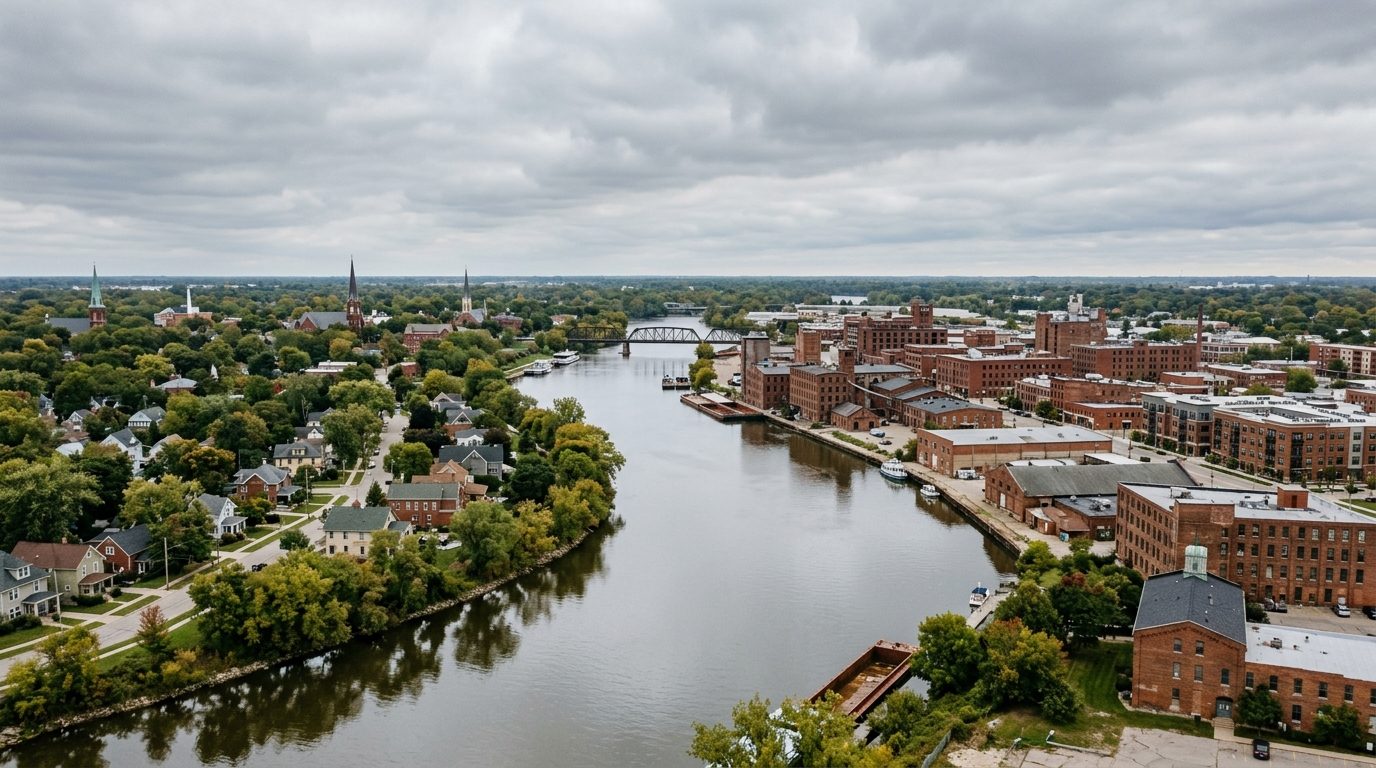
Current real estate market data, news and analysis for the Saginaw, MI metropolitan area — 187,688 residents across Saginaw county.
Data as of May 2026. Sources: Redfin Data Center, U.S. Census Bureau.
Latest Saginaw Real Estate News
Coverage of this market is coming soon. Browse all housing market news.
Saginaw Real Estate Market Overview
Saginaw sits in the flat, glacially leveled Saginaw Valley of east-central Michigan, where the Cass, Shiawassee, and Tittabawassee rivers converge to form the Saginaw River, flowing north into Saginaw Bay on Lake Huron. The metro is defined by Saginaw County and stretches from the city of Saginaw through surrounding townships and smaller communities such as Frankenmuth, Birch Run, Chesaning, St. Charles, Merrill, Oakley, and Zilwaukee. Housing stock reflects the region’s lumber-boom and industrial-era past: the city core contains a dense mix of late-nineteenth and early-twentieth century homes, ranging from modest workers’ cottages to substantial Victorian and Queen Anne houses built along the river by lumber and manufacturing wealth. Surrounding suburban townships carry a mid-twentieth-century character dominated by ranch and split-level homes on larger lots, while the outlying small towns retain compact downtowns set among flat farmland.
Within the metro, stronger demand tends to concentrate in the established suburban townships ringing the city, especially areas near well-regarded school districts, newer subdivisions, medical campuses, and retail corridors, where larger lots and more recently built housing draw buyers seeking updated homes with less deferred maintenance. Frankenmuth stands apart as a distinct micro-market: its carefully maintained Bavarian-themed downtown and year-round visitor economy support sustained interest in nearby residential property. By contrast, sections of the city of Saginaw’s core, which experienced population and manufacturing job losses over recent decades, hold a larger share of older, smaller homes that often need updating, making them more accessible to buyers willing to take on renovation work. The historic riverfront districts fall in between, prized for architectural character and walkability but tempered by century-old construction upkeep and mixed surrounding block conditions.
The regional economy remains anchored in advanced manufacturing, particularly automotive components: Nexteer Automotive, rooted in Saginaw for over a century, still operates multiple production and engineering plants in the city despite relocating its corporate headquarters elsewhere in Michigan, and General Motors maintains a powertrain manufacturing presence in the area. Hemlock Semiconductor, headquartered in nearby Thomas Township, is a major producer of hyper-pure polysilicon used in solar and electronics manufacturing and has continued expanding locally. Healthcare is another leading sector, led by Covenant HealthCare and MyMichigan Medical Center Saginaw, both major hospital systems based in the city. Agriculture and agribusiness remain significant in the surrounding countryside, and higher education, through Saginaw Valley State University and Delta College, adds a stable institutional employment base. Tourism tied to Frankenmuth and the Birch Run outlet corridor also supports regional hospitality and retail jobs.
Buyers should note a few regionally specific factors. Parts of the metro along the Saginaw River and its tributaries fall within FEMA-mapped floodplains, so confirming a property’s flood zone designation and any history of river flooding is worthwhile, particularly near the river through the city center. Michigan’s freeze-thaw winters and lake-effect snow influenced by nearby Lake Huron place ongoing demands on roofs, foundations, and drainage systems, especially in older housing stock. Outside the city, many homes in smaller towns and townships rely on private wells and septic systems rather than municipal water and sewer, and these should be inspected independently. Property tax rates and school district boundaries vary between the city, its townships, and outlying towns, so buyers should verify local millage rates and assessments directly with township or county offices rather than assume uniformity across the metro.
Cities and Towns in the Saginaw Metro Area
Notable Communities and Neighborhoods
Saginaw Real Estate Market FAQ
How is the Saginaw, MI real estate market organized geographically?
The metro is built around the city of Saginaw, which sits where the Cass, Shiawassee, and Tittabawassee rivers join to form the Saginaw River. Around the city, a ring of suburban townships provides most of the newer housing, while smaller outlying towns such as Frankenmuth, Chesaning, Birch Run, St. Charles, Merrill, Oakley, and Zilwaukee each function as their own small housing markets set among the surrounding farmland.
Which parts of the Saginaw metro are pricier or more affordable, and why?
The suburban townships surrounding the city, along with Frankenmuth, tend to see stronger demand because of newer construction, larger lots, well-regarded schools, and proximity to retail, medical, and tourism amenities. Parts of the city of Saginaw’s core, which lost population and manufacturing jobs over past decades, have a larger supply of older homes needing updates, which keeps entry costs lower for buyers willing to renovate. Historic riverfront neighborhoods sit in between, valued for architectural character but requiring more maintenance than newer suburban homes.
What should buyers verify locally before purchasing in the Saginaw area?
Because parts of the metro lie near the Saginaw River and its tributaries, buyers should confirm a property’s flood zone status and any history of river flooding through local or federal flood maps. In the smaller towns and townships outside the city, many homes use private wells and septic systems instead of municipal service, so these should be inspected separately. Property tax rates and school district lines also vary by township and city, so buyers should confirm current millage rates with local assessors rather than assuming they are consistent across the metro.
What regional risks or dependencies are specific to the Saginaw metro?
The local economy has historically leaned on manufacturing, particularly automotive component production, which has made the area sensitive to shifts in that industry over time, though healthcare, higher education, agriculture, and tourism now provide additional stability. Winters bring freeze-thaw cycles and lake-effect snow influenced by nearby Lake Huron, which can stress roofing, foundations, and drainage in older homes, and properties near the Saginaw River carry a flood exposure that should be factored into insurance planning.
Nearby Markets