
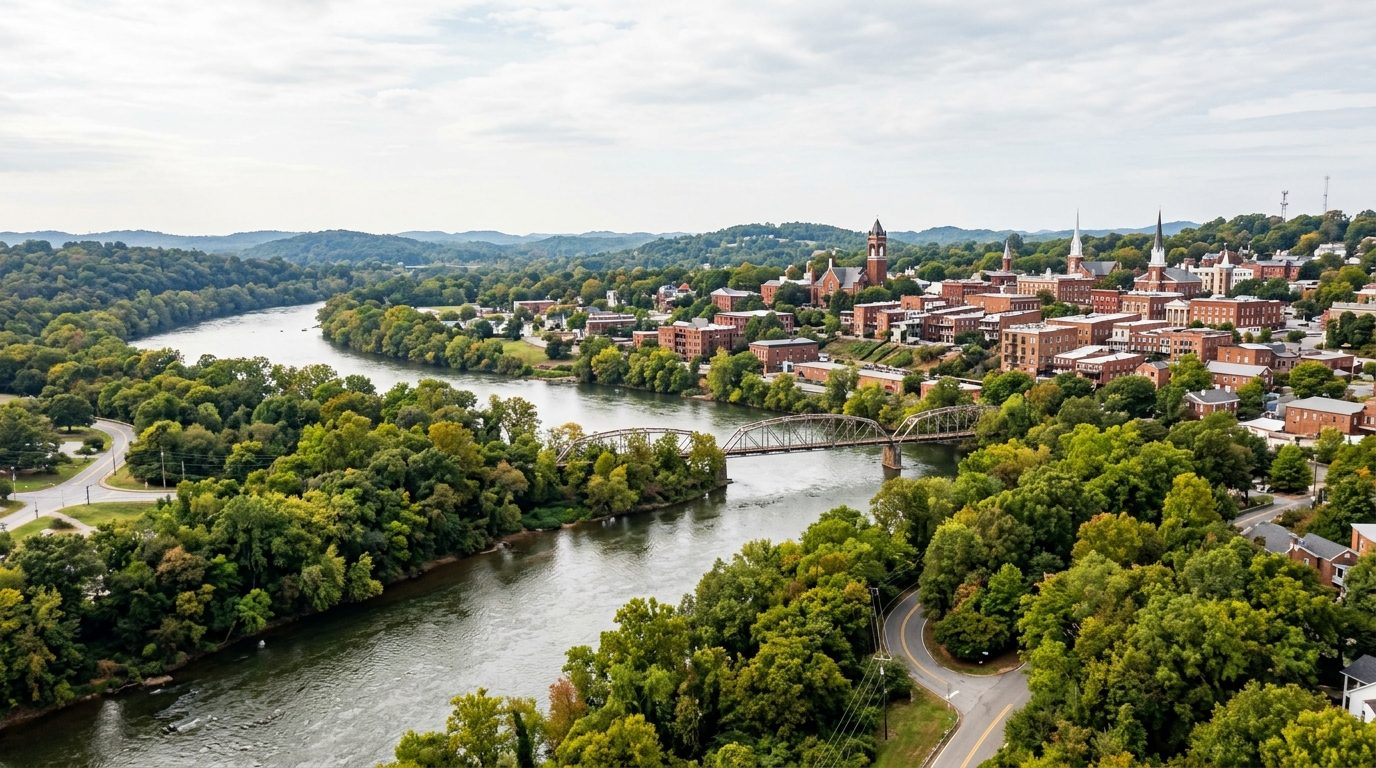
Current real estate market data, news and analysis for the Rome, GA metropolitan area — 101,378 residents across Floyd county.
Data as of May 2026. Sources: Redfin Data Center, U.S. Census Bureau.
Latest Rome Real Estate News
Coverage of this market is coming soon. Browse all housing market news.
Rome Real Estate Market Overview
Rome sits in the foothills of northwest Georgia where the Etowah and Oostanaula Rivers meet to form the Coosa River, and its historic core is built across hills overlooking that confluence, the source of the city’s long-used nickname as a place set on seven hills. Housing stock in the older parts of the city reflects this history: Victorian, Queen Anne, and Craftsman-era homes cluster on the hillsides near downtown, while mid-twentieth-century ranch homes fill neighborhoods that grew outward toward the north side. Outside the city limits, Floyd County turns rural quickly, with wooded acreage, farms, and newer subdivisions toward Armuchee, Shannon, and the Berry College area at Mount Berry. Cave Spring, a small historic town to the southwest built around a natural spring, adds a distinct small-town housing pocket, and Lindale, a former textile mill village south of Rome, contributes an older layer of modest worker housing.
Within Rome, homes on the hills and bluffs near downtown, in the historic districts around the river confluence and Myrtle Hill, tend to draw stronger interest for architectural character, mature tree cover, and walkable access. Newer construction and larger-lot subdivisions near Berry College and the city’s northern edge, close to the Redmond hospital corridor, also see solid demand from newer building stock and school proximity. More modest pricing is generally found in older mill-village areas such as Lindale, in manufactured-home communities in the unincorporated county, and near industrial corridors south of the city. Cave Spring and remote rural sections of the county occupy a middle position, trading in-town density for small-town or country settings.
The local economy rests on healthcare, higher education, and manufacturing. Atrium Health Floyd, anchored by its hospital campus in Rome, is among the area’s largest employers, alongside a second hospital system, AdventHealth Redmond, and the physician group Harbin Clinic. Berry College, a private liberal arts college known for one of the largest contiguous campuses of any college in the country, is both a significant employer and a steady source of housing demand. Manufacturing has deep roots here, including Suzuki Manufacturing of America’s all-terrain-vehicle plant, Mohawk Industries, International Paper, auto-parts supplier F&P Georgia, and a Kellanova food plant tracing to the historic Keebler operation. A Lowe’s distribution center and Walmart round out the job base, and the Rome-Floyd County Development Authority markets industrial sites to recruit investment.
Because downtown Rome and older neighborhoods sit close to the Etowah, Oostanaula, and Coosa Rivers, flood risk is a real, long-documented consideration; upstream reservoirs help moderate river levels, but buyers near the rivers or in low-lying neighborhoods should check FEMA flood zone status and flood insurance requirements before committing. Historic districts carry design-review guidelines that can limit exterior changes, so buyers drawn to Victorian-era neighborhoods should confirm preservation rules first. Property taxes are administered by the Floyd County Board of Tax Assessors, with standard Georgia homestead exemptions for owner-occupants; city residents pay both county and municipal levies, while unincorporated residents pay county taxes only. Public transit is limited to a small local bus system, and the metro is not served directly by an interstate, so commuters should weigh drive times along routes such as US 27 and US 411. Development tends to follow highway corridors and the edges of Rome and Berry College, combining downtown revitalization with subdivision growth in the outlying county.
Cities and Towns in the Rome Metro Area
Notable Communities and Neighborhoods
Rome Real Estate Market FAQ
How is the Rome, GA metro area organized geographically?
The metro is built around Rome, the Floyd County seat, which sits at the point where the Etowah and Oostanaula Rivers join to form the Coosa River; the historic downtown occupies a cluster of hills overlooking that confluence. Beyond the city, Floyd County transitions into rural land and smaller communities, including Armuchee, Shannon, Silver Creek, and the Berry College area at Mount Berry to the north, and the separately incorporated town of Cave Spring to the southwest.
Which parts of the Rome area tend to be pricier, and why?
Homes in the historic districts on the hills and bluffs near downtown and the river confluence, including areas around Myrtle Hill, tend to draw stronger interest for their architectural character and walkable access to downtown. Newer subdivisions near Berry College and the northern edge of the city, close to the Redmond hospital corridor, also see solid demand tied to newer construction and school access. Older mill-village areas, manufactured-home communities in the unincorporated county, and neighborhoods near industrial corridors tend to sit at the more modest end.
What should buyers verify before purchasing in the Rome metro?
Buyers should confirm FEMA flood zone status and flood insurance requirements for any property near the rivers or in low-lying older neighborhoods, check whether a home in one of the local historic districts is subject to design-review guidelines that limit exterior changes, and verify whether a property falls inside Rome’s city limits, which carries both county and municipal taxes, or in the unincorporated county, which does not. Rural buyers should also confirm well and septic status where municipal service is unavailable.
Is flooding a risk in the Rome area given its rivers?
Yes. Rome’s downtown and several older neighborhoods sit near the Etowah, Oostanaula, and Coosa Rivers, and the city has a long documented history of river flooding. Upstream reservoirs now help moderate river levels, but properties near the rivers or in low-lying sections of town can still fall within mapped flood zones, so buyers should check flood zone designation and insurance requirements as part of due diligence.
Nearby Markets