
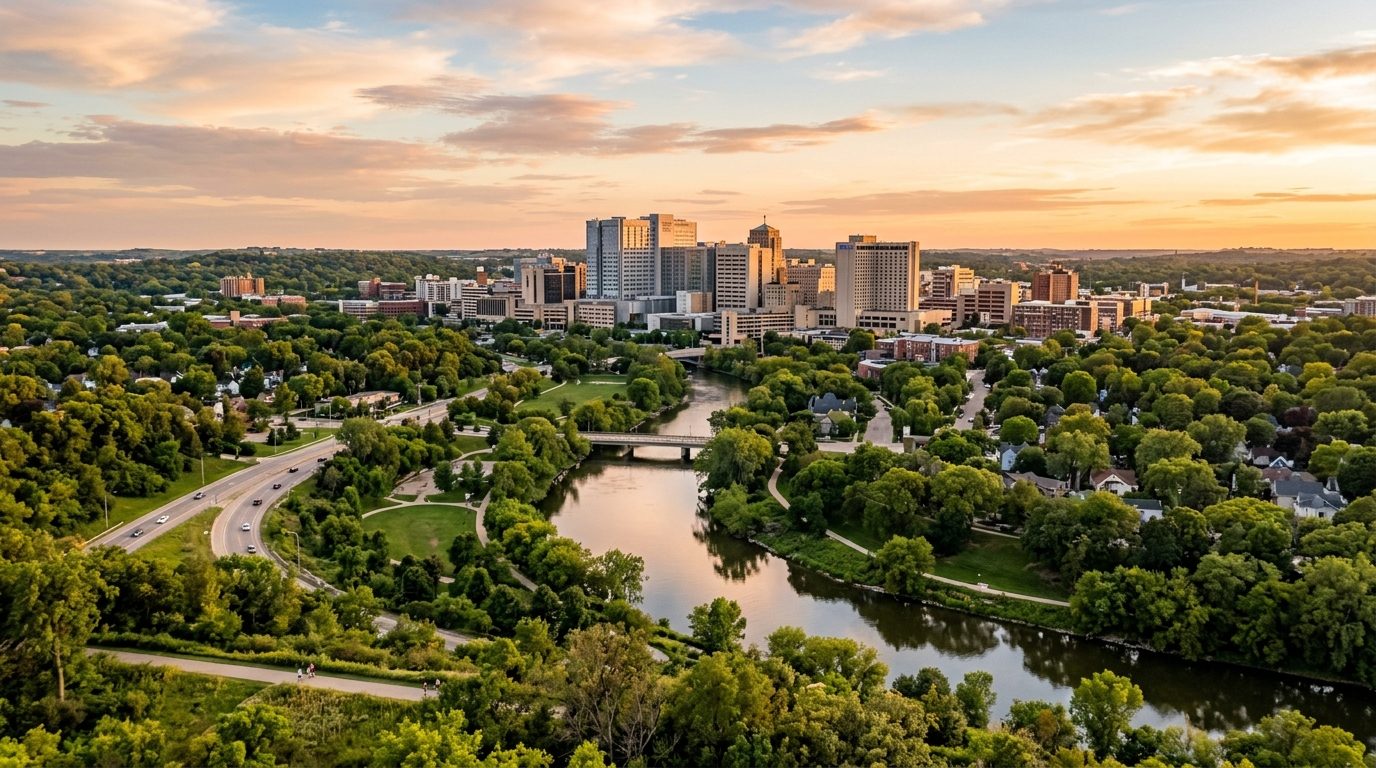
Current real estate market data, news and analysis for the Rochester, MN metropolitan area — 231,184 residents across Dodge, Fillmore, Olmsted and Wabasha counties.
Data as of May 2026. Sources: Redfin Data Center, U.S. Census Bureau.
Latest Rochester Real Estate News
Coverage of this market is coming soon. Browse all housing market news.
Rochester Real Estate Market Overview
Rochester sits in the bluff country of southeastern Minnesota, along the South Fork of the Zumbro River, between rolling farmland to the west and steeper river bluffs to the east. Its neighborhoods radiate outward from a compact, increasingly vertical downtown built around the Mayo Clinic campus, with early-twentieth-century blocks close in giving way to mid-century ramblers and split-levels, then curving subdivisions and larger-lot parcels toward the edges. Housing stock ranges from foursquares and bungalows in the historic core to postwar single-story homes across the established middle ring, to contemporary two-story houses and townhomes in newer developments on the southern, southwestern, and northwestern fringes. Because so much of the area’s growth traces back to one institution, residential construction has largely followed demand tied to hospital staff, visiting patients and their families, and the broader medical and biotech employers built up around the clinic.
Neighborhoods closest to the downtown medical campus, long associated with physician households, carry a premium tied to walkability to the hospital and the character of their older, architect-influenced homes on mature, tree-lined streets. Newer subdivisions south and southwest of downtown, largely built on former farmland over the past couple of decades, occupy a similarly higher tier, pairing larger modern homes and planned amenities with reasonable proximity to newer clinic and business-park campuses. More attainable housing clusters to the northwest and along older commercial corridors, where mid-century ramblers and split-levels predominate, and in condominium- and apartment-heavy pockets nearer downtown serving traveling patients, students, and shorter-term clinic-affiliated workers. Townships beyond the city limits offer larger lots and lower density in exchange for a longer commute into the medical district.
The local economy is dominated by health care, anchored by the Mayo Clinic’s downtown campus and its affiliated research, education, and outpatient facilities, which employ a large share of the workforce and drive steady demand for medical office, laboratory, and specialized housing. A long-running public-private redevelopment initiative tied to the clinic’s expansion has reshaped downtown zoning and streetscape, adding high-rise residential and mixed-use towers to what was historically a low-rise skyline. Beyond health care, the economy includes technology and manufacturing, with a longstanding IBM campus alongside truck and equipment manufacturers, food processors, and other manufacturers tied to the surrounding agricultural region. Public-sector employment is significant too, with the school district, county government, and city government among the area’s larger employers, supplemented by tourism and convention activity tied to medical travel.
Winters are long and snow load is a genuine construction consideration, so roofing, drainage, and foundation work are built around repeated freeze-thaw cycles and heavy accumulation rather than coastal or wind exposure. The Zumbro River and its tributaries run through the city’s core, and a severe flood decades ago prompted an extensive network of dams and reservoirs on the streams feeding downtown; buyers of older homes near the river corridor should still confirm current flood-zone status despite that control system. Minnesota property tax classifications and homestead rules are worth confirming with the county assessor, as is any special assessment tied to downtown redevelopment. Zoning downtown has been actively rewritten to allow denser, taller buildings near the clinic campus, so buyers there should check current zoning and nearby planned development; public transit is limited mainly to local buses, leaving most residents outside the core reliant on cars.
Cities and Towns in the Rochester Metro Area
Notable Communities and Neighborhoods
Rochester Real Estate Market FAQ
How is the Rochester, MN housing market organized geographically?
The market centers on a compact downtown built around the Mayo Clinic campus, with established close-in neighborhoods surrounding it, a middle ring of mid-century housing, and newer subdivisions expanding along the city’s southern, southwestern, and northwestern edges. Townships beyond the city limits offer a more rural, larger-lot alternative for buyers willing to commute.
Which parts of Rochester tend to carry higher prices, and why?
Areas within easy walking or biking distance of the downtown medical campus, along with newer planned subdivisions to the south and southwest, tend to price higher. The former reflects proximity and historic housing character, while the latter reflects larger modern homes and planned amenities built to serve clinic-area demand.
What should buyers verify locally before purchasing in Rochester?
Buyers should confirm current zoning near downtown, since redevelopment tied to the Mayo Clinic’s expansion has changed height and density rules in parts of the core, and check whether a property near the Zumbro River or its tributaries falls within a mapped flood zone despite the area’s flood-control system. Confirming property tax classification and any special assessments with Olmsted County is also worthwhile.
What is the main weather-related risk to factor into owning a home in Rochester?
The primary consideration is winter severity: heavy snow load, freeze-thaw cycles, and ice affect roofing, driveways, and foundation drainage far more than any wind or coastal exposure. Homes near the Zumbro River corridor also warrant a flood-zone check, even though a reservoir system built after a historic flood has reduced river flood risk considerably.
Nearby Markets