
Current real estate market data, news and analysis for the Madison, WI metropolitan area — 709,685 residents across Columbia, Dane, Green and Iowa counties.
Data as of May 2026. Sources: Redfin Data Center, U.S. Census Bureau.
Latest Madison Real Estate News
Madison Real Estate Market Overview
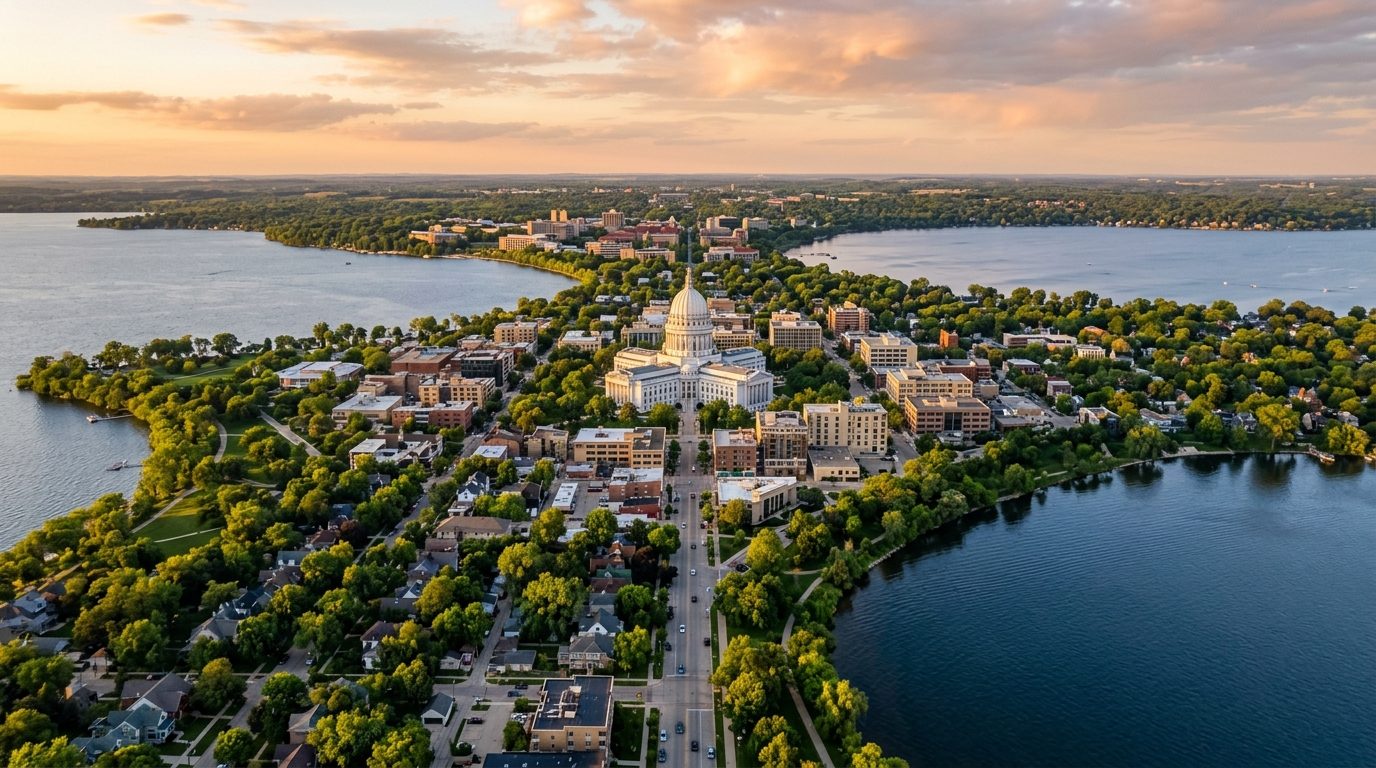
Madison sits at the center of Dane County on a narrow isthmus between Lake Mendota and Lake Monona, part of a chain of four lakes carved by glaciers that also includes Lake Waubesa and Lake Kegonsa. The isthmus holds the state capitol and the University of Wisconsin-Madison campus, with older neighborhoods of bungalows, Prairie-style houses, and postwar cottages built close to the water. Beyond the lakes, the metro spreads into Columbia, Green, and Iowa counties, mixing suburban subdivisions in places like Fitchburg, Middleton, Sun Prairie, and Verona with farmland and small rural towns such as Mount Horeb, New Glarus, Dodgeville, and Portage. Housing stock ranges from early twentieth-century homes near downtown and the isthmus to ranch and split-level houses from the 1960s-1980s in first-ring suburbs, and newer subdivisions with larger lots on the metro’s outer edges where former farm fields have been platted for development.
Homes directly on Lake Mendota or Lake Monona, and those in the isthmus neighborhoods close to campus and the capitol square, tend to sit at the upper end of the local market because of shoreline access, mature tree cover, and short commutes to downtown employers. Near-west neighborhoods and villages like Shorewood Hills and Maple Bluff carry similar premiums for the same reasons, along with proximity to UW-Madison and established parks. Suburban communities such as Middleton, Verona, and Waunakee generally sit in a middle tier, offering newer construction and highly regarded school districts without lakefront pricing. The most affordable homes are typically found farther out in Columbia, Green, and Iowa counties, in towns like Portage, Columbus, Dodgeville, and New Glarus, where land is cheaper and commute times to Madison are longer.
State government and the University of Wisconsin-Madison anchor the regional economy, together employing tens of thousands of workers across administration, research, and campus operations. Epic Systems, a major electronic health records software company, is headquartered on a large campus in Verona and draws employees from across the metro. American Family Insurance maintains its corporate headquarters in Madison, and the region’s hospital systems, including UW Health and SSM Health, are also significant employers. This combination of government, higher education, health care, and software gives the local economy a different character than manufacturing-oriented metros elsewhere in the state.
Winters in the Madison area are cold and snowy, with lake-effect conditions occasionally intensifying snowfall near the Yahara chain of lakes, and buyers should confirm a home’s heating system, insulation, and roof condition are suited to that climate. Wisconsin does not have a state sales tax exemption for groceries but does levy property taxes that vary by municipality and school district, so buyers should check the specific tax rate and any special assessments for a given address. Madison Metro Transit serves the city and some inner suburbs, but a car is necessary in most of the metro, especially in outlying towns. Land-use rules differ by municipality, and some suburbs have adopted growth-management or agricultural-preservation policies that limit new subdivisions, so buyers should verify current zoning, planned development, and floodplain maps with the relevant city or county before purchasing, particularly for property near the lakes or the Yahara River.
Cities and Towns in the Madison Metro Area
Notable Communities and Neighborhoods
Madison Real Estate Market FAQ
How is the Madison metro area organized geographically?
The city of Madison occupies a narrow isthmus between Lake Mendota and Lake Monona in Dane County, with the state capitol and University of Wisconsin-Madison at its core. Surrounding suburbs such as Fitchburg, Middleton, Sun Prairie, Verona, and Waunakee ring the city, while the wider metro extends into Columbia, Green, and Iowa counties, taking in smaller towns and farmland.
Which parts of the Madison area tend to be pricier, and why?
Homes on or near Lake Mendota and Lake Monona, along with isthmus neighborhoods close to downtown, the capitol, and the university, generally command higher prices due to water access and short commutes. Established near-west villages like Shorewood Hills and Maple Bluff carry similar premiums, while outer suburbs and rural towns in Columbia, Green, and Iowa counties tend to be more affordable.
What should buyers verify locally before purchasing in the Madison area?
Buyers should confirm the property’s specific municipal and school district property tax rate, check floodplain and shoreline zoning rules with the relevant city or county for any lake-adjacent or river-adjacent parcel, and review local land-use and growth-management policies that can affect future development nearby.
What regional risk factors are specific to the Madison area?
Winters are cold with substantial snowfall, and homes should be evaluated for adequate insulation, heating capacity, and roof condition. Properties near Lake Mendota, Lake Monona, and the Yahara River corridor can be subject to periodic flooding, so buyers should check FEMA flood maps and local floodplain records for any specific address.
Nearby Markets