
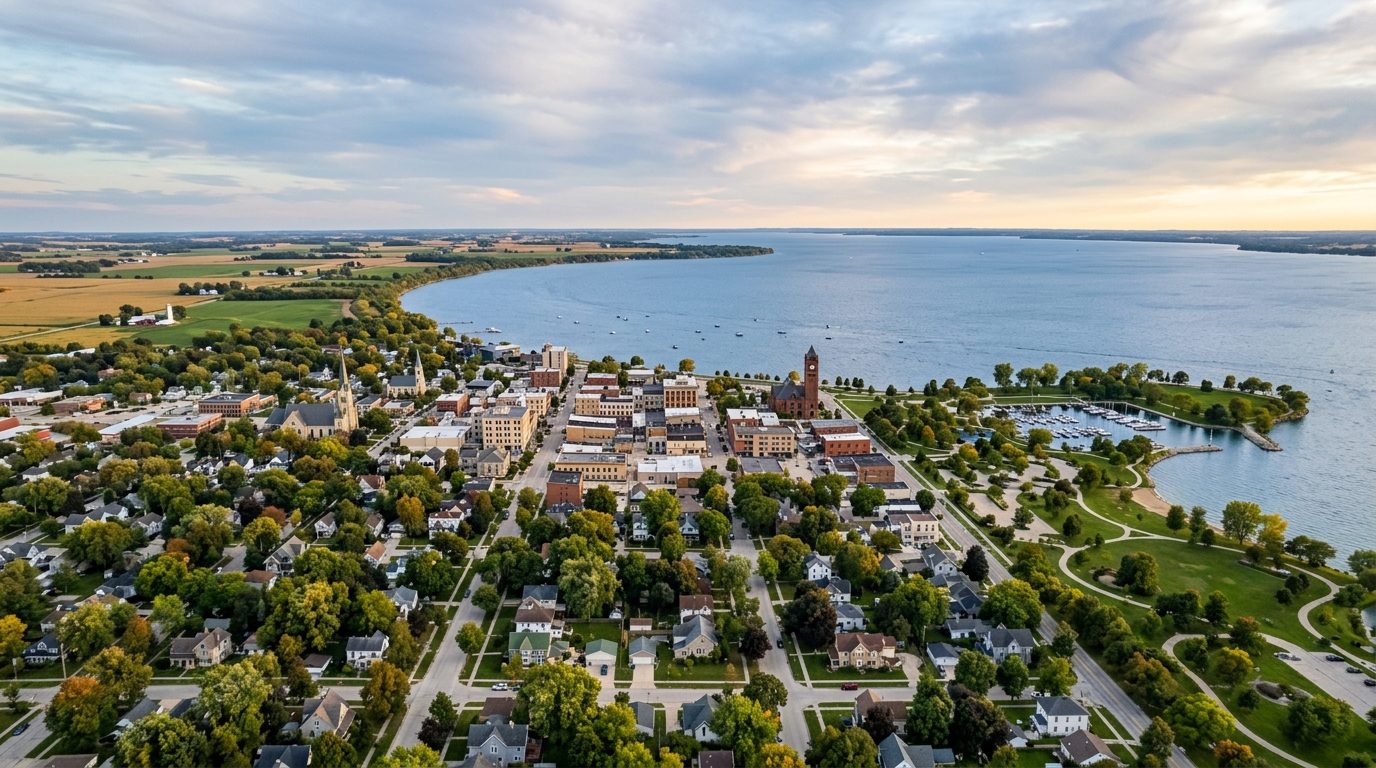
Current real estate market data, news and analysis for the Fond du Lac, WI metropolitan area — 104,669 residents across Fond du Lac county.
Data as of May 2026. Sources: Redfin Data Center, U.S. Census Bureau.
Latest Fond du Lac Real Estate News
Coverage of this market is coming soon. Browse all housing market news.
Fond du Lac Real Estate Market Overview
The Fond du Lac metropolitan statistical area is made up entirely of Fond du Lac County, Wisconsin, anchored by the city of Fond du Lac at the southern tip of Lake Winnebago, the largest inland lake in the state. Outside the county seat, the metro is a patchwork of small cities and villages surrounded by open farmland planted in corn, alfalfa, and soybeans, reflecting a dairy-heavy region. Housing stock mirrors this pattern: the core city carries older homes near downtown, mid-century ranch construction further out, and newer subdivisions on its edges, while surrounding towns favor single-family homes on larger lots, farmsteads, and lake cottages. Ripon stands apart as a small city with its own distinct identity, built around Ripon College and recognized as the birthplace of the Republican Party, giving it a compact, walkable downtown shaped by nineteenth-century academic and civic architecture rather than the industrial history that shaped Fond du Lac proper.
Within the metro, price tiers track a mix of water access, historic character, and proximity to employment. Homes along or near the Lake Winnebago shoreline, including areas toward Taycheedah and St. Peter, draw more interest because lake frontage and water views are inherently limited in supply. Established historic districts near downtown Fond du Lac, with older architecture and walkable proximity to the lakefront park system, similarly draw buyers willing to pay for character and location, even though the homes often need more upkeep. Ripon’s historic core and campus-adjacent streets occupy a similar niche on a smaller scale. By contrast, rural farm towns across the county’s interior, built around agriculture and small church-centered communities rather than commercial cores, offer more house and land for the money, appealing to buyers who prioritize space and privacy over walkability or lake access. School district boundaries also shape preference among the Fond du Lac, North Fond du Lac, Ripon, and smaller rural districts.
The local economy centers on manufacturing, healthcare, and agriculture. Mercury Marine, a division of Brunswick Corporation, is headquartered in Fond du Lac and manufactures marine engines, making it the metro’s largest private employer. Michels Corporation, a large family-owned infrastructure and energy construction firm, is headquartered in nearby Brownsville within the county. Healthcare is anchored by SSM Health, which operates St. Agnes Hospital in Fond du Lac under the legacy Agnesian HealthCare name. Agriculture and its supporting businesses, including dairy farms, feed and equipment suppliers, and food processing, remain a substantial economic base across the county’s rural towns.
Buyers should weigh a few local factors. The area has a humid continental climate with cold, snowy winters and warm, humid summers, and proximity to Lake Winnebago can add localized moisture and wind exposure for shoreline properties, along with ice conditions, seasonal flooding, and shoreland zoning restrictions near the water. Property tax rates and assessed values vary by municipality and school district, so figures should be verified with the relevant town, village, or city assessor. Zoning differs between the incorporated city and village cores, which allow denser residential and mixed-use building, and the surrounding towns, where agricultural zoning and larger lot sizes are common. Buyers considering rural or shoreline parcels should confirm well and septic status, floodplain mapping, and any farmland preservation or easement restrictions tied to the land, since these are handled locally and are not always obvious from a listing.
Cities and Towns in the Fond du Lac Metro Area
Notable Communities and Neighborhoods
Fond du Lac Real Estate Market FAQ
How is the Fond du Lac metro area organized geographically?
The metro consists of all of Fond du Lac County, with the city of Fond du Lac at the southern tip of Lake Winnebago serving as the population and employment center. Surrounding it are smaller cities and villages, including North Fond du Lac immediately adjacent to the county seat, and Ripon to the west, along with a ring of villages and unincorporated communities set among farmland. The county’s rural interior is largely agricultural, organized into townships with small crossroads communities rather than dense suburban development.
Which areas in the Fond du Lac metro tend to be pricier, and why?
Properties near or along the Lake Winnebago shoreline tend to draw the most buyer interest because water access and views are limited in supply. Historic residential districts close to downtown Fond du Lac and Ripon’s college-adjacent neighborhoods also command attention for their architectural character and walkability. Rural farm towns in the county’s interior generally offer more land and space for the price, since they trade water access and walkable amenities for acreage and privacy.
What should buyers verify locally before purchasing in this metro?
Because the metro spans one incorporated city, several villages, and numerous townships, zoning rules, property tax rates, and school district boundaries all vary by municipality and should be confirmed with the specific town, village, or city rather than assumed to be uniform across the county. Rural and shoreline parcels warrant additional diligence on well and septic systems, floodplain status, and any agricultural or conservation restrictions tied to the land.
What is a region-specific risk buyers should be aware of?
Shoreline and low-lying properties near Lake Winnebago and the county’s rivers and wetlands can be subject to seasonal flooding and shoreland zoning restrictions that limit building, expansion, or land alteration near the water. Winters bring sustained cold and regular snowfall, so buyers should also evaluate a property’s heating system, insulation, and driveway or roof snow-load considerations as part of any inspection.
Nearby Markets