
Current real estate market data, news and analysis for the Laredo, TX metropolitan area — 281,224 residents across Webb county.
Data as of May 2026. Sources: Redfin Data Center, U.S. Census Bureau.
Latest Laredo Real Estate News
Coverage of this market is coming soon. Browse all housing market news.
Laredo Real Estate Market Overview
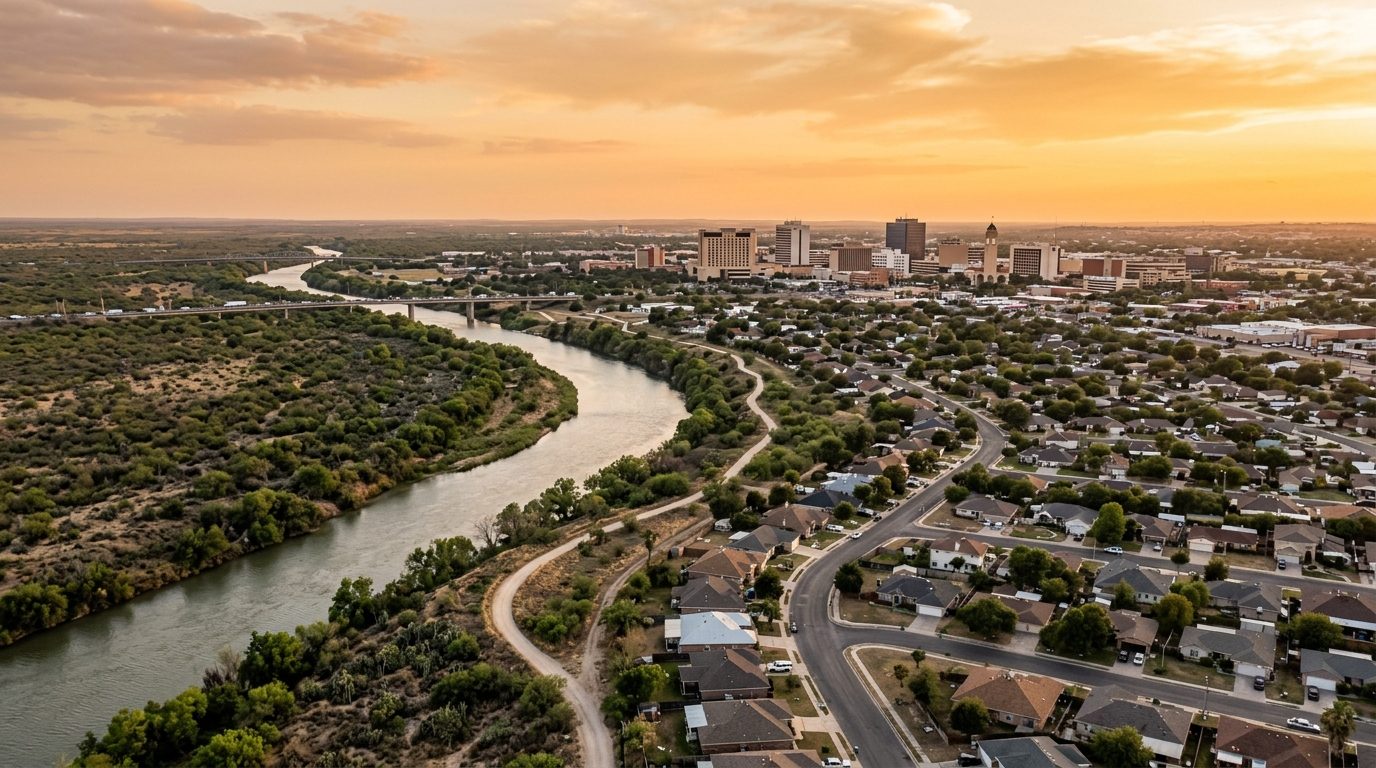
Laredo sits on the north bank of the Rio Grande in South Texas brush country, directly across the river from Nuevo Laredo, Mexico, within Webb County. The metro’s terrain is flat to gently rolling, historically covered in mesquite, cactus, and thorny scrub, with the city and its smaller neighbors, Rio Bravo and El Cenizo, strung along the river to the south and east. Housing stock reflects this outward growth pattern: a compact historic core of masonry and stucco buildings near downtown gives way to mid-century brick ranch houses in older inner neighborhoods, then to newer single-family subdivisions, apartment complexes, and master-planned developments spreading north and northwest along the interstate corridor. Most residential construction is single-story, single-family, and detached, arranged along curving suburban streets rather than a traditional grid, with density thinning toward the city’s edges and giving way to ranchland at the outer fringe.
Newer subdivisions in north Laredo, including those built around the Laredo Country Club and along the city’s northwestern edge, tend to command higher prices, largely because they offer more recent construction, larger lots, modern drainage and utility infrastructure, and easier access to newer schools, hospitals, and retail centers. Established central neighborhoods closer to downtown and the historic core carry older housing stock and proximity to legacy commercial and rail corridors, which keeps values more modest there. Rio Bravo and El Cenizo, along the river south of Laredo, remain the most affordable and least developed parts of the metro, shaped by their origin as unincorporated riverside settlements with limited municipal infrastructure and continued reliance, in some sections, on private wells, septic systems, or county rather than city road maintenance.
Laredo’s economy centers on international trade and logistics, anchored by its position as a major inland port on the US-Mexico border; trucking, customs brokerage, warehousing, and cross-border freight companies employ a substantial share of the workforce. Public institutions are also significant employers, including the City of Laredo, Webb County government, Laredo Independent School District, United Independent School District, Texas A&M International University, and Laredo College. Health care is anchored by Laredo Medical Center and Doctors Hospital of Laredo, the latter part of the Universal Health Services system. Retail and financial services add further depth, led by H-E-B and International Bank of Commerce, alongside business-service employers such as Concentrix. Manufacturing and distribution facilities tied to the trade corridor round out the local economic base.
Laredo has a hot semi-arid climate with intense summer heat and periodic flash flooding along the Rio Grande and its tributary creeks, so flood-zone status is worth checking parcel by parcel rather than assumed from a neighborhood’s general reputation. Property taxes are levied by multiple overlapping authorities, including the city, county, school district, and community college, so buyers should confirm the exact taxing entities tied to a given address with the Webb County Appraisal District. Newer north-side subdivisions are frequently governed by homeowners associations with deed restrictions and dues, while some outlying areas, including sections that originated as colonias, may still rely on private wells, septic systems, or county rather than city road maintenance. Given the metro’s location on an international border, cross-border trade patterns and truck traffic along key corridors and bridges are also worth factoring into a location decision, along with independently verifying school attendance zones and utility service for a specific property.
Cities and Towns in the Laredo Metro Area
Notable Communities and Neighborhoods
Laredo Real Estate Market FAQ
How is the Laredo metro area organized geographically?
The metro is built around Laredo, the Webb County seat, which sits on the north bank of the Rio Grande directly across from Nuevo Laredo, Mexico. The city’s historic core lies near downtown along the river, with development expanding outward mainly to the north and northwest over time. Two smaller incorporated communities, Rio Bravo and El Cenizo, sit along the river to the south and east of the city, while the broader county is otherwise made up of ranchland and unincorporated rural areas.
Which parts of the Laredo area tend to be pricier, and why?
Newer subdivisions in north Laredo, particularly areas near the Laredo Country Club and along the city’s northwestern growth corridor, tend to sit at the higher end of the market. These areas generally offer more recent construction, larger lots, updated drainage and utility infrastructure, and closer proximity to newer schools, hospitals, and retail development. Older neighborhoods nearer downtown and the smaller river communities of Rio Bravo and El Cenizo tend to be more affordable, reflecting older housing stock in the case of the former and, in the case of the latter two, a history as more informally developed, unincorporated settlements with fewer municipal services.
What should buyers verify locally before purchasing property in the Laredo area?
Buyers should independently confirm a property’s flood-zone designation given the area’s exposure to flash flooding along the Rio Grande and local creeks, and check whether a homeowners association governs the subdivision, since many newer north Laredo developments carry deed restrictions and dues. In outlying or rural parts of the county, and in some older settled areas, it is also worth confirming whether the property relies on a private well and septic system versus municipal water and sewer, and whether roads are maintained by the city or the county. Property tax obligations should be confirmed directly with the Webb County Appraisal District, since city, county, school district, and community college taxes can apply together on the same parcel.
What is a distinctive risk factor for the Laredo real estate market?
The local economy is closely tied to cross-border trade and logistics through Laredo’s ports of entry with Mexico, which makes the area’s job base more exposed to shifts in international trade policy and freight volumes than a more economically diversified metro. Climate is also a factor: Laredo has a hot semi-arid climate with intense summer heat and a risk of localized flash flooding, so buyers should weigh cooling costs, drainage, and flood-zone status alongside more typical purchase considerations.
Nearby Markets