
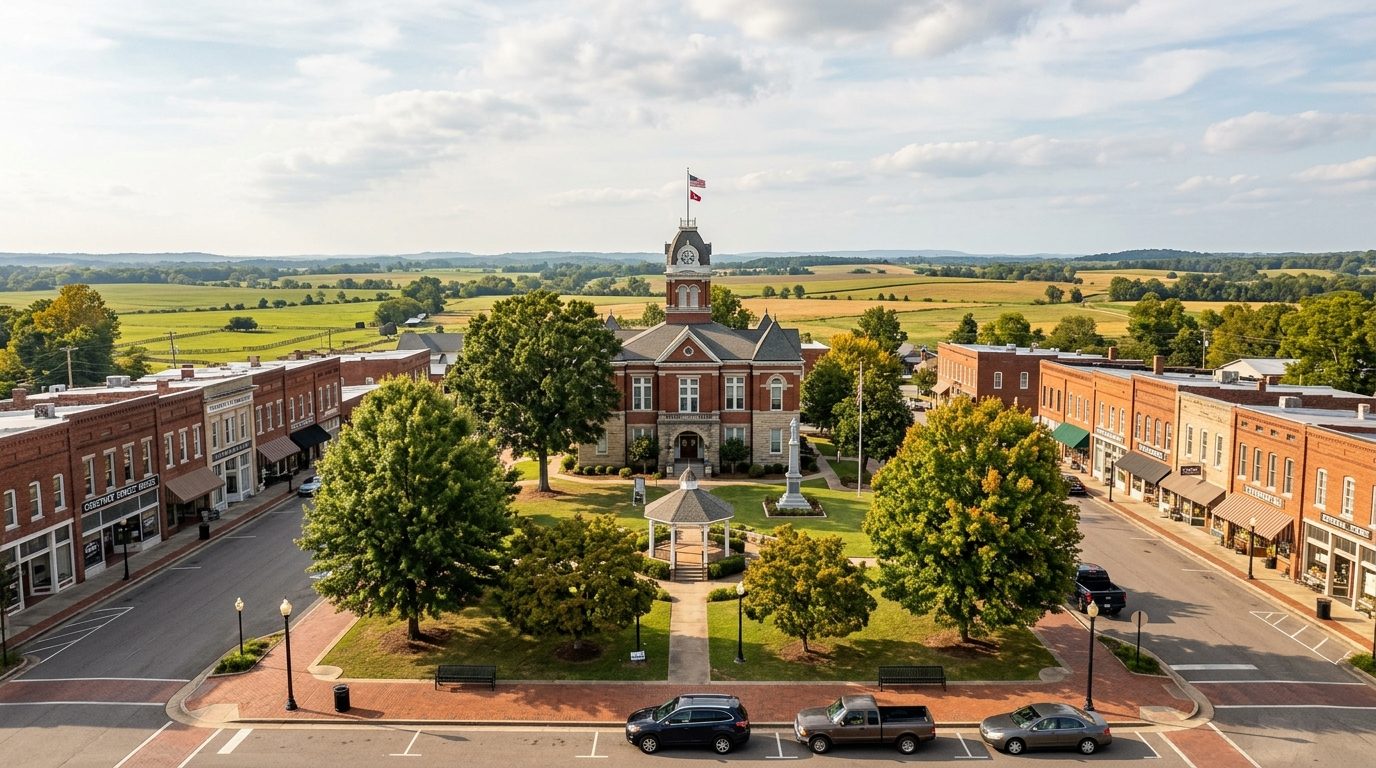
Current real estate market data, news and analysis for the Jackson, TN metropolitan area — 184,569 residents across Chester, Crockett, Gibson and Madison counties.
Data as of May 2026. Sources: Redfin Data Center, U.S. Census Bureau.
Latest Jackson Real Estate News
Coverage of this market is coming soon. Browse all housing market news.
Jackson Real Estate Market Overview
Jackson is the anchor city of a multi-county metro area in West Tennessee, spanning Madison, Chester, Crockett, and Gibson counties, with Jackson itself serving as the seat of Madison County. The region lies along Interstate 40 roughly midway between Memphis and Nashville, in gently rolling farmland drained by the forks of the Forked Deer River. Housing stock reflects the area’s layered growth: a compact courthouse-square core with early twentieth-century bungalows and brick commercial buildings gives way to postwar ranch-style subdivisions, then to newer suburban development along the city’s northern and eastern edges. Outside city limits, the surrounding towns mix older farmhouses, manufactured homes, and small-town residential blocks built around local schools and Main Streets.
Within Jackson, higher-priced housing clusters toward the north and northeast, where newer subdivisions sit near Union University and established retail corridors along tree-shaded streets that have long attracted move-up buyers. These areas benefit from proximity to newer schools, parks, and shopping along the city’s main growth corridor. Lower-priced housing concentrates in the older core and in southwestern parts of the city, where smaller lots, older construction, and a larger share of rental and long-held family properties keep entry costs down. The historic Bemis mill village and pockets near downtown occupy a middle ground, valued for character and walkability despite older housing stock. In the smaller towns across the metro, prices generally track the local job base and distance from Jackson’s commercial center, with places nearest Jackson and the interstate drawing more interest than the most rural stretches.
The metro’s economy centers on healthcare, manufacturing, and education, with Jackson functioning as the commercial and medical hub for a wide swath of rural West Tennessee. West Tennessee Healthcare, anchored by Jackson-Madison County General Hospital, is the region’s dominant employer and draws patients and staff from well beyond the core counties. Manufacturing has deep roots too: Kellanova operates a major Pringles plant in Jackson, and Toyota Boshoku Tennessee runs automotive seating and metal-stamping operations tied to the Toyota supply chain. Kirkland’s Home, the home-decor retailer, maintains a distribution and customer-care presence locally. Higher education adds stability, with Union University, the historically Black Lane College, and Jackson State Community College all based in the city, contributing jobs and steady housing demand. Retail, logistics, and agricultural trade tied to the surrounding farm counties round out the employment base.
Buyers should weigh several regional factors. West Tennessee sits in a zone prone to severe thunderstorms and tornadoes, and the humid subtropical climate brings hot, muggy summers with generally mild winters, so wind and storm coverage is worth reviewing with an insurer. Portions of the metro lie near the forks of the Forked Deer River and its tributaries, making a flood-zone check through FEMA mapping a sensible step, especially for older neighborhoods and low-lying rural parcels. The area is car-dependent, without a significant fixed-route transit system, so daily life depends on the local road network and Interstate 40. Property tax bills can combine county and, inside city limits, municipal levies, so confirming jurisdiction matters. In smaller towns and unincorporated parts of the counties, many homes rely on private wells and septic systems rather than municipal utilities, which warrants inspection before purchase. Ongoing automotive-manufacturing investment elsewhere in West Tennessee is also worth watching, given its potential effect on regional housing demand.
Cities and Towns in the Jackson Metro Area
Notable Communities and Neighborhoods
Jackson Real Estate Market FAQ
How is the Jackson, TN metro area organized geographically?
The metro is built around Jackson, the seat of Madison County, and also includes Chester, Crockett, and Gibson counties in West Tennessee. Interstate 40 runs through the area roughly midway between Memphis and Nashville, and the region is shaped by the forks of the Forked Deer River along with a scattering of smaller incorporated towns surrounded by farmland outside the city itself.
Which areas of Jackson tend to be pricier or more affordable, and why?
The north and northeast sides of Jackson, near Union University and established retail corridors, tend to carry higher prices because of newer subdivisions, mature landscaping, and proximity to newer schools and shopping. The older core and southwestern parts of the city tend to be more affordable because the housing is older, lots are smaller, and a larger share of homes are rentals or long-held family properties. Smaller towns outside Jackson generally price according to their distance from the city and their local job base.
What should buyers verify locally before purchasing in the Jackson, TN metro?
Buyers should check FEMA flood-zone status for any parcel near the Forked Deer River or its tributaries, confirm whether a property falls under county-only or combined city-and-county property tax jurisdiction, and, for homes in smaller towns or unincorporated areas, verify whether the property relies on a private well and septic system rather than municipal water and sewer, which can require inspection and permitting.
What is a notable regional risk for homeowners in this metro?
West Tennessee lies in a zone that experiences severe thunderstorms and tornadoes, so buyers should review wind and storm coverage carefully with an insurer. The area’s economy also carries some concentration risk, since healthcare and a handful of large manufacturing employers account for a significant share of local jobs, making the region sensitive to shifts in those industries.
Nearby Markets