
Current real estate market data, news and analysis for the Idaho Falls, ID metropolitan area — 173,851 residents across Bonneville, Butte and Jefferson counties.
Data as of May 2026. Sources: Redfin Data Center, U.S. Census Bureau.
Latest Idaho Falls Real Estate News
Coverage of this market is coming soon. Browse all housing market news.
Idaho Falls Real Estate Market Overview
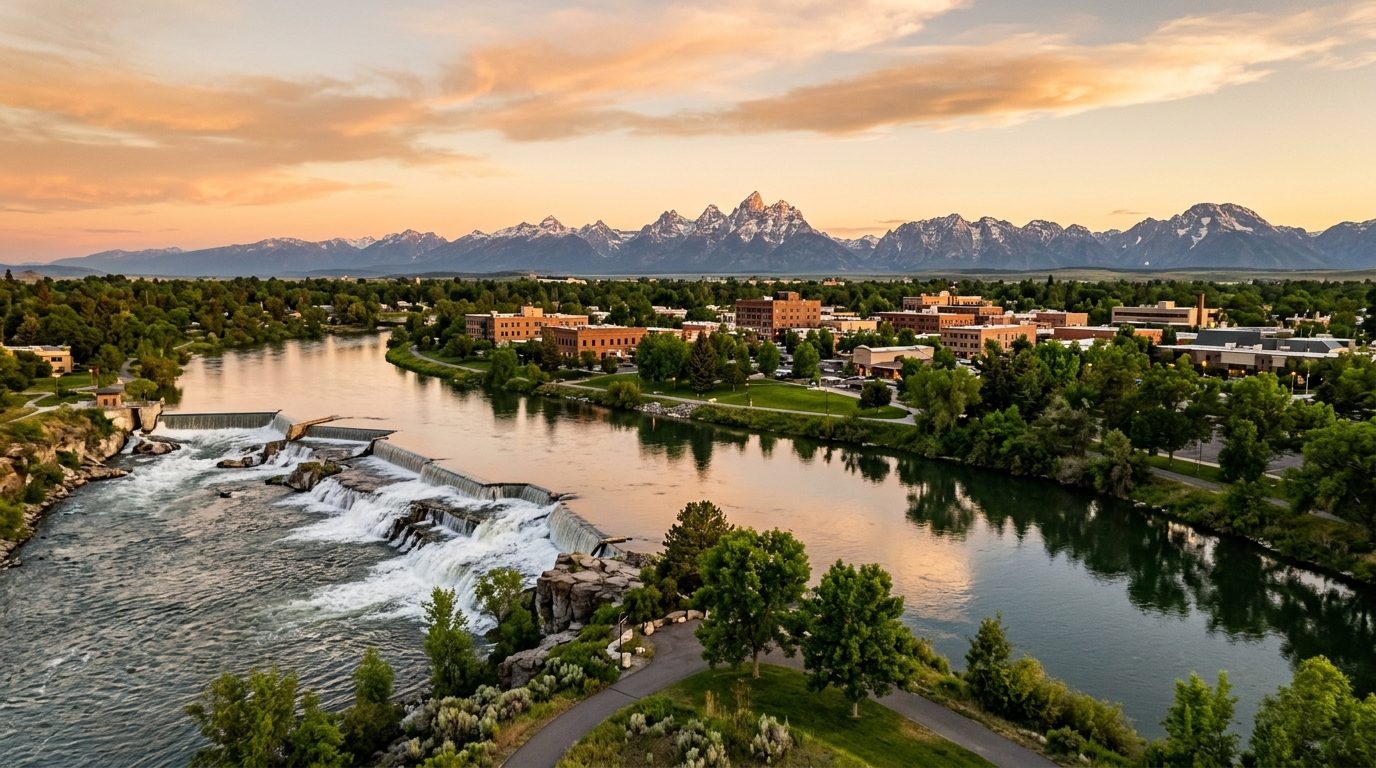
The Idaho Falls metro spans three landscapes: the high desert plains of Butte County, home to the Idaho National Laboratory site and the small towns of Arco, Butte City, Moore and Mud Lake; the irrigated farmland of the Snake River Plain around Idaho Falls, Ammon, Rigby, Iona, Ucon, Menan and Roberts; and mountainous, forested terrain near Swan Valley and Irwin along the South Fork Snake River and Palisades Reservoir. The Snake River runs directly through downtown Idaho Falls, where a signature falls and a greenbelt trail anchor the city’s open space. Housing stock reflects this range: older mid-century homes cluster near downtown and the greenbelt, newer subdivisions have filled the city’s east and south sides toward Ammon, rural Jefferson County towns favor larger-acreage properties with barns and outbuildings tied to their agricultural roots, Butte County’s housing is older, smaller and sparser, and Swan Valley and Irwin offer a distinct recreational-property market of cabins and view homes oriented to the reservoir and river.
Newer construction and river access set the top of the local range. Ammon and the Snake River Landing corridor draw a premium for newer homes close to retail and employment, while downtown Idaho Falls commands a premium for walkability and river access, offset by smaller, older lots. Swan Valley and Irwin carry a real premium for reservoir and river frontage and mountain views, though as recreational and second-home markets rather than commuter suburbs. Rigby and the rest of rural Jefferson County are structurally more affordable, reflecting a longer commute to the Idaho Falls job core, and Butte County is the most affordable part of the metro, a small, high-desert area whose economy has always been tied more to the national laboratory site than to a commuter relationship with the city.
The Idaho National Laboratory, a U.S. Department of Energy nuclear-research site managed under contract by Battelle Energy Alliance, is by far the region’s dominant employer. Melaleuca, a health and wellness products company, and the United Potato Growers of Idaho cooperative are both headquartered in Idaho Falls. Eastern Idaho Regional Medical Center and Mountain View Hospital are the metro’s two hospital systems, and Idaho Falls Power, one of relatively few municipally owned electric utilities in the country, supplies a meaningful share of the city’s electricity from its own Snake River hydroelectric plants. Idaho State University maintains an Idaho Falls campus alongside the Center for Advanced Energy Studies, a research partnership tied to the national laboratory, and the College of Eastern Idaho serves as the area’s community college. Agriculture — potatoes, wheat, barley and dairy — remains important in the outlying counties.
Idaho follows a prior-appropriation water-rights doctrine, and across much of the Snake River Plain, surface water is delivered through irrigation districts rather than owned outright by a parcel, so buyers of rural property should confirm through the state water-resources department what water rights, if any, attach to the land. Wildfire risk is real in the rangeland and forested foothills east of the city, particularly near canyon terrain, and spring snowmelt is the primary flood hazard along the Snake River system, so a flood-map check is worthwhile for river-adjacent property. Because the regional economy is unusually concentrated in one federally funded research institution, buyers should weigh that concentration when thinking about long-term employment stability.
Cities and Towns in the Idaho Falls Metro Area
Notable Communities and Neighborhoods
Idaho Falls Real Estate Market FAQ
How is the Idaho Falls-area market organized?
The Idaho Falls metro runs from the high desert of Butte County, centered on the national laboratory site, through irrigated Snake River Plain farm towns like Rigby, Ammon and Iona, to mountain recreational property near Swan Valley and Irwin, with the city of Idaho Falls itself serving as the metro’s commercial and medical center.
Which parts of the Idaho Falls area tend to be pricier?
Newer subdivisions in Ammon and along the Snake River Landing corridor, and downtown Idaho Falls near the river and greenbelt, tend to sit toward the top of the local range, along with reservoir and riverfront property in Swan Valley and Irwin. Rural Jefferson County and the small towns of Butte County are generally the most affordable parts of the metro.
What should buyers verify locally in the Idaho Falls area?
Because much of the region’s water is delivered through irrigation districts rather than attached directly to a parcel, buyers of rural or agricultural property should confirm what water rights, if any, come with the land through the state water-resources department. River-adjacent buyers should also check current flood maps, since spring snowmelt is the area’s primary flood hazard.
What’s a region-specific risk to know about in Idaho Falls?
The regional economy is unusually concentrated around the Idaho National Laboratory, a single federally funded institution, which is worth factoring into any long-term view of local employment and housing demand. Wildfire risk is also real in the rangeland and forested foothills east of the city, particularly for property near canyon terrain.
Nearby Markets