
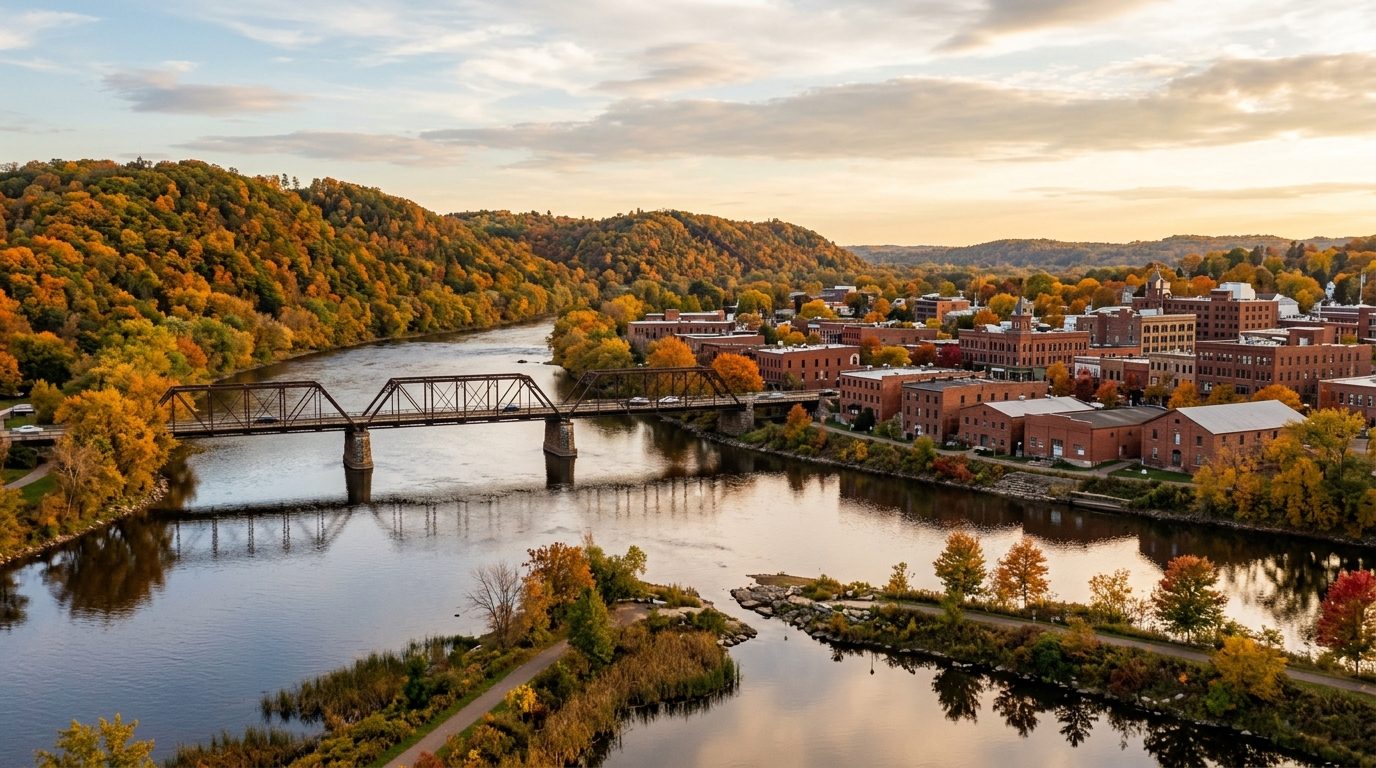
Current real estate market data, news and analysis for the Eau Claire, WI metropolitan area — 176,647 residents across Chippewa and Eau Claire counties.
Data as of May 2026. Sources: Redfin Data Center, U.S. Census Bureau.
Latest Eau Claire Real Estate News
Coverage of this market is coming soon. Browse all housing market news.
Eau Claire Real Estate Market Overview
Eau Claire sits at the confluence of the Chippewa and Eau Claire rivers in the rolling, forested terrain of western Wisconsin’s Chippewa Valley, with river bluffs and glacial terrain giving way to farmland and lake country outside the built-up core. Housing stock includes lumber-era Queen Anne, Italianate and bungalow homes in the historic neighborhoods near downtown and the university, mid-century ranch and split-level houses in Altoona and other inner-ring areas, and newer subdivisions on the city’s growing northeast side, in the village of Lake Hallie and around outer Chippewa Falls. Chippewa Falls itself retains a compact, historic mill-town core along Bridge Street surrounded by its own older residential streets, giving the metro an urban river core that transitions quickly into rural western Wisconsin.
Architectural pedigree and water access set the higher end of the local market. Chippewa Falls’s West Hill district, built on a bluff above the Chippewa River by 19th-century lumber executives, and Eau Claire’s Third Ward and Historic Randall Park neighborhoods, developed by lumber barons, bankers and professionals, carry premiums for large historic homes and mature tree canopy near downtown. Lake Wissota, a reservoir on the Chippewa River east of Chippewa Falls, commands a premium for waterfront lots and recreational access, and Altoona’s River Prairie district draws buyers to newer construction near riverside trails and mixed-use retail. Older core neighborhoods on Eau Claire’s near west and north sides, with smaller housing stock and higher student rental density near the university, tend to be more affordable, as do outlying small towns such as Boyd, Stanley, Cornell, Cadott, Fairchild, Fall Creek, New Auburn and Augusta, which trade a longer commute for larger lots and lower costs.
Healthcare, manufacturing and higher education anchor the local economy. Mayo Clinic Health System operates the area’s main hospital and regional trauma center, and Marshfield Medical Center runs a second hospital and clinic system with additional locations in Altoona and Chippewa Falls; a longtime third hospital, Sacred Heart, closed in 2024, consolidating regional healthcare capacity onto the two remaining systems. Eau Claire is home to the corporate headquarters of both National Presto Industries and Menards, and Xcel Energy’s Wisconsin utility subsidiary is based in the city as well. The University of Wisconsin-Eau Claire and Chippewa Valley Technical College are major employers and economic anchors, while Chippewa Falls supports a manufacturing base that includes printed-circuit-board maker TTM Technologies, footwear company Mason Companies and the Leinenkugel’s brewery.
The Chippewa and Eau Claire rivers have a documented history of flooding, and the city participates in FEMA’s Community Rating System, which can reduce flood-insurance costs for residents in mapped flood zones — buyers near either river should check current floodplain maps before purchasing. Severe thunderstorms, hail and tornadoes, concentrated in the late spring and early summer, are the area’s primary weather hazards. Wisconsin assesses property at market value with no assessment caps, and because the metro straddles Eau Claire and Chippewa counties and multiple school districts, tax rates can vary meaningfully by exact address, so buyers should confirm the specific taxing jurisdictions for any parcel before making an offer.
Cities and Towns in the Eau Claire Metro Area
Notable Communities and Neighborhoods
Eau Claire Real Estate Market FAQ
How is the Eau Claire-area market organized?
The Eau Claire metro centers on the confluence of the Chippewa and Eau Claire rivers, with the city of Eau Claire and neighboring Altoona forming the urban core, Chippewa Falls anchoring a separate historic mill-town center to the northeast, and smaller communities such as Cadott, Stanley and Augusta serving the surrounding rural county.
Which parts of the Eau Claire area tend to be pricier?
Historic districts with large lumber-era homes, including Chippewa Falls’s West Hill and Eau Claire’s Third Ward and Historic Randall Park neighborhoods, tend to command premiums for architectural character and proximity to downtown. Waterfront property on Lake Wissota and newer construction in Altoona’s River Prairie district also sit toward the top of the local range.
What should buyers verify locally in the Eau Claire area?
Because the metro spans two counties and several school districts, buyers should confirm the exact taxing jurisdictions for any property, since rates vary by address. Anyone considering property near the Chippewa or Eau Claire rivers should also check current FEMA floodplain maps rather than assume a location is outside a flood zone.
What’s a region-specific risk to know about in Eau Claire?
Severe thunderstorms, hail and tornadoes are the area’s primary weather hazard, concentrated in the late spring and early summer months. Low-lying property near the Chippewa and Eau Claire rivers carries documented flood risk, and buyers should verify a parcel’s flood-zone status directly rather than rely on assumptions about older flood-control work.
Nearby Markets