
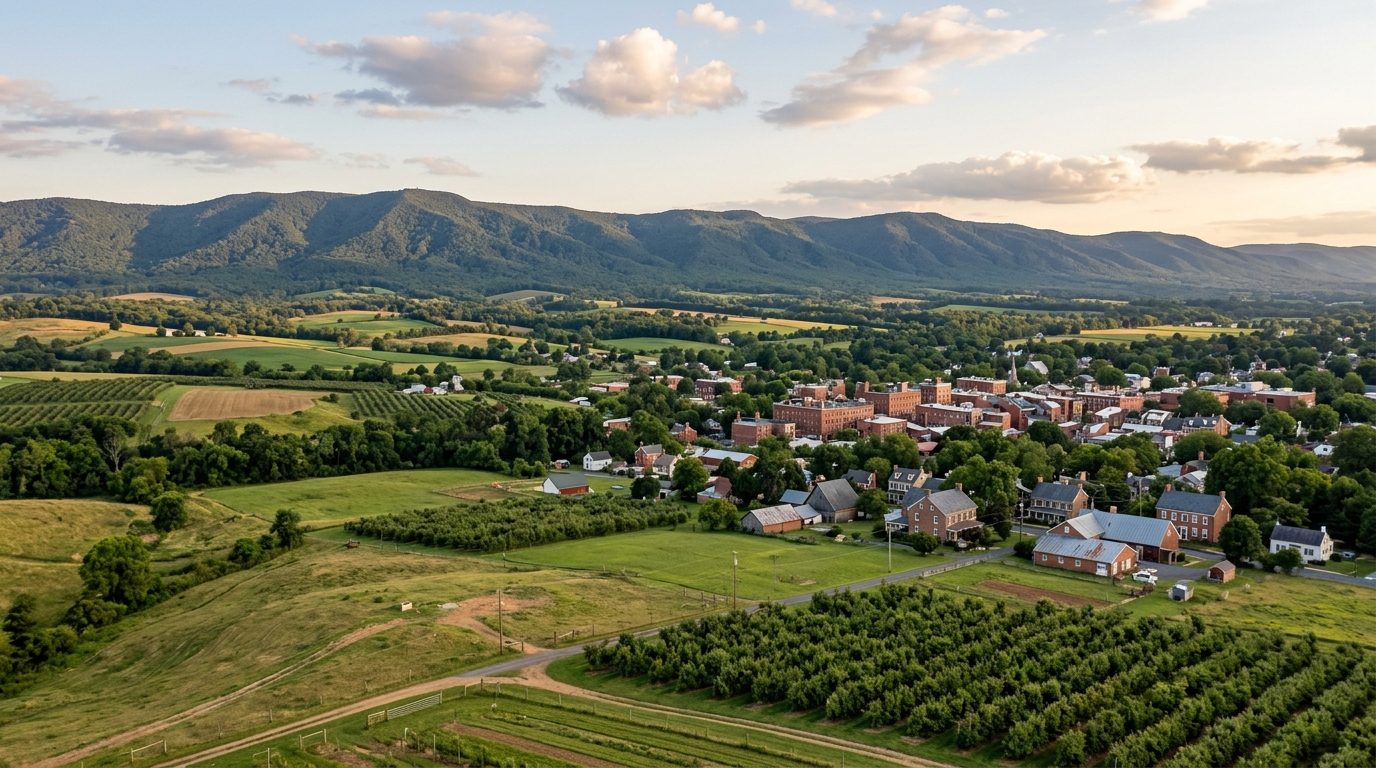
Current real estate market data, news and analysis for the Winchester, VA-WV metropolitan area — 152,332 residents across Frederick, VA, Hampshire, WV and Winchester city, VA counties.
Data as of May 2026. Sources: Redfin Data Center, U.S. Census Bureau.
Latest Winchester Real Estate News
Winchester Real Estate Market Overview
The Winchester metro sits at the northern end of Virginia’s Shenandoah Valley, where the Blue Ridge Mountains rise to the east and the ridge-and-valley folds of the Appalachians roll westward into the eastern panhandle of West Virginia. The independent city of Winchester anchors surrounding Frederick County, Virginia, and the metro stretches west across the Cacapon and South Branch Potomac watersheds into rural Hampshire County, West Virginia. Small towns punctuate the landscape: Stephens City and Middletown along the old Valley Turnpike south of Winchester, Romney and Capon Bridge along winding river roads to the west. Housing stock reflects this layered history: brick and stone farmhouses, log structures, and colonial and Victorian-era townhouses cluster around Winchester’s old core, while newer subdivisions of vinyl-sided colonials, ranches, and townhomes spread across former orchard and farmland on the valley floor.
Within the metro, proximity to the Washington DC commute corridor shapes where value tends to concentrate. Neighborhoods along the eastern edge of Frederick County, closer to Route 7 and the roads feeding toward Loudoun County and the DC exurbs, along with newer planned communities built on former farmland outside Winchester, tend to draw buyers seeking modern construction, larger lots, and community amenities. Winchester’s historic core, centered on the pedestrian mall and surrounding blocks of colonial and Victorian-era homes, draws interest for its walkability and character but comes with older systems and preservation oversight on exterior changes. Farther west, toward Hampshire County and the more remote reaches of the valley, distance from employment centers and limited highway access, paired with older or more rural housing stock, tends to keep that end of the metro comparatively affordable. School zones remain another consistent thread in where buyers choose to settle.
The regional economy centers on health care, manufacturing, agriculture, and logistics. Valley Health System, a nonprofit network based in Winchester, operates Winchester Medical Center along with several smaller hospitals and outpatient clinics on both sides of the metro, making it the area’s largest employer. Trex Company, a manufacturer of composite decking, is headquartered and manufactures products in Winchester. Navy Federal Credit Union operates a large campus in Frederick County, and Frederick County Public Schools, Amazon, and Walmart round out the major employers. Agriculture, especially apple growing, has shaped the county’s identity for generations, and orchards remain part of the working landscape alongside newer vineyards and cideries. The metro’s position along Interstate 81 has also drawn distribution and warehousing operations, including cold storage and third-party logistics firms serving the Mid-Atlantic.
Buyers considering the Winchester metro should weigh the realities of a long commute toward Washington DC; the drive east on Route 7 or north via Interstate 81 can be lengthy, and MARC commuter rail service on the Brunswick Line reaches only as far as Martinsburg, West Virginia, not Winchester. Tax structures also differ across the state line: Virginia jurisdictions levy an annual personal property tax on vehicles, while West Virginia’s approach to vehicle and property taxation differs, and each side administers its own real estate assessments and local levies. Land-use patterns vary too: Frederick County directs new growth into designated development areas while maintaining rural preservation zoning across most of its land, whereas Hampshire County has fewer land-use controls outside its incorporated towns. Within Winchester’s historic district, exterior changes to homes require architectural review, worth knowing before planning renovations.
Cities and Towns in the Winchester Metro Area
Notable Communities and Neighborhoods
Winchester Real Estate Market FAQ
What region does the Winchester metro area belong to geographically?
The metro sits at the northern end of the Shenandoah Valley in Virginia, bordered by the Blue Ridge Mountains to the east and the ridge-and-valley Appalachians extending into the eastern panhandle of West Virginia, giving the area a mix of valley farmland, wooded ridges, and river corridors.
Why does the Winchester metro area span two states?
The metro grouping includes Frederick County and the independent city of Winchester in Virginia along with Hampshire County in West Virginia, reflecting a shared economic and commuting relationship across the state line rather than a single state boundary, since the Shenandoah Valley and its river systems connect communities on both sides.
What is the historic character of Winchester’s downtown?
Winchester’s downtown, known as Old Town, centers on a pedestrian mall lined with commercial buildings and is surrounded by residential blocks dating to the colonial and Victorian eras. The area falls within a historic district subject to architectural review that governs exterior changes to preserve its character.
What industries have historically shaped the local economy?
The region’s economy has long been tied to health care, agriculture (particularly apple growing), manufacturing, and transportation logistics along the Interstate 81 corridor, reflecting both its farming heritage and its position as a crossroads along a major north-south highway.
Nearby Markets