
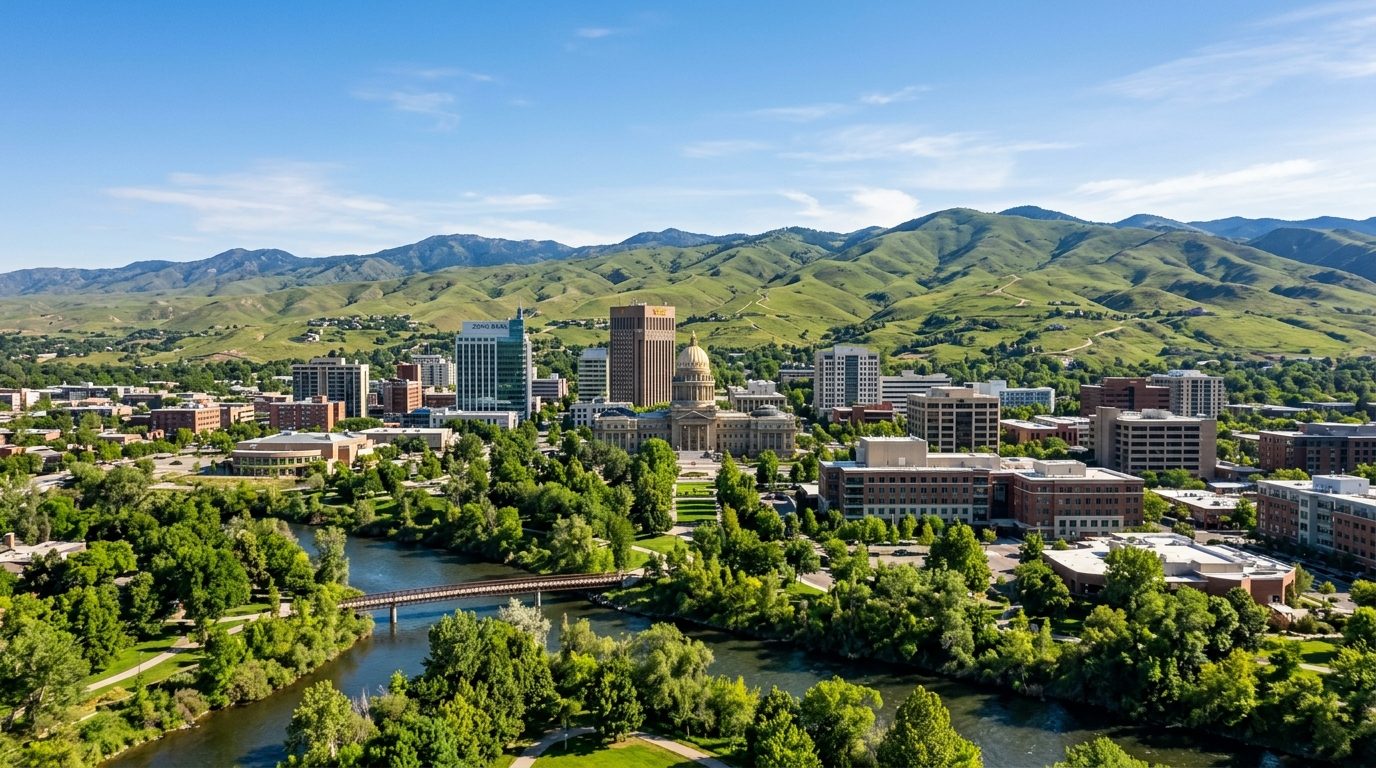
Current real estate market data, news and analysis for the Boise City, ID metropolitan area — 864,243 residents across 5 counties in Idaho.
Data as of May 2026. Sources: Redfin Data Center, U.S. Census Bureau.
Latest Boise City Real Estate News
Coverage of this market is coming soon. Browse all housing market news.
Boise City Real Estate Market Overview
Boise City metro sits in the Treasure Valley, a broad basin along the Boise River in southwestern Idaho. The urbanized core stretches west from Boise through Garden City, Meridian, and Nampa toward Caldwell, with Eagle, Star, and Kuna filling the valley floor and smaller towns such as Middleton and Parma anchoring the agricultural edges of Canyon County. To the north, Ada County climbs into pine-covered foothills and mountain communities like Idaho City, while Owyhee and Gem counties remain sparsely settled high-desert country. Housing stock reflects this geography: the historic core of Boise offers early-twentieth-century bungalows and brick homes in tree-lined grid neighborhoods, while the surrounding valley is dominated by newer subdivisions from successive waves of suburban expansion, ranging from modest ranch-style tract homes to large-lot construction in master-planned communities. Single-family detached homes dominate throughout most of the metro, with multifamily and infill growth concentrated in downtown Boise.
Price tiers generally track proximity to downtown Boise, the foothills, and established East Boise and North End neighborhoods, where mature tree canopy, walkability, and limited buildable land support stronger demand. Foothills-adjacent and view-oriented subdivisions in Boise and Eagle command a premium tied to lot scarcity and trail access. Meridian’s newer master-planned communities also draw a premium for design, amenities, well-regarded schools, and a shorter commute to Boise’s job centers. Moving west into Canyon County, communities such as Caldwell and Nampa offer lower price points, reflecting greater land availability and longer commutes. Kuna and the rural fringes of Ada County occupy a middle position, offering larger lots while still functioning as commuter communities. Mountain and small agricultural towns in Owyhee County sit apart from these valley dynamics, shaped by remoteness and limited services.
The Boise metro’s economy is anchored by healthcare, technology, government, and food and agribusiness. St. Luke’s Health System and Saint Alphonsus Health System operate extensive hospital networks that make healthcare one of the region’s largest employment sectors. Micron Technology, headquartered in Boise, is a major semiconductor manufacturer with ongoing fabrication-plant investment in the valley. The J.R. Simplot Company, a diversified food and agribusiness firm, is also headquartered in Boise, alongside financial technology firm Clearwater Analytics and direct-sales company Scentsy in Meridian. Idaho Power, the region’s electric utility, is headquartered in Boise as well. Boise State University and the West Ada School District are major employers in education, and state government, centered on the Idaho Capitol downtown, adds a substantial public-sector base. Agriculture remains significant outside the urban core.
Southwestern Idaho’s high-desert climate brings hot, dry summers and cold winters, and wildfire smoke drifting in from regional wildfires has become a recurring late-summer air quality concern. The Boise Foothills carry wildfire exposure of their own, and homes along the wildland-urban interface may face specific insurance or defensible-space expectations. Property taxes are assessed at the county level, with a homeowner’s exemption on primary residences, and rates vary by taxing district, so buyers should confirm exact levies with the county assessor. Much of the valley floor is served by longstanding irrigation districts; many lots carry pressurized irrigation service and water-right assessments, and canals crossing a property can carry easements restricting fencing or landscaping. Public transit is limited, and most of the metro is car-dependent. Rapid growth has driven outward expansion alongside infill, so buyers should check land-use plans and school assignments.
Cities and Towns in the Boise City Metro Area
Notable Communities and Neighborhoods
Boise City Real Estate Market FAQ
How is the Boise City metro organized geographically?
The metro is centered on the Treasure Valley, a river basin that runs along the Boise River from Boise westward through Garden City, Meridian, and Nampa to Caldwell, with Eagle, Star, and Kuna also part of the core urbanized valley. Ada County contains the primary urban corridor and rises into forested foothills and mountain towns such as Idaho City and Horseshoe Bend to the north. Canyon County to the west is more agricultural, anchored by Caldwell and Nampa, with small farm towns like Parma, Notus, Wilder, Greenleaf, and Middleton. Gem County, centered on Emmett, and Owyhee County, home to Homedale, Marsing, and Grand View, form the metro’s rural outer edges, each with a distinct small-town and agricultural character separate from the valley’s suburban growth.
Which areas of the Boise metro tend to be pricier, and why?
Areas closer to downtown Boise, the foothills, and established neighborhoods like the North End and East End tend to command a premium due to mature tree canopy, walkability, and limited buildable land. Foothills-adjacent and view-oriented properties in Boise and Eagle carry added value tied to scarce hillside lots and proximity to trail networks. Meridian’s newer master-planned communities also draw stronger demand for their design, amenities, and shorter commute to job centers. Farther out in Canyon County, communities such as Caldwell and Nampa tend to be more affordable, reflecting greater land availability, an agricultural land-use history, and longer commutes into the core employment areas.
What should buyers verify locally before purchasing in the Boise area?
Buyers should confirm whether a property carries pressurized irrigation service and any associated water-right assessments, since many valley subdivisions rely on irrigation-district water rather than treated water for landscaping. It is also worth checking for canal or lateral ditch easements crossing a lot, which can limit fencing, structures, or landscaping near the waterway. Because the metro continues to grow, school-boundary assignments, HOA covenants and dues in master-planned communities, and zoning or annexation status for properties near the urban edge can shift, so these should be verified directly with the relevant city, county, or school district. For homes in or near the foothills, checking wildfire risk and insurance availability is also advisable.
What region-specific risks should buyers understand in the Boise area?
Two conditions are particularly distinctive to this region. Irrigation water in the Treasure Valley is governed by longstanding prior-appropriation water rights and delivered through a network of canals and ditches maintained by irrigation districts; many residential properties owe irrigation assessments and have limited control over ditches crossing their land, which is worth understanding before purchase. Separately, wildfire smoke drifting in from regional wildfires can affect air quality during summer months, and homes situated in or near the Boise Foothills carry additional wildfire exposure that can influence insurance terms and defensible-space expectations.
Nearby Markets