
Current real estate market data, news and analysis for the Bloomington, IN metropolitan area — 165,231 residents across Monroe and Owen counties.
Data as of May 2026. Sources: Redfin Data Center, U.S. Census Bureau.
Latest Bloomington Real Estate News
Coverage of this market is coming soon. Browse all housing market news.
Bloomington Real Estate Market Overview
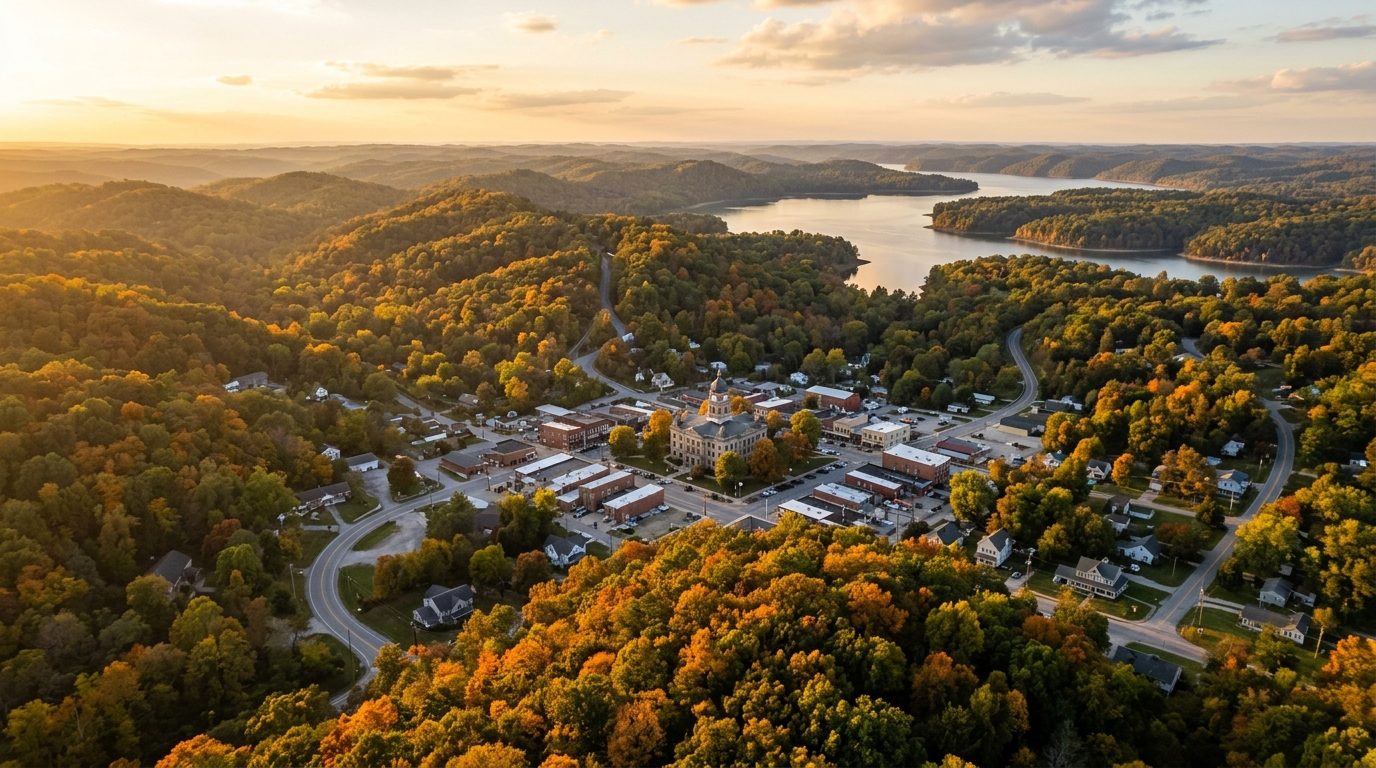
The Bloomington metro sits in the limestone country of south-central Indiana, where the city rests at the meeting point of the Norman Upland and the Mitchell Plain, two karst landscapes marked by sinkholes, caves, underground streams, and outcrops of the same Salem limestone once quarried for buildings nationwide. Beyond city limits the terrain rolls into wooded ridges and hollows across Monroe and Owen counties, with the White River winding past Spencer and Gosport. Housing stock reflects this layered history: limestone and brick homes with deep porches cluster near downtown and the university, older ranch and bungalow subdivisions ring the core, wooded and lake-adjacent houses sit on larger lots toward Lake Monroe, and newer mixed-use developments and rural homesteads extend outward into Owen County and the small towns.
Housing costs generally track distance from downtown and the university campus, along with proximity to Lake Monroe and the character of the tree canopy and architecture. Historic districts near downtown and the Indiana University campus command a premium for walkability, mature landscaping, and limestone or brick construction from the city’s early twentieth-century building boom. Wooded, lake-adjacent areas toward Lake Monroe draw buyers seeking recreation and privacy on larger lots. Farther from the core, including Ellettsville and the rural stretches of Owen County toward Spencer, Gosport, and Stinesville, housing tends toward more affordable price points, reflecting longer commutes to the employment center and a more rural, less amenity-dense setting. Neighborhoods with heavy student rental conversion near campus can see owner-occupant values diverge from comparable non-rental blocks.
The metro’s economy centers on Indiana University Bloomington, the flagship state university campus and by far the region’s largest employer, drawing students, faculty, and a broad research and administrative workforce. Cook Group and its Cook Medical division, a medical device manufacturer headquartered in the area, anchor a life sciences and advanced manufacturing cluster that also includes Baxter Healthcare’s pharmaceutical operations and a General Electric manufacturing plant. IU Health Bloomington Hospital, now operating from a newer campus built as a regional academic health center, is another major employer alongside Monroe County government and area school corporations. Limestone quarrying, once the city’s signature industry, continues on a smaller scale in Monroe and Owen counties, while Owen County’s economy leans more toward agriculture, quarrying, and small manufacturing tied to Bloomington’s broader labor market.
Buyers should factor in the region’s karst geology, since sinkholes, shallow bedrock, and irregular drainage can affect septic systems, foundations, and stormwater handling, particularly on rural parcels in Owen County. Bloomington enforces a residential occupancy ordinance limiting the number of unrelated adults per household in single-family zones, along with a rental registration and inspection program, both aimed at managing the large student rental market that surrounds campus; buyers considering a property near the university should confirm its zoning and rental history before assuming owner-occupant use. The city has pursued infill redevelopment, including reuse of the former hospital campus near downtown, alongside newer walkable, mixed-use neighborhood development on the city’s edges. Local transit is bus-based through Bloomington Transit, with no passenger rail service and the nearest major commercial airport in Indianapolis, so buyers weighing commute patterns from the outlying towns should verify road access along the state routes connecting them to Bloomington.
Cities and Towns in the Bloomington Metro Area
Notable Communities and Neighborhoods
Bloomington Real Estate Market FAQ
How is the Bloomington-area housing market organized geographically?
The market radiates outward from downtown Bloomington and the Indiana University campus, through older in-city neighborhoods and historic districts, into ring subdivisions, then out toward Lake Monroe, Ellettsville, and the more rural expanses of Owen County around Spencer, Gosport, and Stinesville. Terrain matters too: the city and its surroundings sit on karst limestone landscape with rolling, sometimes irregular topography rather than flat farmland, which shapes how subdivisions and lots are laid out.
Which parts of the metro tend to carry higher prices, and why?
Historic, walkable neighborhoods close to downtown and the university campus tend to command a premium because of their limestone and brick architecture, mature tree canopy, and proximity to jobs and campus life. Wooded or lake-adjacent settings near Lake Monroe also draw a premium for recreational access and larger, more private lots. Areas farther from the employment core, including the outlying towns and rural Owen County, tend to be more affordable, reflecting distance from downtown and campus and a more rural setting with fewer amenities nearby.
What should buyers investigate given the area’s large student rental market?
Indiana University Bloomington supports a substantial off-campus rental market concentrated in and around neighborhoods near campus. Bloomington enforces zoning limits on the number of unrelated adults per household in single-family districts and requires rental units to be registered and inspected. Buyers looking at property near campus should confirm current zoning classification, whether the home is licensed as a rental, and how nearby rental density might affect long-term owner-occupant demand and resale.
What region-specific risk should buyers verify before purchasing in this metro?
Because the area sits on karst limestone terrain, buyers should have properties checked for sinkhole activity, shallow or irregular bedrock, and drainage issues that can affect foundations, septic systems, and stormwater management, especially on rural parcels in Owen County and other areas outside city sewer service. A geotechnical or septic evaluation alongside a standard inspection is a reasonable precaution in much of the metro.
Nearby Markets