
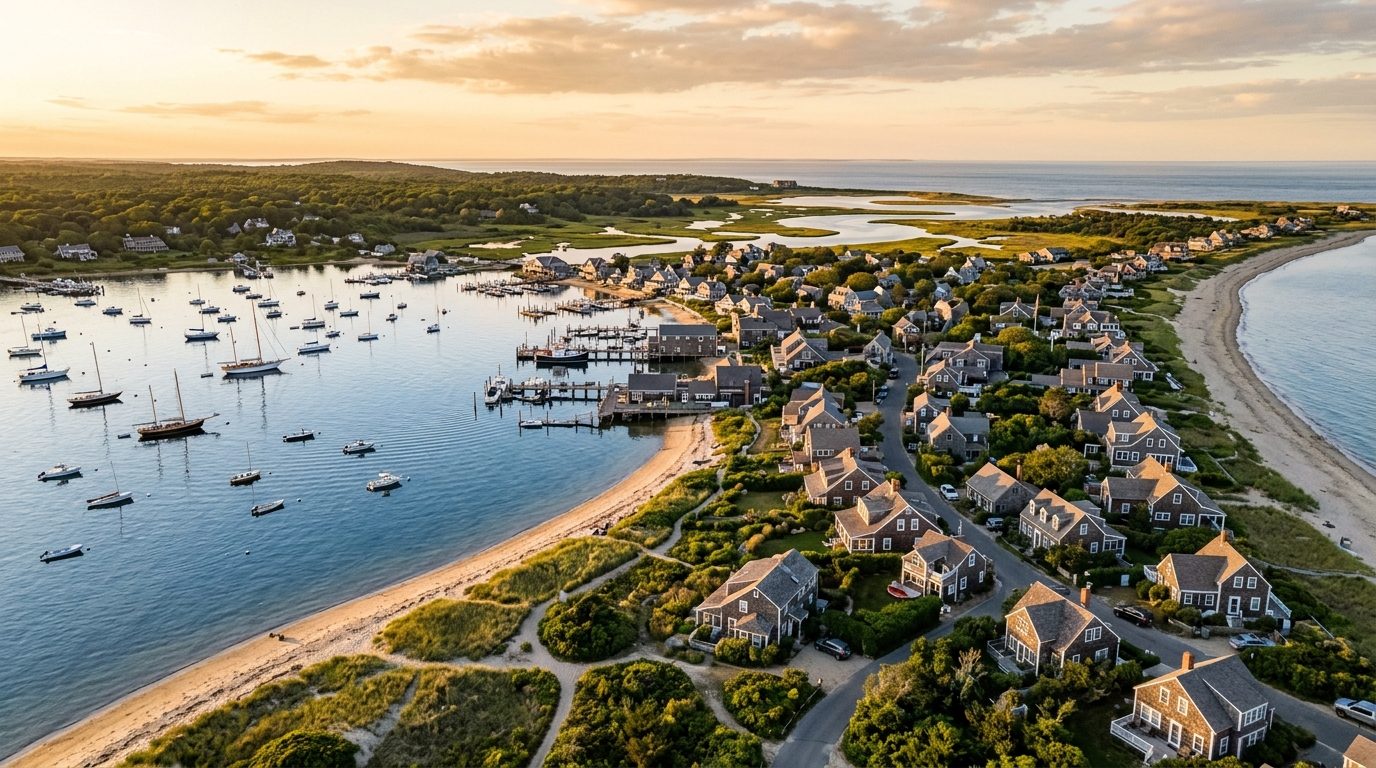
Current real estate market data, news and analysis for the Barnstable Town, MA metropolitan area — 233,539 residents across Barnstable county.
Data as of May 2026. Sources: Redfin Data Center, U.S. Census Bureau.
Latest Barnstable Town Real Estate News
Barnstable Town Real Estate Market Overview
Barnstable Town, the official name for the metro that covers all of Cape Cod, is a hook-shaped peninsula bounded by Cape Cod Bay to the north, Nantucket Sound to the south, and Buzzards Bay to the west, connected to the Massachusetts mainland by bridges crossing the Cape Cod Canal. The metro is organized around a chain of towns strung along the Mid-Cape Highway and the old shore roads, each containing several distinct villages rather than a single downtown. Housing stock ranges from historic Cape-style cottages and colonial-era farmhouses clustered around old town centers to shingle-style shorefront estates, condominium complexes near harbors and golf courses, and inland subdivisions built for year-round commuting. Many neighborhoods were originally platted as seasonal cottage colonies and have gradually converted to full-time residences.
Waterfront villages with direct access to protected harbors or south-facing beaches on Nantucket Sound sit at the top of the price spectrum, both for their views and for proximity to private yacht and beach clubs; examples include the Osterville and Hyannis Port areas of Barnstable, Chatham’s harbor district, and Woods Hole in Falmouth. These villages also tend to have the least remaining buildable land, which keeps competition for existing homes high. Villages fronting Cape Cod Bay on the quieter north side, and inland areas away from salt water, are generally more attainable, as are neighborhoods clustered along the commercial corridors near Hyannis, the Cape’s year-round commercial hub. The Outer Cape towns near the Cape Cod National Seashore carry a price premium of their own because conservation land sharply limits new construction.
Cape Cod’s economy has historically run on tourism, hospitality, and retail trade tied to the summer visitor season, and food service and lodging remain among the largest employment categories. Healthcare is the steadiest year-round sector, anchored by Cape Cod Healthcare’s hospital campuses in Hyannis and Falmouth. Falmouth’s Woods Hole village is also a globally recognized center for marine science, home to the Woods Hole Oceanographic Institution and the Marine Biological Laboratory, which together support a resident population of scientists and researchers. Joint Base Cape Cod, spanning Bourne, Sandwich, Mashpee, and Falmouth, hosts Coast Guard, Air National Guard, and Army National Guard units and is another significant employer. Commercial fishing remains culturally and economically important in Chatham and Provincetown, and Cape Cod Community College and the regional public school systems round out the base of stable, non-seasonal employment.
Coastal flood exposure and hurricane and nor’easter risk are defining considerations for property here; FEMA flood zone maps vary block by block along the shoreline, and waterfront and low-lying properties often require separate flood insurance and face ongoing coastal erosion. Many homes outside sewered village centers still rely on private wells and septic systems, and state-mandated septic inspections and nitrogen-loading rules enforced through the Cape Cod Commission’s regional planning authority can affect what a lot may be used for. Large minimum lot sizes and separated residential and commercial zoning, both longstanding features of Cape towns, limit new construction and keep much of the housing stock older. Buyers should also check local short-term rental registration rules, since many Cape communities depend heavily on seasonal rental income and regulate it closely.
Cities and Towns in the Barnstable Town Metro Area
Notable Communities and Neighborhoods
Barnstable Town Real Estate Market FAQ
How is the Cape Cod real estate market organized geographically?
The Barnstable Town metro covers the entire Cape Cod peninsula, made up of a string of towns running from the Cape Cod Canal out to the tip at Provincetown. Each town contains multiple named villages with their own character, and the region is informally divided into the Upper Cape (nearest the canal), Mid-Cape (around Hyannis), Lower Cape, and Outer Cape (the narrow, conservation-heavy towns toward the tip). Listings are typically discussed by village rather than by town alone.
Which parts of Cape Cod tend to be more expensive, and why?
Villages with direct frontage on protected harbors or south-facing beaches along Nantucket Sound, and those near private yacht or beach clubs, command the highest prices, partly because so little buildable land remains in them. Outer Cape towns near the National Seashore carry their own premium despite being farther from services, since conservation land sharply restricts new construction. Villages on the quieter Cape Cod Bay side and inland areas away from the water tend to be more attainable.
What should Cape Cod home buyers verify locally before making an offer?
Buyers should confirm the property’s FEMA flood zone designation, whether it relies on a private well and septic system and whether that septic system passes required state inspection, and whether any short-term rental use is registered and permitted under local rules. It is also worth confirming whether a home was built or winterized for full-time, year-round living versus seasonal use only, and whether it carries membership obligations tied to a private beach, club, or association.
What is the biggest region-specific risk for Cape Cod property owners?
Coastal flooding and storm exposure are the defining risks, since the entire peninsula is vulnerable to hurricanes, nor’easters, and ongoing shoreline erosion. Standard homeowners policies generally exclude flood damage, so waterfront and low-lying properties typically need separate flood insurance, and FEMA flood maps are updated periodically in ways that can shift a property into a higher-risk, higher-premium zone.
Nearby Markets