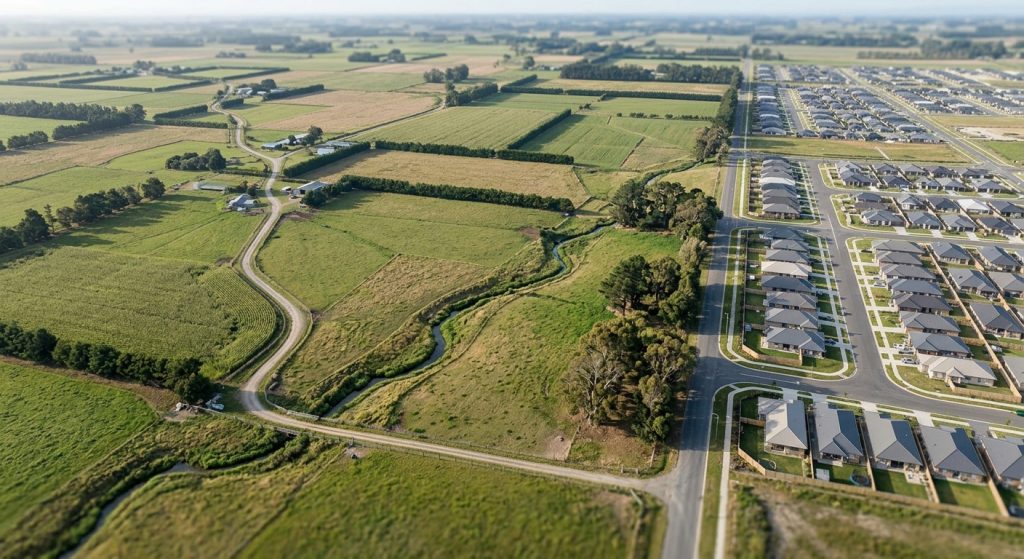
Land id, the mapping and land-analysis platform used by agents, brokers and landowners to build and share property maps, has released an artificial-intelligence product that tries to tell users what all that data means.
The tool, announced Sept. 21 and named The Land id, takes a property address and assembles what is known about it — public records, licensed and contracted data sets, and whatever the user has added themselves — then uses AI to explain the significant points in plain language and plot them on the map, according to the company. Land id says it generates listing-portal-ready property descriptions automatically and produces shareable visualizations on phones, tablets and browsers.
The company, which is headquartered in Bozeman, Mont., and Austin, Texas, says it has more than 50,000 paid users.
Interpretation, not retrieval
The pitch is a familiar one in proptech right now, and Land id makes it explicitly: the industry’s problem is no longer finding property data but reading it.
“This industry has never had a shortage of property data. It has had a shortage of ways to use it. AI is what finally closed that gap,” founder Steve Roberson said in the announcement. “One tool, one record, and answers where there used to be a stack of subscriptions that never talked to each other.”
Underneath the product is what Land id calls Land id Intelligence, a reasoning system the company says ingests public and private property, environmental, neighborhood and regional data alongside user-supplied content, then decides what matters most for a specific address and surfaces those conclusions next to the underlying records.
Edwin Tofslie, the company’s chief strategy and design officer, framed the target in the announcement as the gap between reports and answers: “For decades, the industry handed people a stack of reports and rarely a clear answer.”
Land id says the product is aimed at residential buyer and seller agents, land and ranch brokerages, multifamily operators and investors, and that it covers properties ranging from single-family homes to large ranches. It is available now to the company’s Pro and Premium subscribers, with access extended to Basic subscriptions for what the company describes only as a limited time. Land id did not disclose pricing for the tier changes or name the licensed data providers behind the product.
A crowded and unaudited field
The launch lands in an increasingly busy segment. ATTOM, one of the larger national property-data aggregators, introduced three AI agents in August that let customers query its records in plain English rather than through exports and filters. Brokerages are buying at the platform level as well: FirstTeam Real Estate adopted an AI operating platform from Purlin in August, and the venture money has followed, with rental-screening company Boom raising $15 million to build leasing AI on top of its data.
What separates these products is harder to evaluate than what they have in common. Land id describes The Land id as a “category-first solution” and says it delivers “trusted answers,” but the announcement does not describe how the system is tested for accuracy, how often the underlying records are refreshed, or what happens when public records and licensed data conflict — which, for parcel boundaries, easements and flood designations, is routine.
Those questions matter more here than in most software categories. An agent who repeats an AI summary of a property’s flood exposure, mineral rights or buildable acreage to a client is making a representation, and the liability for getting it wrong does not transfer to the vendor. Land id’s own framing — that the tool “surfaces relevant answers alongside the underlying data” — suggests the company expects users to check the source records, which is the sensible way to use it and also the step that erases much of the time savings.
Whether agents actually do that is the real test of this generation of tools, and it will not be answered by a launch announcement. More of RealtyWire’s coverage of the sector is on our Technology & AI page.