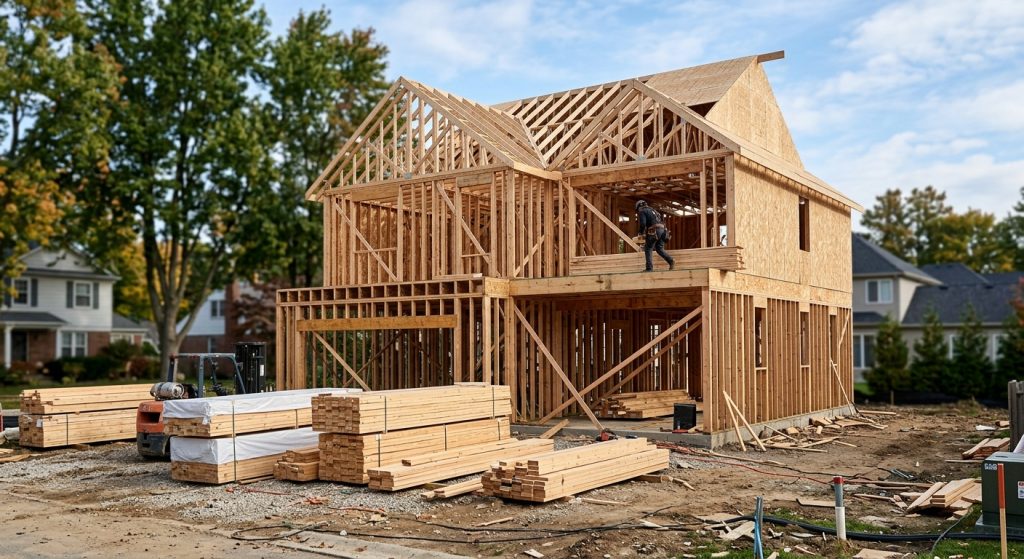
Ninety-four percent of the single-family homes completed in the United States last year were wood-framed, an unchanged share from 2024, according to an analysis published Sept. 21 by the National Association of Home Builders.
The finding, drawn from the Census Bureau’s Survey of Construction data for 2025, is a reminder of how narrow the American homebuilding supply chain actually is. Concrete framing accounted for 5% of completions and steel for half a percent. Everything else rounds to nothing.
In unit terms, NAHB researcher Jing Fu counted roughly 947,000 wood-framed completions in 2025, a 1% decline from 2024 that left the share flat. Concrete-framed homes fell about 4%, to roughly 53,000. Steel-framed homes rose 25% — but from a base so small that the increase amounts to about 1,000 additional houses nationwide, with the total still near 5,000. The three categories together account for roughly 1.005 million single-family completions.
Why the concentration matters now
A 94% share means that essentially every cost shock to framing lumber passes through to essentially every new house. That is not an abstract concern this year. The Trump administration’s tariffs on Canadian softwood lumber, welcomed by the U.S. Lumber Coalition when they were imposed, apply to an input that almost no builder can design around on a residential project. Substitution exists in theory; at 5% and 0.5% market share, it does not exist at scale.
The same concentration shapes who absorbs price moves. NAHB has separately found that small builders take on roughly five times the material cost increases that the largest builders do, because volume buyers negotiate framing packages that regional and custom builders cannot.
The South is the exception, and it is a code story
What non-wood construction exists is heavily regional. Concrete-framed homes made up 9% of single-family completions in the South last year — nearly double the national rate — and about 60% of all steel-framed homes completed in 2025 were built in the South. NAHB attributes the pattern to residential resiliency requirements, the hurricane- and wind-driven code provisions that govern much of the Gulf and South Atlantic coasts.
That is a useful detail for anyone reading builder margins by region. Where codes push toward concrete block or steel, the cost structure of a house is different, the trade labor required is different, and the exposure to lumber prices is lower. It also means the industry’s one visible growth trend in non-wood framing is not a national shift in building preference but a compliance response concentrated in a handful of coastal states.
The framing data lands alongside a soft stretch for production. Single-family starts fell sharply in July of this year, and the 1% decline in wood-framed completions points to a market that built slightly fewer homes in 2025 than in 2024 without changing how it built them. The share held at 94% through the decline, which is itself the finding: a downturn did not push builders toward cheaper or faster alternative systems, because at this concentration there is no alternative system at scale to move to.
The Survey of Construction tracks characteristics of new privately owned residential construction and is published annually by the Census Bureau. More of RealtyWire’s coverage is on our Housing Market page.