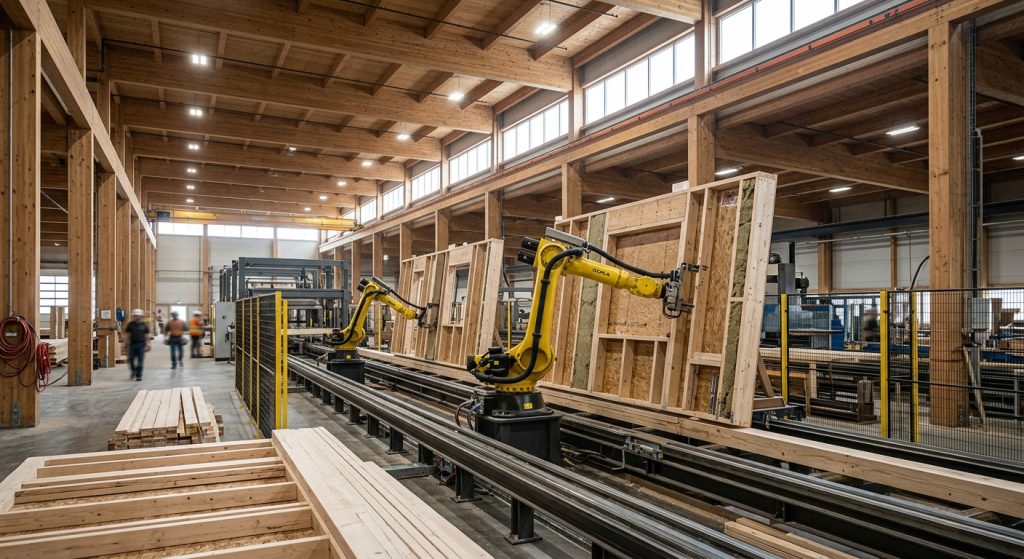
D.R. Horton, the largest U.S. homebuilder by volume, has signed a multi-year commercial agreement with Promise Robotics to support the production of more than 1,250 homes through its robotic factory platform, the two companies said in an announcement dated Oct. 13.
Under the agreement, D.R. Horton gains access to Promise Robotics’ Factory-as-a-Service platform, which the company describes as taking a builder’s existing house designs and translating them into a production process that spans robotic manufacturing, factory operations and onsite installation. Builders rent the capacity rather than build and staff plants of their own.
Promise Robotics said D.R. Horton is the first major U.S. homebuilder to use its production platform, and that the agreement comes as the company expands its U.S. manufacturing network. Neither company disclosed the financial terms, the factory locations or which D.R. Horton markets the homes will be built in.
A pilot-scale number from an enormous builder
The 1,250-home figure is small against D.R. Horton’s output. The builder closed 23,983 homes in its fiscal third quarter alone, the three months ended June 30, and guided to 83,800 to 84,300 closings for fiscal 2026, according to the earnings release it filed with the Securities and Exchange Commission on July 21. Against that, the Promise Robotics commitment amounts to roughly one and a half percent of a year’s homes.
What makes it notable is the counterparty rather than the count. Offsite and robotic construction have accumulated pilots with regional builders for years; a multi-year commitment from the company that closes more American houses than anyone else is a different kind of reference customer, and one that smaller builders and their lenders will read as validation.
What the platform does
Promise Robotics applies AI at several points in the production chain: interpreting a builder’s existing designs, generating production plans and the instructions that drive the robots, orchestrating the manufacturing itself, and connecting what comes out of the factory to installation on the lot. The company’s pitch is that it integrates those steps rather than automating any one of them in isolation.
“Homebuilding has long lacked the production infrastructure needed to scale with the speed, predictability, and efficiency of modern manufacturing. Physical AI changes that by creating a new production model that can expand capacity within and across markets,” said Ramtin Attar, CEO and co-founder of Promise Robotics. “Our goal is to make that capability accessible to builders across North America and support the industry’s long-term growth.”
D.R. Horton framed the deal in operational terms. “At D.R. Horton, we are always looking for innovations that can help us improve how we build. We are continuously focused on improving cycle times, increasing production capacity, and bringing greater consistency and predictability to our operations,” said Brad Conlon, the builder’s senior vice president of strategic growth and innovation. “Promise Robotics’ integrated platform gives us a new capability to support those goals.”
Promise Robotics argues the U.S. is its largest opportunity because builders there are contending with what it called persistent housing demand, labor shortages, rising costs and pressure to increase output. That characterization is the company’s own, though the labor constraint is well documented: NAHB research this year found that only two of 47 construction occupations rate high for exposure to AI, which is to say most of the trades remain hands-on work that automation has not reached.
From Calgary to the U.S.
The D.R. Horton agreement follows the path Promise Robotics laid out a year ago. In a release dated Sept. 24, 2025, the company announced a multi-year partnership with the Alberta division of Mattamy Homes covering single-family, semi-detached and multifamily homes in two master-planned communities, produced at a Promise Robotics facility in Calgary. That release described the Calgary plant as a flagship hub that could be replicated in U.S. markets.
Capital has been moving toward the same thesis. Earlier this year SoftBank put $200 million into construction robotics firm Gravis Robotics, and D.R. Horton itself has been buying into the software layer, joining PulteGroup to back a $15 million round for homebuilder data startup Scaffold in September.
The open question in all of it is unit economics, and neither company addressed it. Factory-built components have to beat site-built labor on delivered cost, not just on cycle time, and a multi-year agreement for 1,250 homes is the size of a commitment a builder makes while it finds out. More technology and AI coverage follows these deals as they scale or stall.