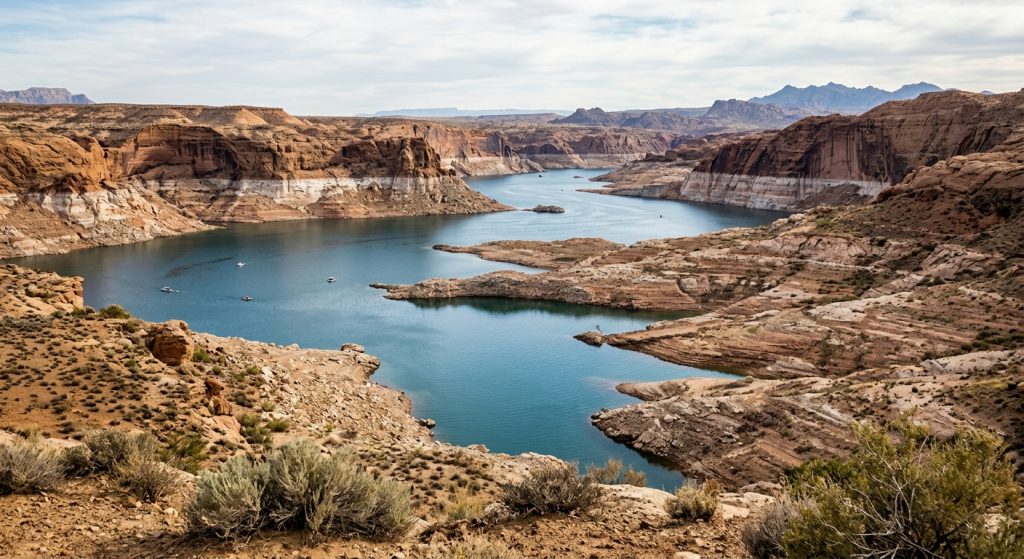
The U.S. Bureau of Reclamation published a final Environmental Impact Statement Thursday that would require Arizona, California and Nevada to collectively reduce their Colorado River water use by up to 3 million acre-feet over the next decade, setting a new operating framework for the river through 2036, according to the Interior Department’s announcement.
The Colorado River supplies water to roughly 40 million people across seven states, 30 tribes and two Mexican states, and underpins growth in some of the country’s fastest-growing metro areas, including Phoenix, Las Vegas and much of Southern California. Reclamation’s preferred alternative establishes what the agency calls an “adaptive decision framework” rather than fixed, reservoir-level-triggered cuts: it permits Lower Basin shortages of up to 3.0 million acre-feet, allows Lake Powell releases ranging from 5.0 to 12.0 million acre-feet annually, and creates storage provisions of up to 8.0 million acre-feet in Lake Powell and 3.0 million acre-feet in Lake Mead for future use. Operating guidelines under the framework will be reissued roughly every two years through 2036 unless the seven Basin states reach consensus agreements that extend those terms.
The plan reflects a sharp downward revision in expectations for the river’s supply. Reclamation’s data show the river’s average annual inflow from 2000 through 2024 was 12.9 million acre-feet, well below the 18 million acre-feet assumed in the original 1922 Colorado River Compact that allocates the river among the states. Average consumptive use across all users from 2020 through 2024 was 13.1 million acre-feet — still exceeding actual average inflow. Reclamation noted that unregulated inflow into Lake Powell through July 2024 measured just 3.5 million acre-feet, underscoring the strain on the system.
The final plan is notably shorter in duration than Reclamation’s draft version, released in January, and does not lock in hard, automatic cutback triggers tied to reservoir elevations, instead preserving room for the Basin states to negotiate consensus-based agreements. The four Upper Basin states — Colorado, New Mexico, Utah and Wyoming — are not subject to mandatory cuts under the framework, though it includes provisions for up to 200,000 acre-feet of voluntary Upper Basin conservation depending on hydrologic conditions.
Interior Secretary Doug Burgum said the department has a responsibility to keep river operations “reliable and resilient” amid the ongoing water shortage. Assistant Secretary Andrea Travnicek said the plan “strikes a balance between flexibility and predictability” given what she described as unprecedented drought conditions facing the basin. The final EIS caps a National Environmental Policy Act review process that began in June 2023; Reclamation said it received more than 18,000 comments, including 785 unique submissions from the public, tribes, states and federal agencies, after releasing its draft EIS in January 2026. A separate, related process addressing Colorado River water deliveries to Mexico under the 1944 Water Treaty is nearing completion through the International Boundary and Water Commission, the department said.
What it means: For real estate markets across the Lower Basin, the plan is a signal that water-supply constraints will remain a structural, long-term planning consideration for housing and commercial development rather than a short-term drought response. Metro areas like Phoenix — where RealtyWire has tracked continued office and industrial market tightening even amid growth pressures — will likely see continued scrutiny of water allocations tied to new residential and commercial projects as the mandated cuts phase in through 2036. Because the framework avoids hard triggers in favor of periodic guideline updates and continued negotiation among the states, the practical scale and timing of cuts to any specific city or water provider remains uncertain and will depend on both hydrology and ongoing interstate negotiations over the next decade.