American Homes 4 Rent, one of the nation’s largest single-family rental REITs, reported second-quarter 2026 revenue of $470.1 million, up 2.8% year over year, and raised its full-year Core FFO guidance for a second consecutive quarter, according to the company’s second-quarter earnings release filed with the Securities and Exchange Commission.
Net income attributable to common shareholders was $113.6 million, or $0.31 per diluted share. Core funds from operations rose 5.2% year over year to $0.49 per share, while adjusted FFO climbed 8.3% to $0.45 per share. For the first half of 2026, the company reported $942.1 million in revenue and Core FFO of $0.98 per share, up 5.4% from the prior-year period.
Within its same-home portfolio, AMH posted Core net operating income growth of 2.7% year over year, with average occupied days at 96.0% and blended rate growth of 2.7%, made up of 3.2% growth on lease renewals and 1.4% growth on new leases — a common pattern in the single-family rental sector this year, where renewal pricing power has outpaced pricing on new move-ins. The company ended the quarter with 60,482 homes in its operating portfolio, a net increase of 282 homes during the quarter, plus 3,961 homes held in unconsolidated joint ventures and 701 properties held for sale.
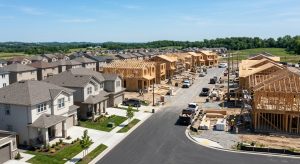
AMH’s build-to-rent development program delivered 651 newly constructed homes during the quarter — 542 wholly owned and 109 through joint ventures — and the company raised its full-year development guidance to 1,700 to 2,100 homes, representing $650 million to $850 million in investment. The company also sold 608 homes during the quarter for $181.2 million and repurchased 4.1 million of its own shares at an average price of $29.88, for a total of $123.0 million.
On the balance sheet, AMH held $83.7 million in cash against $5.2 billion in total debt at a 4.5% weighted-average interest rate and a 7.6-year weighted-average maturity, with $390 million drawn on its $1.25 billion revolving credit facility. The company paid $135.9 million in common distributions during the quarter. AMH raised the midpoint of its full-year 2026 Core FFO guidance to $1.95 per share, within a range of $1.93 to $1.97, implying full-year growth of roughly 4.3% over 2025. CEO Bryan Smith said the results reflected “a strong first half of 2026, supported by healthy demand for single-family rental housing” and pointed to the company’s development program, which he said has delivered more than 15,000 new homes nationally to date.
What it means: AMH’s results track closely with the pattern RealtyWire has seen from peer single-family rental operator Invitation Homes, which also raised guidance this quarter on accelerating renewal-driven rent growth even as new-lease growth stays comparatively muted. The build-to-rent sector continues to expand supply through in-house development programs like AMH’s rather than relying solely on acquiring existing homes, a strategy that has drawn political scrutiny in some states — including Michigan’s new law restricting large institutional investors from buying existing single-family homes, which notably does not apply to newly built rental product. The wider gap between renewal and new-lease rate growth across the sector suggests landlords are prioritizing retaining existing tenants at higher renewal rates over aggressively repricing turnover units in a softer leasing environment.