U.S. employers added 162,000 jobs in August, roughly three times what forecasters expected, and the two prior months were revised higher — a combination that pushes the Federal Reserve further away from the rate cut housing markets have been waiting for. The Bureau of Labor Statistics released the Employment Situation report at 8:30 a.m. ET on Friday, Sept. 4.
For real estate, the report cuts both ways. A labor market this durable supports household formation and keeps buyers employed. It also removes the argument for cheaper money at a moment when the 30-year mortgage rate sits at a 13-month high.
The unemployment rate was unchanged at 4.1 percent, and the number of unemployed people held at 7.0 million. The labor force participation rate edged up to 61.6 percent. BLS also revised June up by 11,000, from +31,000 originally reported as +20,000, and revised July from a loss of 23,000 to a gain of 21,000 — together, 55,000 more jobs than previously counted. July’s originally negative print had been read as evidence the labor market was cracking; that reading is now gone.
Construction employment holds its ground
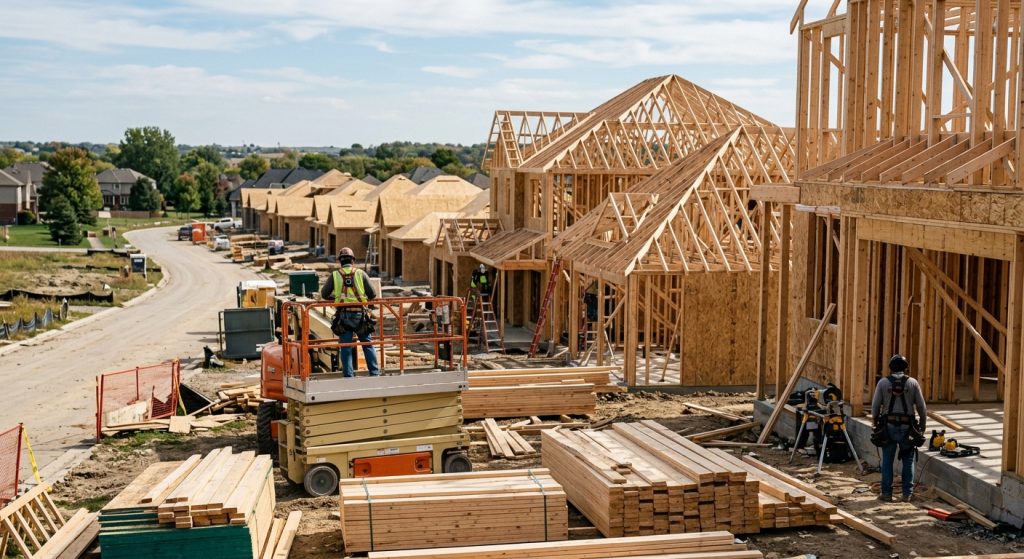
Construction added 22,000 jobs, a gain BLS characterized as little changed because it falls inside the survey’s margin of error. The composition underneath it is more informative than the headline.
Residential building construction added 7,300 jobs to reach 923,700, and residential specialty trade contractors — framers, roofers, electricians and the rest of the subcontractor base — added 3,400 to reach 2,349,000, according to the establishment survey’s detailed industry table. Nonresidential building construction lost 1,800 jobs, falling to 947,300, while nonresidential specialty trade contractors added 7,800 to reach 2,927,700. Heavy and civil engineering construction, the category that captures highways, utilities and site work, added 4,400 to 1,210,800.
In other words, the sector’s growth in August came mostly from the trades that build and wire structures rather than from the general contractors that erect the shells. That pattern is consistent with the industry’s uneven state-by-state picture through the summer.
Real estate and rental and leasing moved the other way, shedding 3,500 jobs to 2,435,100. The narrower real estate industry — brokerages, property managers and leasing offices — lost 3,200 jobs, ending August at 1,843,700.
Wages, hours and the rest of the economy
Average hourly earnings for all private employees rose 10 cents, or 0.3 percent, to $37.75, and were up 3.1 percent over the year. Production and nonsupervisory workers earned $32.53, up 11 cents. The average workweek edged up 0.1 hour to 34.4 hours — a small move, but one that adds aggregate hours worked without adding headcount.
Manufacturing added 16,000 jobs and has now added 58,000 since a low in December 2025, led by machinery and fabricated metal products. Local government education added 42,000. Health care added 13,000, well below its 12-month average of about 32,000. Information lost 23,000, with declines in computing infrastructure, publishing and broadcasting. Retail, financial activities and professional services were little changed.
What it means for rates
The Fed’s September meeting was already contested. The committee held rates steady in a rare 9-3 vote, with three officials pushing for an increase. A jobs report this strong gives that minority more to work with.
Redfin economist Chen Zhao wrote in the brokerage’s analysis of the report that the data slightly increases the odds of a hike this month, but that next week’s Consumer Price Index release is the “real deciding factor.” Redfin’s analysis said the six-month average pace of hiring has now topped 100,000 a month, the strongest in two years, and that the trend suggests “underlying inflationary pressure is building, not letting up.” It also said recent public comments from Fed officials indicate the committee is not ready to hike yet but could be persuaded by a high inflation print — which effectively lowers the bar for what counts as high.
That is attributed interpretation, not established fact. What is verified: the labor data above, and the fact that borrowing costs are already elevated. Freddie Mac’s Primary Mortgage Market Survey put the 30-year fixed rate at 6.71 percent on Sept. 3, up from 6.66 percent a week earlier and 6.50 percent a year ago. The 15-year rate was 6.04 percent. Those levels reflect a global bond selloff that has pushed yields higher independent of Fed policy.
RealtyWire’s read: the construction detail matters more to builders than the headline number does. Residential trades are still hiring even as single-family activity softens, and the National Association of Home Builders’ analysis of federal job-openings data found 326,000 open construction positions in July, up from 298,000 in June, which NAHB chief economist Robert Dietz attributed in part to data center construction running 46 percent above year-ago levels. Labor is being pulled toward the projects that pay, not released from the industry.
What to watch
Next week’s CPI report is the swing factor for the September Fed decision, and by extension for mortgage rates heading into the fall selling season. Watch the shelter component in particular: it carries the heaviest weight in the index and has been the slowest to cool.