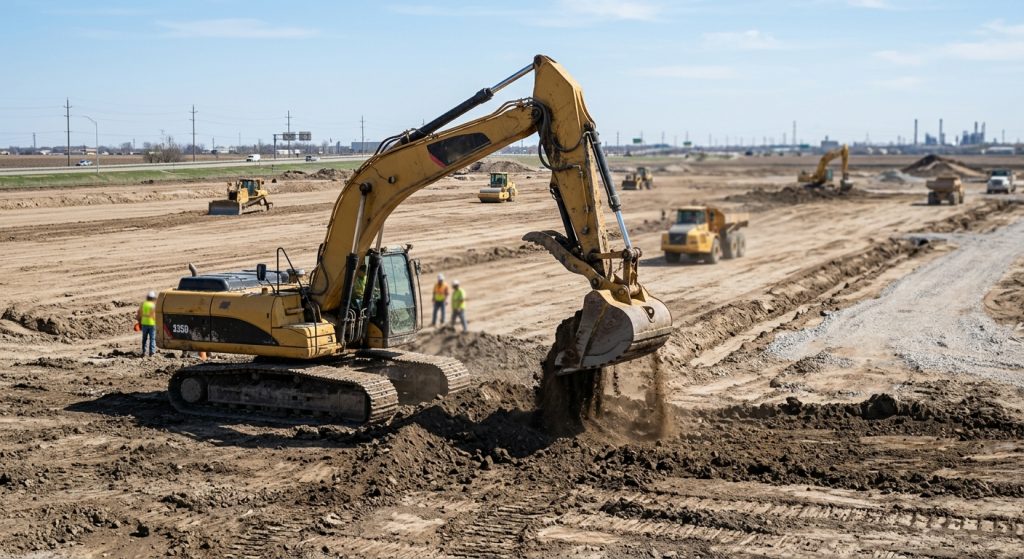
Bedrock Robotics, an artificial-intelligence startup founded by former Waymo engineers, said it has begun operating fully autonomous excavators — with no human in the cab — on active U.S. infrastructure projects, a milestone the company says is the first of its kind for the complex machines. The announcement, detailed on the company’s website this week, marks a step toward automating the heavy earthmoving work that underpins large real estate and infrastructure development.
The deployments matter to developers and contractors because excavation and site work are among the earliest, most labor-intensive and schedule-critical phases of any major project — from data centers and warehouses to housing subdivisions and public infrastructure.
Where the machines are working
Bedrock said its autonomous excavators are running on three live sites: a water treatment facility in Nevada in partnership with Sundt Construction; a multi-million-cubic-yard earthwork site in Texas with Champion Site Prep; and a 1.2 million-cubic-yard civil sitework project with Zachry Construction Corporation.
Rather than build new machines, Bedrock retrofits contractors’ existing excavators with its “Operator” system — a suite of sensors and onboard computing that the company says can be installed in a single day without permanent modifications. Once site managers set the initial parameters, the system handles perception, motion planning and the execution of digging tasks on its own.
A well-funded bet on construction automation
The company has raised more than $350 million to date. Its $270 million Series B, announced earlier this year, was co-led by CapitalG, Alphabet’s independent growth fund, and the Valor Atreides AI Fund, with participation from investors including NVIDIA’s venture arm NVentures, Tishman Speyer, 8VC, Eclipse and Emergence Capital. Bedrock emerged from stealth in mid-2025 with $80 million in early funding.
“The physical economy is the next great frontier for machine learning,” said Boris Sofman, Bedrock’s co-founder and chief executive, who previously worked on autonomous-vehicle systems at Waymo. The company has said it plans to extend its technology to other heavy machines — dump trucks, dozers and loaders — with the eventual goal of coordinated, self-orchestrating autonomous fleets.
Aimed at a labor squeeze
Bedrock is pitching automation as a response to a chronic shortage of skilled equipment operators, a constraint that has grown more acute as construction demand has shifted. Data center construction has pulled workers away from other projects, driving up labor costs and, homebuilders say, competition for both land and crews. Automating repetitive mass-excavation work, Bedrock argues, lets contractors stretch scarce labor and keep projects on schedule.
The startup joins a growing field of investors and companies betting that robotics and AI can reshape a construction industry long known for flat productivity. Backers have poured capital into construction robotics and AI-driven jobsite software, wagering that automation can address labor shortages and cost overruns that weigh on development economics.
What it means: Fully operator-less excavation, if it proves reliable at scale, could gradually lower one of the more stubborn cost and schedule variables in real estate development. The near-term impact is likely to be concentrated in large, repetitive earthmoving jobs — data centers, industrial pads and major civil projects — where the economics of automation are clearest, rather than in smaller or more complex residential sites. The technology’s trajectory will depend on how it performs on live commercial projects like the three Bedrock has now put in the field, and on whether contractors trust it enough to expand its use. For now, it is an early but concrete sign that the automation wave transforming other industries is reaching the construction site.