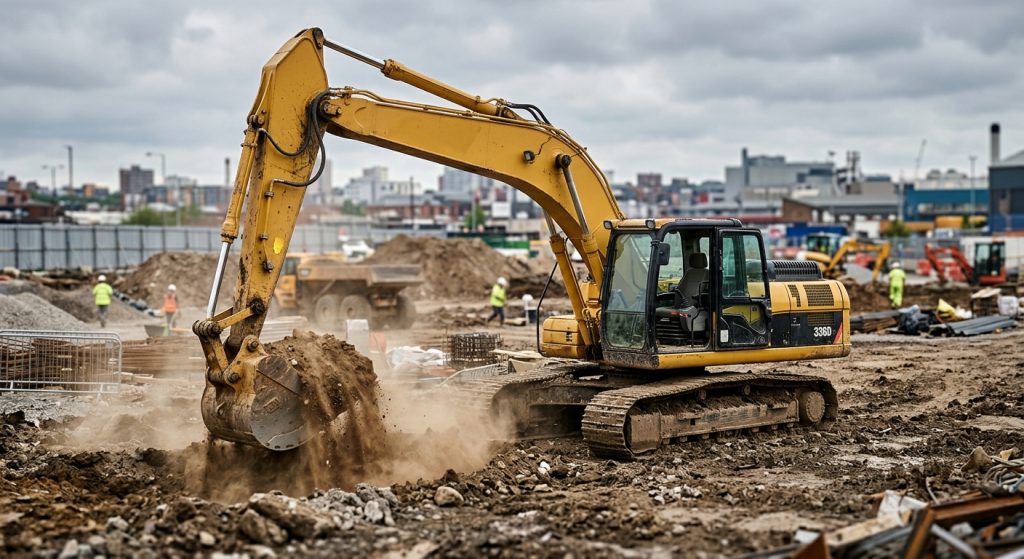
SoftBank Group is investing $200 million in Gravis Robotics, a Zurich-based startup that retrofits excavators and other heavy construction equipment with autonomous controls, in what the companies say is the largest Series A funding round in construction robotics history.
The investment, announced by Gravis on Monday, values the four-year-old company at $1 billion. SoftBank is the sole investor in the round. Gravis was founded in 2022 as a spinout from Switzerland’s ETH Zurich and has since deployed its systems across four continents. The company maintains offices in Zurich, Austin, Texas, and Oxford, England, giving it a direct foothold in the U.S. construction market alongside its European base.
Gravis’s core products are the Gravis Rack, a hardware retrofit kit, and Gravis Copilot, autonomy software that together convert manually operated heavy equipment into self-driving machines without requiring construction firms to buy new fleets. The system is compatible with equipment from major manufacturers including Caterpillar, Case, Develon, John Deere, JCB, Hitachi, Sumitomo and Volvo, and the company says it delivers a 30% productivity boost over manual operation.
“Every project starts with moving earth,” Gravis co-founder and CEO Ryan Luke Johns said, describing that foundational earthmoving work as the bottleneck that has long slowed infrastructure development. Co-founder and Chief Technology Officer Dominic Jud said the company’s AI systems “take physical input and respond to varying subterranean forces at microsecond speeds,” a level of precision he said exceeds what human operators can achieve. SoftBank Group Managing Director Dai Sakata framed the investment within the firm’s broader AI strategy, saying “physical AI is central to SoftBank’s vision for the next phase of AI.”
What it means: Verified facts: SoftBank is putting $200 million into Gravis Robotics at a $1 billion valuation, the largest Series A on record for a construction robotics company, with the funds aimed at scaling an equipment-agnostic autonomy retrofit across major heavy-machinery brands. Company-attributed framing: Gravis and SoftBank both describe the deal as a bet on “physical AI” — applying AI systems developed for digital tasks to control real, heavy machinery in the physical world. RealtyWire’s analysis: because Gravis’s retrofit approach works across a wide range of existing equipment brands rather than requiring purpose-built autonomous machines, it lowers the adoption barrier for contractors already invested in fleets from established manufacturers, a strategy that could accelerate autonomy adoption in construction faster than equipment-replacement approaches have managed to date.
The deal adds Gravis to a growing list of well-funded construction technology plays this year, including Procore’s $845 million acquisition of construction robotics firm DroneDeploy and other efforts to cut labor and cost bottlenecks in homebuilding, such as a SpaceX alum’s startup aiming to cut homebuilding costs in half through manufacturing-style construction methods. Gravis previously led an $8 million U.K. government-backed autonomous-machinery pilot known as the CAM Pathfinder project, in partnership with equipment rental firm Flannery Plant Hire.
Gravis Robotics employs roughly 75 people and has not disclosed specific U.S. deployment customers or contract values tied to Monday’s funding announcement.
The construction industry has been slower than many other sectors to adopt automation, in part because job sites are unstructured and constantly changing, unlike the controlled environments where industrial robots typically operate. Gravis’s retrofit strategy is designed specifically around that challenge: rather than building new autonomous machines from scratch, the company adds sensors, computing hardware and control software to equipment contractors already own, aiming to make autonomy a purchasable upgrade instead of a fleet-replacement decision. That approach mirrors a broader pattern among well-capitalized construction-tech startups this year, which have increasingly focused on layering AI and automation onto existing capital-intensive equipment and workflows rather than asking builders to replace them outright.
SoftBank’s decision to serve as the round’s sole investor also stands out in a venture capital environment where large rounds are typically syndicated across several firms. The Japanese conglomerate, led by founder Masayoshi Son, has increasingly framed its investment strategy around what it calls “physical AI” — systems that apply artificial intelligence to control machines operating in the real world, from robotics to autonomous vehicles — positioning the Gravis deal as part of a broader thesis rather than a one-off construction-sector bet.